Why Mesh Wi-Fi Might Be Overhyped—Discover Budget-Friendly Solutions for Fast Internet in Every Room

While mesh Wi-Fi systems are often regarded as the go-to solution for eliminating dead zones in homes, they can be quite costly for many situations. In many cases, using wired access points and strategically placed extenders can provide faster and more reliable coverage at a lower price. That said, mesh systems do have their advantages in particular scenarios.
The Dependable Choice: Wired Access Points
Ethernet Backhaul Always Outperforms Wireless Hops
Prior to the rise of mesh systems, the common method for providing strong Wi-Fi across large homes was straightforward: run Ethernet cables to key rooms and connect access points. This method continues to work effectively, often outperforming wireless setups. The reason for this lies in backhaul— the connection that transports data between your router and the network nodes. Wired connections transmit this data without interference, signal loss from obstacles, or contention with other devices like smartphones and laptops.
Conversely, many mesh satellites communicate with the main router using the same wireless frequencies as user devices. In dual-band systems, this shared airtime can significantly reduce data transfer speeds with each connection hop. Thus, mesh nodes often feel fast near the router but slower several rooms away. While tri-band models can help with a dedicated band for backhaul, they come at a higher price, and physical barriers still affect performance. Some mesh systems do allow for wired backhaul as well, but at that point, you’re paying a premium for equipment that a simple access point can manage just as effectively.
Access points eliminate these issues. Brands like Ubiquiti, TP-Link’s Omada, and Netgear now offer Wi-Fi 7 models with 2.5GbE uplinks. Many of these models can receive power through the same Ethernet cable, simplifying installation by requiring only one wire per location. When paired with an existing router, a few ceiling or wall-mounted access points can provide consistent coverage throughout a home, enabling easy roaming with the same network name.
The main drawback is the need for cabling. If your home already has Ethernet ports in some areas, you’re mostly set. If not, running cables through attics or along walls requires effort and might not even be feasible for renters. However, using MoCA adapters can enable data transmission over existing coaxial TV lines as a beneficial alternative. Once the necessary wiring is established, it tends to remain useful even as Wi-Fi technology evolves.
Extenders: Another Viable Solution
A Budget-Friendly Fix for Specific Dead Zones
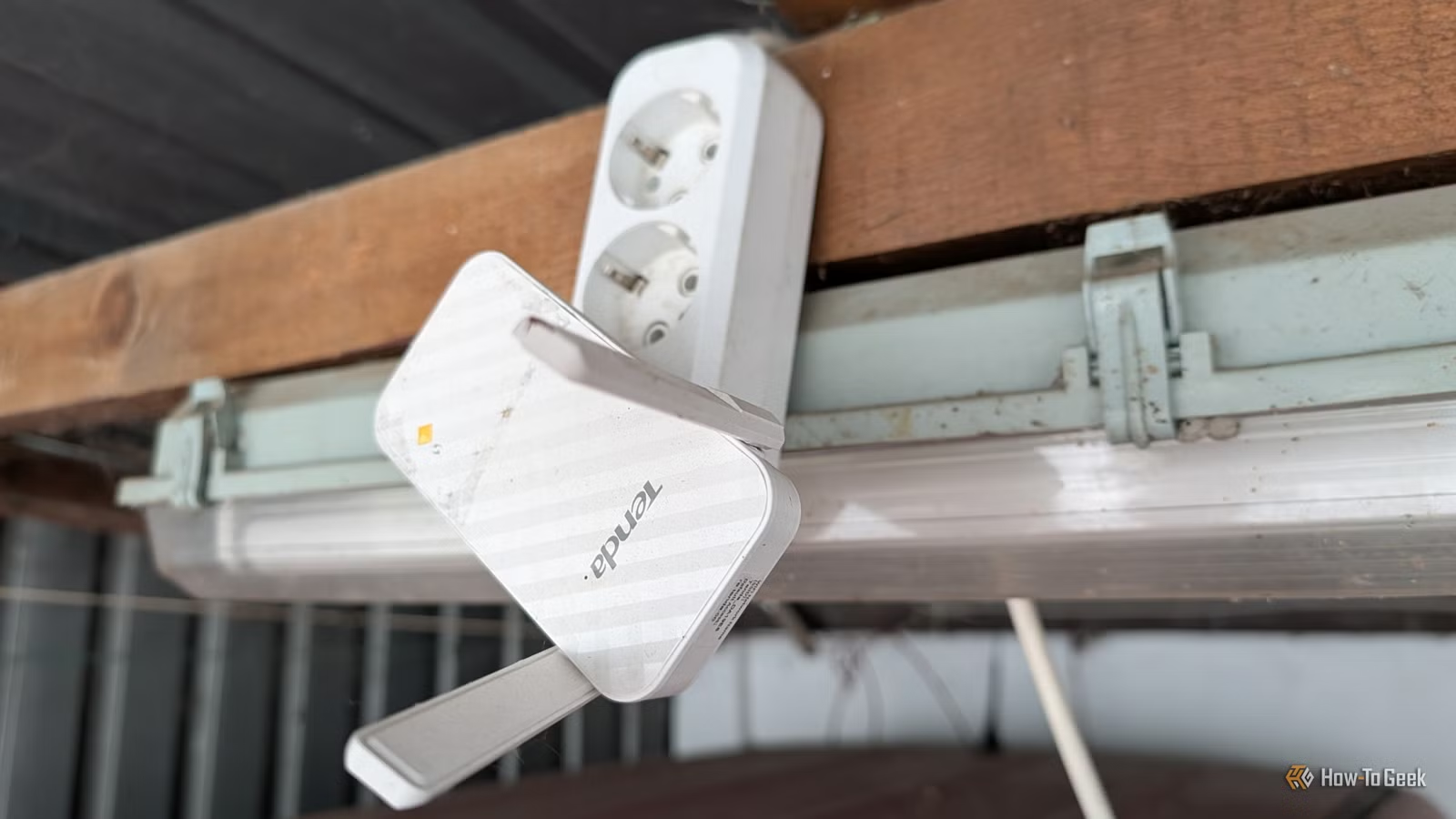
Not every issue with Wi-Fi coverage necessitates an extensive overhaul. If your main router provides adequate coverage but there’s still a spot, like a bedroom or patio, where the signal weakens, a range extender could be a cost-effective solution compared to a mesh system. Although extenders were often seen as cumbersome in the past, today’s Wi-Fi 6 and Wi-Fi 7 models are significantly more efficient than the older plug-in devices.
Correct positioning is crucial for extenders. Because they simply rebroadcast the signal they’re receiving, placing one directly in a weak area would defeat the purpose. The ideal location is typically halfway between the router and the signal-weak area, ensuring a strong connection. Most setup applications from manufacturers provide signal strength indicators to help find this sweet spot.
Be aware of some limitations. An extender that receives and transmits on the same band can lose bandwidth in the process, and some models create separate network names, which can disrupt seamless connectivity as you move around. Opting for an extender made by the same brand as your router may enhance performance since specific ecosystems allow extenders to integrate neatly into the primary network.
Many extenders also feature Ethernet ports, which presents a clever strategy. If you can connect an Ethernet cable to an extender or utilize a powerline adapter, the extender can function as a wired access point, eliminating any wireless speed penalties. This versatility makes extenders a smart initial step for improving coverage. They’re affordable, easily returnable if unsatisfactory, and serve well in smaller homes or apartments where only one weak area causes concern. If a single extender solves the issue, there’s little justification for expending more resources.
When Mesh Wi-Fi is Still the Best Option
Large Homes Without Ethernet Can Benefit from Mesh Systems
In my experience, while mesh Wi-Fi may not be ideal for everyone, certain circumstances warrant its use. This is particularly true in large or multi-story residences where there’s no existing Ethernet infrastructure and no feasible method of installing it. In such cases, a tri-band mesh system that includes a dedicated backhaul can outperform a network of extenders because it’s engineered for coordinated communication between nodes rather than just repeating signals. You’ll likely end up spending a similar amount or even more when setting up multiple extenders compared to a mesh system.
Simplicity also plays a significant role in mesh systems’ appeal. Brands like eero, TP-Link Deco, Netgear Orbi, and Asus ZenWiFi offer guided app setups, automatic channel selections, and seamless firmware updates. Devices can transition between nodes using a single network name without manual intervention. For families that prefer a straightforward experience without diving into technical jargon, this hands-off approach has considerable value.
The pricing landscape has shifted, too. While high-end Wi-Fi 7 kits can still exceed a thousand dollars, budget options from brands like TP-Link and Tenda have significantly lowered entry prices, making them more accessible for smaller setups. For those who are renting, mesh systems can easily move to new locations without the need for drilling or discussions with landlords.
Ultimately, the key is to select a solution that fits your specific needs rather than what marketing might suggest. A modest apartment or a home that is already wired with Ethernet almost never needs a multi-node setup, and high-spec Wi-Fi 7 features are often irrelevant if your internet plan only supports a few hundred megabits.
Choose Your Wi-Fi Setup Based on Your Space, Not Hype
For the majority of households, wired access points yield optimal performance for your investment, while extenders can effectively tackle isolated weak spots. Mesh is not without its merits, but it’s frequently oversold. By evaluating your layout, infrastructure, and internet speed, you’ll probably find more economical ways to achieve better coverage.