Waymo Unveils Affordable Next-Gen Robotaxi Service Available to Riders in Three Cities

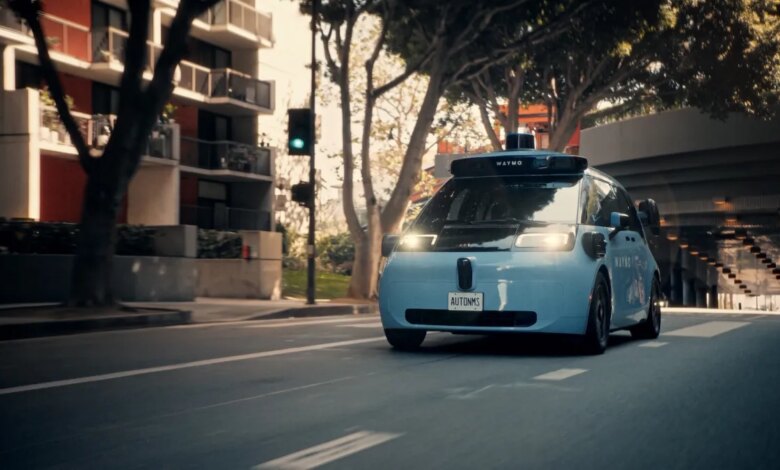
Waymo has officially launched its advanced robotaxi service in Los Angeles, Phoenix, and San Francisco, marking a significant step for the Alphabet subsidiary as it aims to grow its fleet with vehicles that are more cost-effective to produce, operate, and maintain.
Currently, riders in these cities may be paired with the new robotaxi called the Ojai (pronounced oh-hi) upon request. As the fleet of Ojais expands, passengers will eventually have the option to select between this new model and the existing Jaguar I-Pace robotaxi. Waymo has reported having around 300 Ojai vehicles in its operational fleet at present.
The company announced plans to introduce the Ojai in additional cities, including Denver, Las Vegas, and San Diego, by the end of the year.
For several years, Waymo’s robotaxi service has depended on the all-electric, modified Jaguar I-Pace, which operates in 11 cities across the U.S. While the distinctive autonomous hatchback has become familiar in areas like San Francisco, it has served as a temporary solution in Waymo’s broader goal of achieving large-scale operations and future profitability.
The Waymo Ojai robotaxi aims to fulfill that vision. It features Waymo’s sixth-generation self-driving technology, essential for the company’s approach to commercialization, as it is modular and adaptable to various vehicle types. Additionally, the Ojai incorporates a revamped user interface and Google’s Gemini AI, which provides in-car assistance for passengers.
Beneath the tech, the Ojai is a minivan produced by Zeekr, a brand under China’s Geely Holding Group. Waymo has collaborated with Zeekr since 2021, testing prototypes as well as production-ready versions of the vehicle. Built on Zeekr’s SEA-M platform, which has been enhanced for robotaxis and delivery vehicles, the Ojai aims to be attractive and user-friendly, while remaining inexpensive to manufacture and durable for frequent use.
Although the Ojai meets many of these objectives, import tariffs on vehicles from China have increased costs. With existing U.S. trade policies, these imports incur significant tariffs, escalating Waymo’s expenses for each Ojai it acquires. The base Zeekr models arrive without any Chinese connected-car technology, after which they are sent to Waymo’s Arizona facility to be equipped with the self-driving systems.
According to MoffettNathanson, a New York-based research firm that monitors Ojai imports by analyzing shipment data, Waymo is projected to bring in 5,000 Ojai vehicles to the U.S. by the end of 2026, more than doubling the size of its current Jaguar fleet. Notably, in July alone, 725 Ojai vehicles were imported, highlighting the rapid pace of Waymo’s expansion efforts.