Flipkart, the Indian e-commerce powerhouse owned by Walmart, is gearing up to enter the food-delivery sector, taking on the established players Zomato and Swiggy. This market has previously thwarted attempts from giants like Amazon and Google.
Based in Bengaluru, Flipkart is currently conducting internal trials of its food-delivery service, recently expanding from a select group of employees to around 8,000. The company is utilizing a special fleet of delivery personnel through its logistics subsidiary, Ekart, which operates separately from those delivering its quick-commerce items, in anticipation of a broader public rollout.
The employee-only food delivery service is accessible via a dedicated tab within Flipkart’s main shopping app, which also includes its quick-commerce feature, “Minutes,” and travel bookings. This new offering collaborates with restaurants available through ONDC, a government-supported network that facilitates online connections among consumers and vendors, as well as establishments directly onboarded by Flipkart.
Additionally, delivery personnel adorned in “Eat-in by Minutes” jerseys have begun servicing orders on the streets of Bengaluru, the city where Flipkart is headquartered.
As Flipkart’s food delivery initiative develops, it is entering an industry that brokerage firm Bernstein indicates is expanding at a rate of 18% to 20% annually. Yet, online food delivery accounts for just over 15% of the overall food services sector in India. Together, Zomato and Swiggy cater to approximately 85 million to 95 million paying customers annually, highlighting their strong market dominance and the sizable opportunities available for new entrants in a nation with over a billion internet subscriptions.
Flipkart isn’t alone in challenging the food-delivery landscape. Ride-hailing service Rapido has been enhancing its Ownly food delivery platform, which allows restaurants to operate without paying commissions. Meanwhile, Swiggy has introduced Toing, a separate app that targets budget-conscious diners. These developments reflect mounting pressure on the traditional pricing structure and commission rates faced by restaurants.
“While monopoly is problematic, a duopoly is even worse,” remarked Sagar Daryani, president of the National Restaurant Association of India, which represents over 500,000 eateries nationwide. “The two competitors tend to follow each other’s lead.”
Daryani emphasized that restaurants have long sought alternatives to the two leading platforms.
This is not the first time a well-funded company has ventured into India’s food delivery market. In 2020, Amazon initiated a food ordering service in Bengaluru but discontinued it after two years. Similarly, Google’s Areo app, offering food delivery among other services, also struggled to gain traction. Uber exited the sector in 2020 when it divested Uber Eats in India to Zomato.
Daryani notes a significant distinction between Flipkart and its predecessors in the food delivery space. While Zomato and Swiggy originally focused on meal delivery before diversifying into quick commerce, Flipkart is leveraging its established e-commerce platform and burgeoning quick-commerce model as a launchpad for its food delivery service.
“Flipkart’s quick commerce advantage will enhance its food delivery efficiency,” Daryani explained.
Restaurants hold out hope that increased competition will reduce online meal selling costs. Daryani, who is also a co-founder and CEO of the dumpling chain Wow! Momo Foods, stated that Flipkart plans to impose a base commission of around 10%, in contrast to the 20% to 25% typically charged by Zomato and Swiggy.
However, commissions are not the sole expense. When additional costs such as advertising, discounts, and promotions are considered, restaurants can end up paying 40% to 50% of an order’s total value on existing platforms, according to Daryani. He predicts Flipkart could maintain that overall cost closer to 15% to 16%, allowing restaurants to retain more revenue from each transaction.
That said, attracting restaurants is one challenge, while winning over customers presents another. Bernstein suggests new entrants might only save consumers ₹20 to ₹30 (about 20–30 cents) per order by operating more efficiently, which may not entice customers to switch from Zomato and Swiggy. The incumbents might also offer additional discounts to retain their clientele.
Flipkart’s ambitions extend beyond Bengaluru, as it has informed restaurants that it aims to officially launch its food delivery service by the end of October, with plans to scale into five or six additional cities by year’s end.
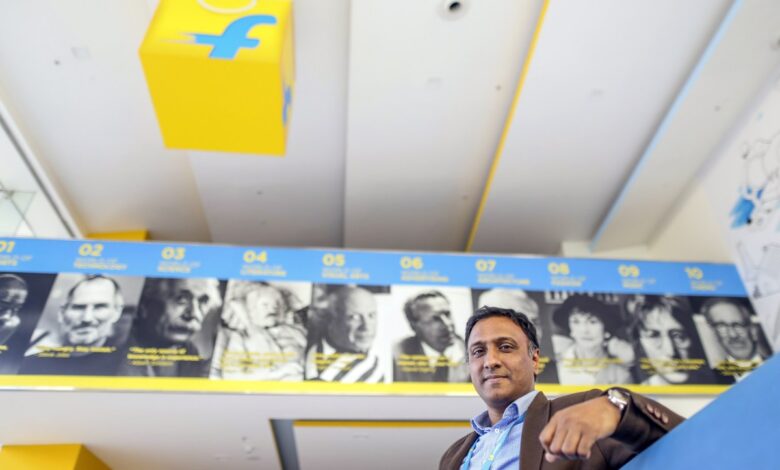
This push into food delivery comes amidst uncertain prospects for Flipkart’s long-anticipated stock-market debut. Chief Executive Kalyan Krishnamurthy recently refrained from providing a timeline for an IPO, even as the company expands into areas likely to drive repeated customer visits to its app.
Amid increasing rivalry in India’s e-commerce domain, quick-commerce players, which originally focused on rapid grocery deliveries, are now also selling high-demand products like the latest iPhones, directly competing with Flipkart and Amazon.
Flipkart did not provide a statement for this article.