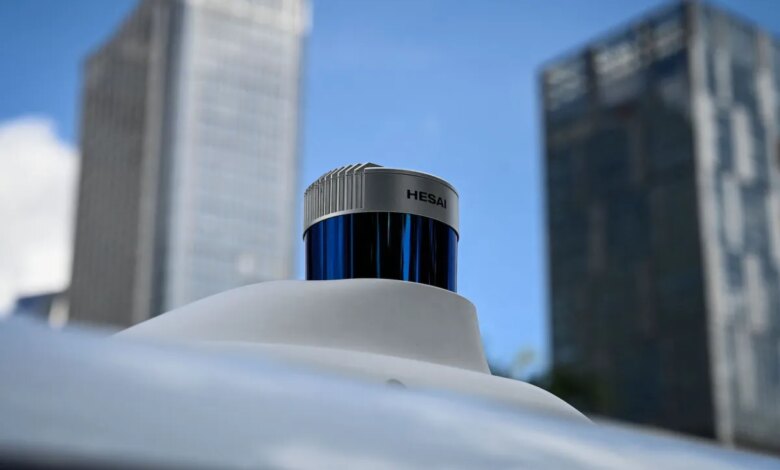
A laboratory under the Department of Energy is assessing the potential security risks posed by Chinese lidar sensors, particularly if they gain significant traction in the U.S. automotive market.
The Idaho National Laboratory is conducting this examination, as reported by two insiders who requested anonymity. They indicated that funding is being supplied by a corporation or a consortium within the electric and autonomous vehicle sectors.
It remains unclear which specific companies are backing this investigation. Representatives from Rivian, General Motors, Ford, Kodiak, Lucid Motors, Nuro, and Uber — all noted to be evaluating Chinese lidar — claimed to be unaware of the ongoing review. Meanwhile, inquiries directed at Nvidia, Zoox, and Aurora received no response regarding their potential involvement.
Idaho National Laboratory has refrained from commenting on the research. A spokesperson stated in June and July that details about the project were not available for public discussion. Leading lidar manufacturers in China, such as Hesai and RoboSense, also did not respond to multiple inquiries.
Lidar, which stands for light detection and ranging, is sensor technology that utilizes laser pulses to gauge distances to objects in proximity. This technology has gained popularity among companies developing autonomous vehicles due to its capability to provide a high-resolution view of a vehicle’s immediate environment.
The review comes at a time when there is growing pressure from lawmakers advocating for a ban on the use of Chinese lidar sensors on American roads. Several legislative proposals are currently in development.
Senator Tammy Baldwin (D-WI), who is leading the Securing Infrastructure from Adversaries Act alongside Senator Ted Budd (R-NC), expressed concerns regarding the potential use of Chinese lidar for espionage, whether military or industrial.
“As our infrastructure grows in complexity, we cannot allow the risks that Chinese LiDAR technology poses to American communities and national security to go unaddressed,” she stated. “It’s crucial to ensure that taxpayer funds are not directed toward technologies that could be used for surveillance.”
Congressman John Moolenaar (R-MI), co-sponsoring another bill aimed at prohibiting Chinese lidar, raised concerns about “back doors” that might transmit information to Chinese interests.
Cost vs. Concerns
Omer Keilaf, CEO and co-founder of the Israeli lidar company Innoviz, indicated that the risks associated with Chinese lidar can be viewed through multiple lenses.
The first consideration is supply chain risk. Keilaf noted that the Chinese government considers lidar technology strategically important. “If, for instance, a company builds its entire autonomous driving system relying solely on a Chinese supply chain, that could lead to significant risks in the future,” he explained during a recent interview.
However, the current review focuses primarily on cybersecurity threats, with the goal of evaluating whether Chinese lidar can be deemed secure from a cybersecurity standpoint, according to the sources familiar with the investigation.
Keilaf identified two primary cybersecurity issues linked to Chinese lidar. First, sensors could potentially be disabled on a large scale, affecting vehicles in motion and rendering immobile ones non-operational. Past research has indicated that individual lidar sensors can be disrupted through targeted laser attacks; however, it’s unclear how a coordinated attack could be executed against active robotaxi fleets.
Additionally, Keilaf mentioned that the rich data collected by lidar can be compressed and transmitted via cellular networks. He emphasized that extracting this information isn’t overly complicated, given his background in Israeli intelligence.
Such concerns are timely as the price of lidar technology has significantly decreased over the last decade.
Historically, lidar has been more expensive compared to other sensors like radar or cameras. In fact, Tesla has opted out of using lidar entirely, with CEO Elon Musk deeming it a “crutch” and favoring a camera-centric approach for their autonomous driving technology.
Yet, Chinese firms like Hesai and RoboSense have rapidly scaled operations and reduced costs substantially, bringing prices down from as high as $75,000 a decade ago to just a few hundred dollars today.
While U.S. lidar manufacturers are striving to keep pace, matching China’s economies of scale and lower labor costs has proven challenging. This has led to consolidation within the industry, with companies like Luminar resorting to bankruptcy.
As a result, an increasing number of U.S. automakers and autonomous vehicle developers are considering the integration of Chinese lidar sensors into their systems.
For instance, Rivian is reportedly developing a version of its new R2 SUV that incorporates a lidar sensor into its design. In March, CEO RJ Scaringe mentioned that Rivian is weighing the possibility of manufacturing its own lidar in the U.S., leveraging Chinese technology potentially through a joint venture.
“Several automobile manufacturers are exploring how to collaborate on developing production capacity within the United States or at least outside of China,” noted Scaringe, mentioning ongoing discussions with lidar firms, which may include other automakers.
Rivian’s CFO later clarified that there are currently no plans to internalize lidar development.
While U.S. companies can legally utilize Chinese-made lidar, the future regulatory landscape remains uncertain. The Department of Defense has included Hesai and RoboSense on a list for allegedly supporting the People’s Liberation Army, which limits their engagement with U.S. military projects.
Since 2025, the Commerce Department has enacted a rule restricting the use of Chinese-made connectivity hardware in U.S. passenger vehicles; however, this rule does not extend to lidar and other autonomous driving sensors.
Lawmakers such as Congressman Raja Krishnamoorthi (D-IL), who initiated the bill co-sponsored by Moolenaar, have long expressed concerns that widespread integration could enable China to illicitly collect sensitive data or sabotage American systems.
As of now, fears regarding broad disabling of Chinese lidar remain speculative. However, there was a notable incident earlier in 2024 when customers utilizing Hesai lidar experienced a complete operational shutdown of their autonomous vehicles for a day due to a leap year oversight by the company.
Your purchases made through links in our articles may help us earn a small commission, which does not affect our editorial independence.