Welcome back to our report on innovations in transportation, especially how artificial intelligence is enhancing these developments. For a weekly update delivered to your inbox, subscribe for free!
Quick notice for our readers: There will be no issue next week due to the July 4th holiday. I look forward to connecting with you the week after.
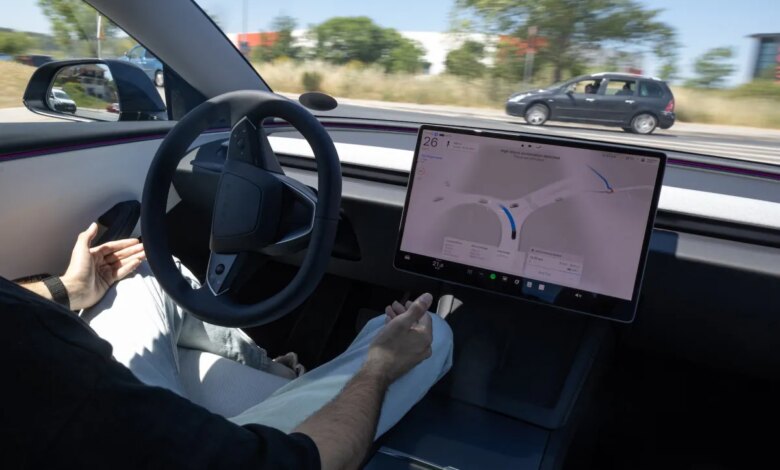
This week’s news highlights increasing scrutiny surrounding Tesla’s Full Self-Driving (Supervised) system. A tragic accident in Texas, where a Tesla crashed into a house, resulting in the death of a 76-year-old woman, has brought this issue to the forefront. A witness reported that the vehicle was operating under Autopilot, a previously used driver-assistance feature.
Ashok Elluswamy, Tesla’s AI software vice president, provided an alternate perspective via X, claiming the driver actively accelerated to the maximum while in a residential area, indicating the use of FSD (Supervised) rather than Autopilot. However, the exact circumstances remain unclear pending a thorough investigation.
The National Highway Traffic Safety Administration (NHTSA) and the National Transportation Safety Board (NTSB) have launched inquiries into the incident.
In related news, Tesla reached a settlement concerning another deadly crash from 2023 involving the FSD (Supervised) system. This event is currently part of a broader NHTSA investigation examining the capabilities of FSD to react to various challenging visibility conditions like sun glare or fog.
All of this scrutiny coincides with Tesla’s effort to brand itself as a frontrunner in AI and robotics, with FSD (Supervised) being its most prominent and revenue-generating product.
Interesting Developments
One of our readers passed along a research report concerning Waymo and its expanding fleet of Ojai robotaxis. To recap, Waymo has entered into a partnership with Zeekr, under the umbrella of China’s Geely Holding Group, to acquire electric vehicles designed for robotaxi use.
The Ojai, designed in Sweden and produced in China, will be retrofitted with Waymo’s self-driving technology upon arrival in the U.S., given that current U.S. policies prohibit any Chinese-connected vehicle technology. Each Ojai is fitted with an advanced suite of safety equipment including 13 cameras, four lidar sensors, and more.
The New York-based firm MoffettNathanson conducted research through shipping documents to assess the seriousness of Waymo’s Ojai plans. Their findings show that Waymo aims to import about 3,156 vehicles this year, averaging around 300 per month.
If you have any tips or insights, feel free to contact us!
Recent Deals

Aseon Labs, a startup focused on mobile pods for autonomously inspecting and cleaning robotaxis, secured $10 million in a seed round led by Crane Venture Partners.
CaoCao and May Mobility are collaborating to explore robotaxi commercialization in international markets, initially targeting Europe.
Elroy Air, a startup specializing in autonomous heavy-lift drones, plans to go public through a merger with Columbus Circle Capital Corp II, valued at approximately $1 billion.
Partly raised $50 million in a Series B round to enhance its AI tools for the automotive repair supply chain, led by DST Global Partners.
Spiro, an electric vehicle and clean energy platform based in Africa, recently secured a $55 million investment from NewTrails Capital.
Terawatt Infrastructure, which provides charging solutions for electric vehicle fleets, including those for Waymo, established a five-year credit facility permitting up to $300 million in borrowing to further develop charging depots.
Noteworthy Updates

Companies like Tesla and Zoox could benefit from recent proposals by the U.S. Department of Transportation to amend vehicle regulations that would eliminate the need for brake pedals in vehicles operated solely by automated systems.
Lucid Motors announced layoff plans affecting 18% of its workforce, around 1,500 employees, alongside the termination of a second production shift at its Arizona plant. These layoffs follow a previous reduction just four months earlier and are seen as part of an effort to streamline operations and enhance competitiveness.
Lyft CEO David Risher introduced a new multi-sensor safety standard for autonomous vehicles in a recent blog post. This new policy disallows vehicles using only one type of sensor, such as the Tesla Cybercab with FSD (Unsupervised), from joining Lyft’s network.
OpenAI has appointed Prabhjeet Singh, former president of Uber India, as its first managing director.
Polestar, the electric vehicle manufacturer under Geely, is unable to market its new vehicles in the U.S. due to governmental restrictions on Chinese car tech.
Samsara is introducing new sticky tracking labels aimed at combating cargo theft.
Slate Auto is launching a basic electric truck starting from $24,950, which features a limited range and minimal technology. Debate continues regarding the value of such stripped-down vehicles.
Uber is facing shareholder litigation that accuses board members of prioritizing profit over safety and compliance, posing risks to the company.
Waymo is advancing its efforts in Germany with a newly registered entity aimed at establishing a robotaxi service, although insiders caution that this launch is not imminent. Meanwhile, the company has lifted the waitlist for accessing its services in Nashville.
Zoox is enhancing its custom-designed robotaxis in preparation for commercial operations and larger-scale production at its facility in Hayward, California.