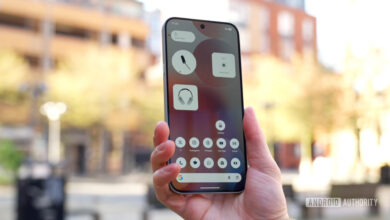
Tushar Mehta / Android Authority
Key Points:
- SpaceX has officially announced plans to develop a terrestrial mobile network that complements Starlink satellites.
- The launch of Starlink Mobile is projected for late next year, utilizing advanced satellite technology.
- The company aims to outpace traditional mobile carriers by effectively addressing coverage gaps.
Initially, when news surfaced about SpaceX’s interest in launching a Starlink-branded mobile service, it seemed like a distant ambition. Early information indicated that the company had begun discussions with investors regarding a consumer wireless offering, leveraging its recent acquisition of EchoStar’s spectrum, and looking into a corresponding terrestrial infrastructure. Just a short time later, SpaceX moved from speculation to confirmation regarding these initiatives.
During SpaceX’s recent earnings call following its IPO, President Gwynne Shotwell revealed the company’s plans to create a land-based mobile network alongside its satellite framework, providing a clearer vision of what Starlink Mobile aims to achieve.
Shotwell stated, “The spectrum we’ve obtained from EchoStar includes terrestrial elements, and we fully intend to develop this component.” SpaceX envisions a hybrid network model that merges satellite and ground systems, offering what it terms a “true mobile service.”
This hybrid strategy is crucial. Currently, Starlink’s service for direct-to-cell communications utilizes roughly 5MHz of spectrum leased from partner carriers for basic coverage outside of cellular networks. Upon finalizing the EchoStar acquisition, the company will gain access to 65MHz of spectrum, along with next-gen satellites that Shotwell claims will enhance Starlink Mobile’s capabilities significantly above the current levels.
Innovative Strategy for Mobile Network Development
SpaceX also provided insights on its approach to creating a terrestrial network while avoiding the massive infrastructure expenditures typical of traditional carriers.
Instead of constructing extensive cellular towers, Elon Musk noted that SpaceX is focusing on a decentralized system of smaller base stations, which can integrate with current Starlink setups in homes and businesses.
This means many rooftops already equipped with Starlink dishes could later contribute to mobile coverage.
Importantly, SpaceX possesses significantly less spectrum than major players like AT&T, Verizon, or T-Mobile. Instead of directly competing with these carriers, the strategy involves using satellites to bridge coverage gaps while smaller ground stations enhance service where needed.
SpaceX anticipates attracting customers from major US carriers by eliminating dead zones and ensuring more reliable connectivity during emergencies. Musk went so far as to assert that Starlink Mobile could provide bandwidth exceeding that of existing cellular networks.
Thank you for engaging with us. Please review our Comment Policy before contributing your thoughts.