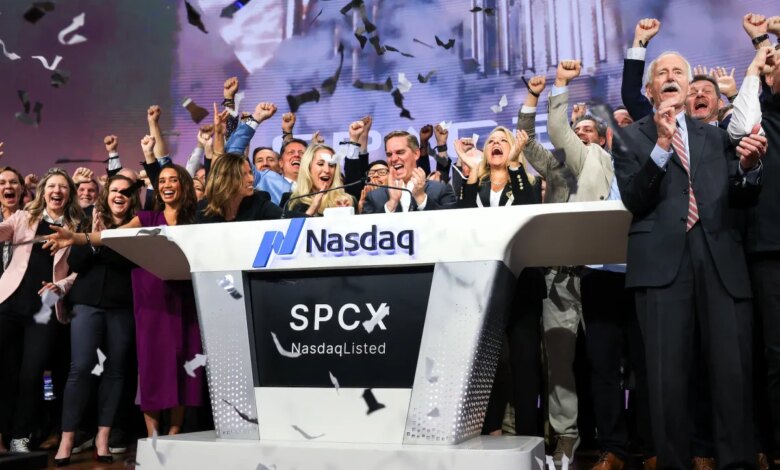
This week, SpaceX made headlines by going public in the largest initial public offering (IPO) to date, catapulting CEO Elon Musk into the status of the world’s first trillionaire.
Despite its commercial space endeavors, SpaceX has been focusing heavily on its AI ventures, with industry rivals OpenAI and Anthropic potentially gearing up for their own IPOs. In the latest episode of TechCrunch’s Equity podcast, hosts Kirsten Korosec, Sean O’Kane, and I explored the prospects of what seems to be an exciting summer for IPOs.
“SpaceX is not just taking a substantial portion of available funds in the public markets; it’s also pushing the boundaries of how a public company can operate and the extent to which one individual can exert control,” Sean remarked. “I’m particularly interested in how other tech firms approaching the IPO process will try to replicate this model.”
Kirsten pointed out that numerous startups are attempting to capitalize on SpaceX’s IPO momentum, including those aiming to fund orbital data centers, a concept that SpaceX has notably popularized.
“There’s a ripple effect throughout the market that I find even more captivating than just the headline about SpaceX making Elon a trillionaire,” she added.
Below is a summary of our discussion, edited for brevity and clarity.
Anthony Ha: Let’s broaden our focus beyond the SpaceX IPO itself. Beyond the implications for Elon Musk, this could be the start of multiple IPOs from various AI firms. We’ve already seen Anthropic confidentially file to go public, and now OpenAI is in the same boat. How do you both feel about this?
Kirsten Korosec: I’m really fond of Julie Bort’s article, which captures the shift nicely. The headline reads: “It’s not FAANG anymore, it’s MANGOS.” FAANG represents Facebook (now Meta), Amazon, Apple, Netflix, and Google (now Alphabet). Now, the landscape has changed, including Meta, Anthropic, NVIDIA, Google, OpenAI, and SpaceX. There’s a notable transition here, especially with a growing emphasis on AI labs rather than traditional consumer and social media platforms. It’s an intriguing evolution in public markets, along with the substantial capital that’s gravitating toward AI and innovative technologies like SpaceX. This summer promises to keep us reporters very busy, likely more than any other summer in recent memory.
Sean O’Kane: There was a time I envisioned a career in law, but I shied away due to the paperwork. Now, I find myself anticipating an avalanche of SEC filings over the coming summer—quite the beach read!
This anticipated moment has been in the making for some time. We’ve spent the last few years pondering whether the IPO market would “reopen” following doubts about private markets. This represents a significant test for public markets overall.
SpaceX is not only absorbing a considerable portion of public market funds; it’s also challenging the conventional limits of what defines a public entity and the degree of control one individual can have. I’m watching how other tech companies will follow suit in their IPO approaches.
I keep contemplating how SpaceX is merging the extreme aspects of early 2000s IPO playbooks of companies like Google and Meta, alongside the “We’ll lose money indefinitely” model of Amazon. It raises the question of whether Anthropic and OpenAI will mirror this approach or take a different path.
Anthony: One thing that struck me while reading about the OpenAI IPO is how much of this seems to be a timing race. SpaceX has taken the lead, bringing both advantages and challenges. They position themselves as an AI company but have diverse operations beyond just that.
Analysts suggest that OpenAI and Anthropic may be eager to go public first, given the limited capital and excitement available. Eventually, some valuations may need to pull back, leading to a potential scramble among them.
Kirsten: There’s definitely competition between Anthropic and OpenAI, evident in OpenAI’s recent discussions of reducing prices, reflecting their rivalry on the IPO calendar. However, this short-term view could be shortsighted. They should focus more on the long-term strategy.
While Anthropic, OpenAI, and SpaceX prepare for their respective moments, numerous other companies are also leveraging the success of SpaceX for fundraising or seeking SPAC opportunities. For instance, a firm called Quantum Space is currently pursuing a SPAC to capitalize on the SpaceX IPO momentum.
Many other startups, as reported by our colleague Tim Ferholz, are not aiming for public offering just yet. However, they are seeking funds based on the success prospects of space data centers, spurred by SpaceX’s achievements. This ripple effect throughout the market is indeed more fascinating than just the headline about Elon’s newfound trillionaire status.
Sean: The prevailing theory in Silicon Valley is that AI is reshaping the economy through its applications, but it’s also altering it currently due to how companies are approaching their development. The rush among firms for public listings raises questions about whether they may later regret this urgency.
Even traditional companies like Ford and General Motors are adapting their surplus battery production to serve as energy suppliers for data centers. Ford’s stock surged upon its announcement of a seemingly modest energy storage initiative, in comparison to Tesla. Tim De Chant also provided intriguing insights into GM’s changes this week.
The economy is undergoing transformation right now. Whether this progress is sustainable remains an open question.
Kirsten: That’s a compelling point. Years ago, headlines often revolved around “the next Tesla killer.” Automakers and other firms have continued trying to emulate the various strategies of Elon Musk without learning much in the process.
I wish I could convey this to auto industry CEOs: While I understand the pivot to innovative concepts, modeling your business around Tesla or SpaceX doesn’t always pan out. It may be worth exploring other avenues instead.
Sean: So you’re suggesting that Ford should not delve into space data centers?
Kirsten: Exactly. But just wait; I suspect it may happen anyway.