The competition to increase chip production is intensifying, and Europe is joining in. ASML, the Dutch firm that dominates the machines essential for chip manufacturing, might soon be part of a broader success story.
Similar to initiatives in the U.S., the European Chips Act seeks to bolster the semiconductor sector, partially aided by government subsidies. One startup reaping the benefits is QuantumDiamonds, a German company innovating in chip inspection methods.
With the European Commission’s backing, QuantumDiamonds has secured €76 million in non-dilutive funding from Germany’s federal economy ministry and the Bavarian state. The funds will help establish a new manufacturing facility for semiconductor testing equipment in Munich, contributing to a previously announced investment plan of $178 million.
QuantumDiamonds is a spinoff from the Technical University of Munich (TUM) and recently completed a €15 million equity round led by World Fund, a venture capital firm, as confirmed by TechCrunch. While the startup chose not to disclose its valuation, the funding round also included participation from Bayern Kapital and other existing investors, including Creator Fund, Earlybird, First Momentum, IQ Capital, Onsight Ventures, and UnternehmerTUM.
CEO Kevin Berghoff shared that the fundraising process was relatively swift due to the demonstrated demand from customers. “We collaborate with nearly every player in the chip ecosystem,” he noted. With an increasing need for various types of chips, there is an equal demand for solutions that accelerate the manufacturing process and enhance productivity.
QuantumDiamonds claims to offer a solution that compresses a defect detection process, traditionally taking weeks, into just two minutes without halting production lines. This efficiency can reportedly save companies like Taiwan-based foundries and Korean memory makers hundreds of millions of dollars.
According to Berghoff, their hardware typically pays for itself within a couple of months. This also allows room to cover a subscription fee for on-site support and software that analyzes data, providing clients with insights on improvements in their manufacturing processes.
This advancement marks one of the first practical applications of quantum technology, with quantum sensing already being effective in generating magnetic fields that can identify defects with remarkable accuracy. “Customers are more concerned about results than the quantum aspect,” Berghoff remarked with humor.
While the nature of the diamonds may not be a concern for clients, it’s worth noting that they are synthetic. QuantumDiamonds utilizes their unique properties to analyze the electrical flow in chips. Unlike traditional inspections that typically examine only the surface of a chip, this method allows for defect detection throughout all layers without damaging the chip.
This capability is particularly significant as chips become more multi-layered. Companies like Semron are developing 3D chips, which the industry appears to acknowledge as crucial for AI data centers, according to Berghoff. “As transistors can’t be made smaller, more layers are added to maintain the same power and computing capability.”
While large firms, including massive U.S. inspection companies, are likely to adapt eventually, QuantumDiamonds currently enjoys a first-mover advantage, as stated by Berghoff. “No company in the U.S. or Asia has delivered similar tools.” The startup is transitioning from laboratory settings to operational semiconductor manufacturing facilities.
“Currently, we have tools designed for lab environments, where sample-based testing occurs, examining perhaps one in a million chips,” Berghoff explained. “We aim to implement high-throughput testing, enabling complete quality control in manufacturing plants.”
While these machines are expensive, Berghoff noted that costs vary. “Our lab tools are priced in the single-digit millions, and the high-throughput systems could range from $10 to $15 million. However, this is still significantly less than ASML machines, which can cost around $400 million. Therefore, while our products are costly, they remain quite affordable compared to alternatives.”
Such comparisons lead to optimistic views; World Fund managing partner Daria Saharova stated that QuantumDiamonds could emerge as Europe’s equivalent to ASML. While this optimism is clear, Berghoff noted that ASML has expressed less interest in mergers and acquisitions recently.
At this stage, QuantumDiamonds finds itself paralleled with another World Fund investment, IQM, a Finnish quantum spinoff that recently went public. Both firms stem from Europe’s thriving tech scene and aim to utilize European support to expand internationally.
Although QuantumDiamonds is still in its early stages, it has taken steps towards global expansion in 2026, opening a regional hub in Taiwan and completing its first commercial deployments in Taiwan and the U.S., including a system installation at Eurofins EAG Laboratories in Sunnyvale, California.
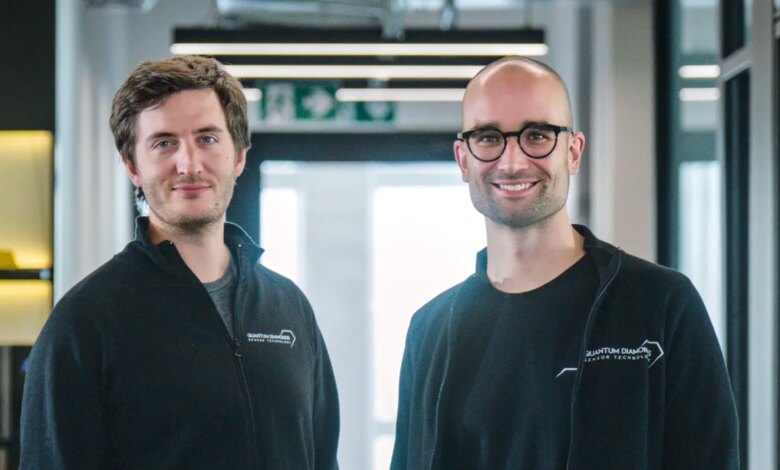
Additionally, the new funding will create jobs in Munich, where most of the company’s 70-person team is based. CEO Berghoff and co-founder/CTO Fleming Bruckmaier intend to double their engineering team in the next year, leveraging the local talent pool skilled in both quantum technology and semiconductors. “We have the resources needed here to facilitate our overseas operations,” Berghoff concluded.