Nvidia is setting its sights on a new frontier: the moon.
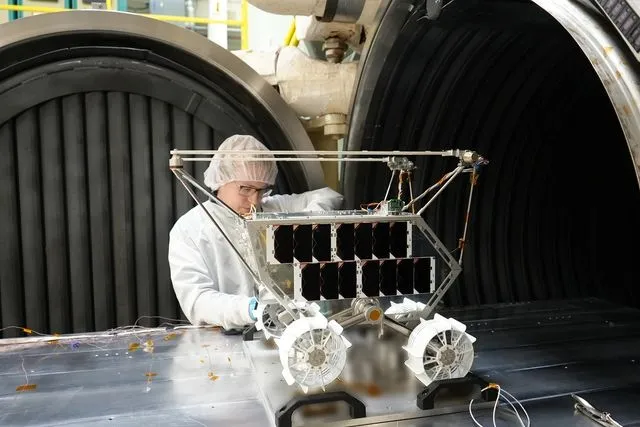
Lunar Outpost, a startup developing robotic systems for space infrastructure, has revealed that its upcoming lunar rover will utilize Jetson chips to manage its LiDAR technology. This could mark the first deployment of a GPU on the lunar surface.
“We’re evaluating the NVIDIA Jetson against our existing flight compute platform, which has a bit more experience in spaceflight,” said Lunar Outpost CEO Justin Cyrus. “[We’re] assessing the benefits and drawbacks. Our goal is to integrate these advanced GPU systems into extreme environments.”
In a bid to encourage lunar exploration, NASA has initiated a program to fund private enterprises for missions on the moon, with plans to send astronauts back by as early as 2028. This initiative, modeled after NASA’s collaboration with SpaceX, invites tech companies to build vehicles equipped with scientific instruments to study the lunar terrain and seek resources like water, which may be valuable for future use.
Nvidia also recently formed a partnership with Firefly Aerospace, which successfully landed a robotic probe on the moon. This collaboration will see the Jetson platform used on a satellite orbiting the moon to process imaging data. The satellite is intended to help scientists map the lunar landscape while also monitoring the increasing number of robotic missions on the surface.
The new rover from Lunar Outpost will be integrated onto a lander crafted by Intuitive Machines, another company focused on lunar technology. Its design includes a suite of sensors capable of exploring craters and other hard-to-reach areas. The rover’s mission will include investigating the lunar region known as Reiner Gamma, which has presented a magnetic anomaly that has intrigued researchers.
All missions are anticipated to launch aboard a Falcon 9 rocket before the year concludes.
While Nvidia’s Jetson platform might not be as recognized as leading AI models like Blackwell or Vera Rubin, it plays a crucial role in various physical AI applications. Its compact and efficient design enables robotic systems to process sensor data locally, enhancing their speed and responsiveness to environmental changes.
“Five years ago, our autonomy framework was more deterministic. Now, it includes both deterministic elements and physical AI, which is exciting,” Cyrus noted. “We still run both systems in tandem and aim to find synergies where physical AI can contribute and enable us to accomplish unprecedented feats.”
Deploying GPUs in space presents challenges due to the extreme conditions. Most GPUs designed for space use are in low Earth orbit, where they are shielded from significant radiation and temperature fluctuations. The moon, however, faces intense cosmic radiation and drastic temperature changes during its phases.
“The system must endure lunar nights while operating on minimal power,” Cyrus explained.
Should the chips perform effectively in such conditions, Lunar Outpost’s engineers anticipate that their rovers will gain enhanced capabilities, allowing for quicker environmental processing and decision-making. NASA envisions a sustained human presence on the moon, which will likely depend on autonomous systems to facilitate preliminary exploration and necessary work.
“At Lunar Outpost, we’re focused on transitioning from exploration to establishing a permanent presence, which involves building a lunar outpost,” Cyrus expressed. “We believe the integration of our deterministic models with physical AI is essential for sustaining human activities in space, aided by a robotic workforce.”
Over the next few years, Lunar Outpost plans to launch several smaller autonomous rovers to the moon, alongside a larger rover named Pegasus, designed for astronaut transport. Pegasus is awaiting a launch from Blue Origin, a company founded by Jeff Bezos, but complications during a recent test have delayed its schedule for return to flight.
“They appear to be making good progress on the launch pad,” Cyrus commented. “I can’t provide details on Blue Origin’s timelines or NASA’s progress on the pad repair, but all indications are that we’re aligned for the same timeline as 2028.”
This leaves ambitious concepts for lunar data centers and swarms of operational robots awaiting the same essential factor: a larger rocket.