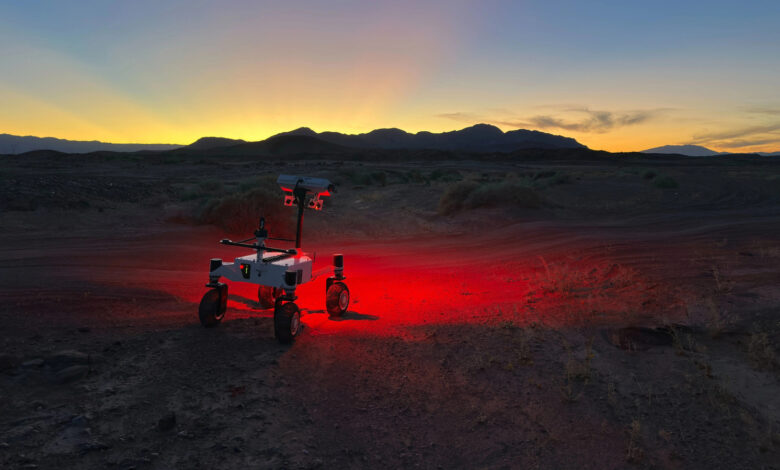
Since the late 1990s, NASA’s Mars rovers have made significant strides in space exploration. However, even the most recent models face inherent limitations. For example, the Perseverance rover, although considered exceptional, can only reach a maximum speed of around 0.1 mph on flat terrain. Additionally, the challenging Martian landscape can wear down the rovers’ wheels, and steep inclines filled with rocks and sand often necessitate lengthy detours to approach specific targets. In response, NASA has revealed advancements in a new prototype designed to tackle these issues: the Exploration Rover for Navigating Extreme Sloped Terrain, known as Ernest.
NASA has been testing Ernest in the Colorado Desert, exploring innovative strategies that could be applicable for future Mars and lunar missions. Unlike the current six-wheeled rovers, Ernest has four wheels and measures four feet in length, but potential mission-ready versions would be twice that size. Notably, the prototype can individually lift its wheels to navigate over or around obstacles. During recent trials in the desert, Ernest operated for over 37 hours across seven days, traveling approximately 16 miles and achieving a top speed of about 0.6 mph.
James Keane, a planetary scientist at JPL involved with lunar exploration, remarked, “You could do a science road trip across the Moon — or Mars — with this vehicle.” Historically, Mars rovers have utilized a passive suspension system called the rocker-bogie system, which helps distribute weight evenly across their wheels. Now, with Ernest, engineers are experimenting with an active suspension system that enhances mobility. NASA explains that “two powered joints in front articulate a gimbal that allows the rover to drive using different gaits like squirming, wheel-walking, and obstacle-climbing.”
Ernest can alternate between active and passive suspension based on its tasks and energy requirements. Thanks to its four steerable wheels, it can maneuver in any direction. Since the start of the program in 2022, there have been several prototypes of Ernest, with nearly a dozen active suspension configurations tested. The latest iteration also features improved independent decision-making abilities. The ultimate objective for Ernest is to refine technology for rovers that can traverse larger areas more efficiently and with reduced dependence on remote human control from Earth.