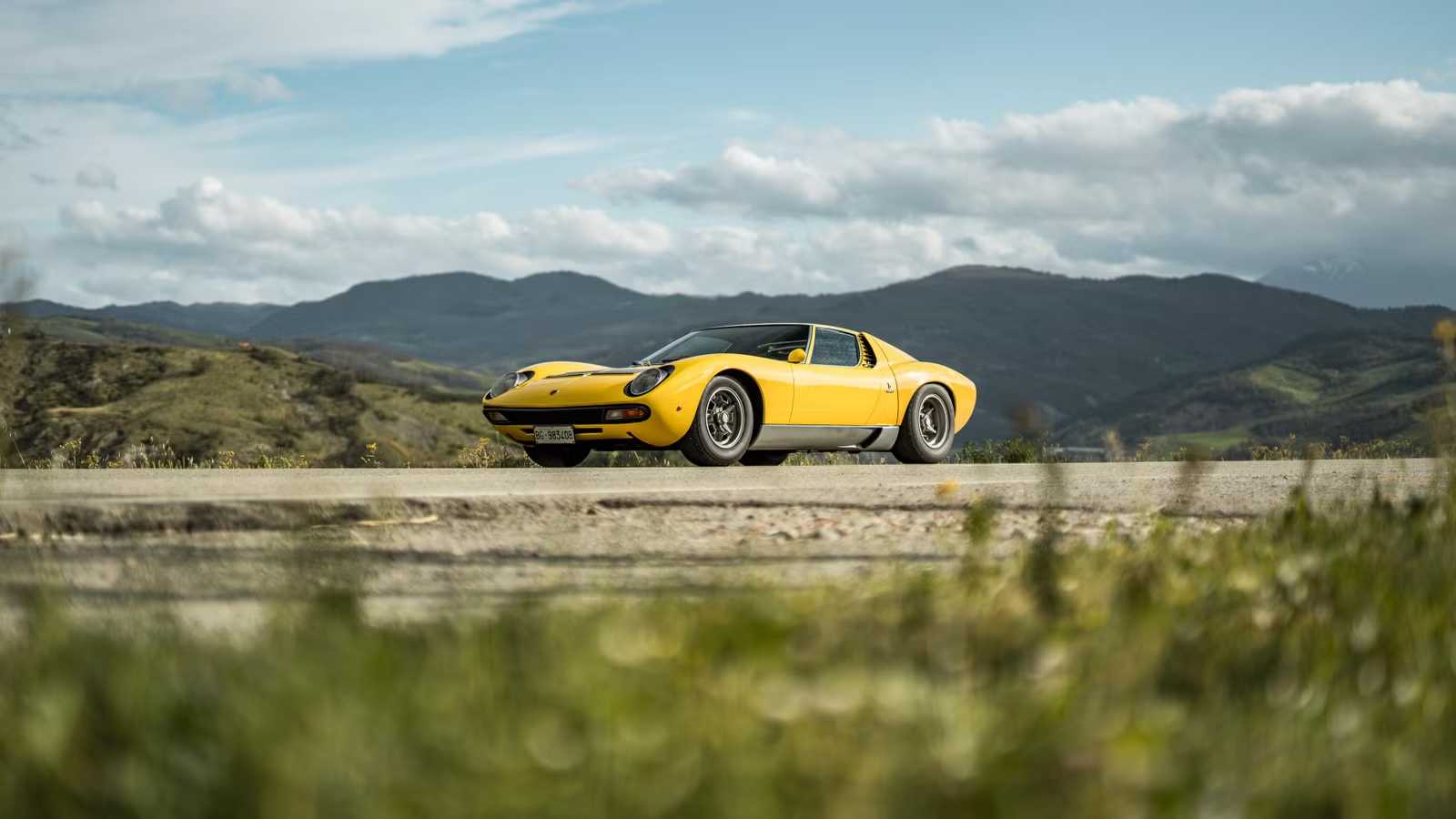
In the early 1970s, Lamborghini faced a unique challenge that many automakers would envy: improving a car that was already an icon. This vehicle was the Miura, and the outcome of this endeavor was the Miura SV, a model that established a naming convention still utilized by Lamborghini today.
Recently, Lamborghini celebrated the 55th anniversary of the Miura SV’s launch, sharing insights into its development and the reason behind the enduring appeal of the SV badge.
The Miura first made its debut in 1966 as the Miura P400, becoming the inaugural production car equipped with a V12 engine transversely positioned ahead of the rear axle. This unique layout contributed to its immediate fame and solidified its status as the first modern supercar. The Miura S followed in 1968, introducing various enhancements, yet both iterations faced similar issues: high-speed lift and a shared oil system for the engine and transmission.
Origins of the Super Veloce Concept
Technical Upgrades in the Miura SV
In response to the Miura S, Lamborghini introduced the Miura SV, which stands for Super Veloce, translating to “super fast” in Italian. Released in 1971, this model was produced for a limited time until 1973. Lamborghini’s engineers separated the lubrication systems for the engine and transmission, increased the rear track width, fine-tuned the suspension, and added ventilated disc brakes. Some models even included a limited-slip differential for improved traction.
The SV also saw the removal of the “eyelash” trim surrounding the headlights, creating a more streamlined front end, and the rear fenders were modified to accommodate larger tires. The eyelash element, introduced by the Italian design house Bertone, had become a defining feature since the original Miura P400. By replacing them, Lamborghini traded an ornamental detail for a more aggressive and focused appearance.
However, there was one exception: the red SV owned by Ferruccio Lamborghini, which retained the eyelash trim and is currently showcased at the Lamborghini family museum.
“With the Miura SV, Lamborghini reached the pinnacle of the Miura’s evolution,” commented Stephan Winkelmann, Chairman and CEO of Automobili Lamborghini. “Super Veloce has always encapsulated the essence of Lamborghini’s performance, providing an unmatched driving experience, improved dynamics, and a unique character.”
Specifications of the Lamborghini Miura SV (1971-1973):
- Engine: 3.9-liter V12
- Output: 385 horsepower at 7,850 rpm, 286 lb-ft of torque at 5,500 rpm.
- 0-62 mph: 5.5 seconds.
- Top Speed: Over 180 mph.
- Curb Weight: Approximately 2,745 lbs.
- Original Price: 8,600,000 lire (around $13,800 in 1971 or about $114,000 today, adjusted for inflation).
More Than Just Performance
Craftsmanship in Customization
Lamborghini highlights three key elements contributing to its cars’ lasting value: rarity, personalization, and craftsmanship, all in addition to the performance engineering that the SV badge represents. The current lineup, which includes the Revuelto, Urus SE, and Temerario, showcases this philosophy.
The Ad Personam division, Lamborghini’s bespoke customization studio, crafted a two-car set called Temerario, featuring woven wool for the first time in a Lamborghini interior. Each vehicle combined this unique material, known as Gessato (Italian for “pinstripe”), with distinct paint and interior themes tailored specifically to the owner’s preferences. These vehicles made their public debut at the 2026 Goodwood Festival of Speed.
The same principles that defined the Miura SV in its era apply to these modern offerings. While the SV badge emphasizes peak performance, Ad Personam focuses on pushing craftsmanship to its limits.
Originating in 2006 and evolving into a dedicated division by 2013, Ad Personam established its own studio at Lamborghini’s Sant’Agata Bolognese headquarters in 2016. The majority of new Lamborghinis now feature at least one customized attribute, whether it’s unique colors, stitching patterns, or interior materials, similar to offerings from brands like McLaren and Rolls-Royce.
The Evolution of the SV Badge
After a hiatus of over twenty years, Lamborghini revived the SV badge for the 1996 model year with the Diablo SV, launched at the Geneva Motor Show in March 1995 as an entry-level model designed to boost sales. Initially offering 510 horsepower, it reached 530 by 1999, maintaining the philosophy of refining existing models, a principle first introduced with the Miura SV.
Following another silence, the Aventador SV debuted in 2015, boasting 740 horsepower and shedding 110 lbs compared to the standard model. The Huracan did not receive the SV designation; instead, other names like Performante and STO were used for its sportier variants.
Decades after the Miura made its groundbreaking V12 engine placement famous, the SV badge still signifies a commitment to uncompromising performance and excellence in automotive design.