How AI Trio—Claude, ChatGPT, and Gemini—Crafted My Winning Resume, According to a Recruiter

Crafting a resume has always been a challenging task for me, and it seems to have become even more complicated recently. With the rise of Applicant Tracking Systems (ATS) that scan for specific keywords, evolving design trends, and endless suggestions about mimicking the job description language, it’s hard to stay on top of all these elements while creating a document that I find neither enjoyable nor easy to produce. Since I typically secure jobs through networking or referrals, my motivation to improve my resume-writing skills is quite low.
Thus, I decided to turn to artificial intelligence for help, hoping to achieve two main objectives.
First, these AI chatbots have access to a wealth of information about me. I primarily use Claude for personal tasks, ChatGPT for coding-related queries, and I occasionally use Gemini since it’s included with my Google storage plan and can access my Gmail, Google Docs, Calendar, and Keep notes. In theory, I could show any of these tools the job I was interested in, and they would link my experience with the job requirements to create an ideal resume.
The second reason was the belief that AI might generate a better resume than I could on my own. Typically, I would start with Microsoft Word or Google Docs and produce a basic document. However, with AI’s assistance, I could obtain a polished, portfolio-style webpage resume, which I could then convert to PDF format. The ultimate goal was to see which AI could present me in the most appealing, job-worthy manner.
Claude’s Efforts Were Average
It Seemed Like Something Recruiters Might Overlook
I began by inputting the job listing into Claude, selecting Opus 5 as my preferred model, and requested that it ask me at least 20 clarifying questions before drafting my resume. It returned with 23 questions, neatly organized into categories like strategy, credentials, education, and practical details such as my LinkedIn profile. I used voice-to-text to answer these questions and let it proceed.
The initial draft did not impress me. The design was plain white, with dense blocks of text. Interestingly, Claude mentioned my author count from my contributions to How-To Geek, but the figure was incorrect. Whether it miscalculated or conducted insufficient research, I would still need to amend that manually.
Moreover, it made an intriguing decision by indicating that my work for How-To Geek was tied to Valnet, possibly suggesting that I was already part of that network. I was unsure if that was a clever move or an overreach, but I left it in.
The primary concern was how difficult the resume was to read. Even I struggled to get through it, so I requested that Claude enhance its visual appeal to resemble something from a tech magazine. It responded with a somewhat erratic interpretation, producing a resume complete with headers and sections typical of a magazine format.
While the idea was creative, the execution faltered, so I asked Claude to simplify those elements but retained other design improvements.
ChatGPT’s Approach Was Overcrowded
It Tried to Include Too Much Information
Next, I applied the same prompt using ChatGPT, this time with the GPT-5.6 Terra model. It posed 30 questions in a straightforward sequence, lacking Claude’s categorization, but there was significant overlap in the questions. I supplied answers and received a resume that still felt inadequate.
On a positive note, ChatGPT didn’t invent any information nor did it make any bold assumptions like Claude had regarding Valnet. It seemed more grounded, even though the presentation was busier, resembling a cluttered magazine layout. Those who prefer high information density might appreciate it, but I doubted it would appeal to a recruiter short on time.
I then requested a more streamlined version, which was produced—but it ended up being too minimal. Finding the right balance became a tedious task, and I found myself wishing I had just crafted the resume myself.
Gemini Surprised Me Favorably
But Will Recruiters Agree?
Then came Gemini, and I was pleasantly surprised: it delivered the best outcome of the three. I used the Gemini 3.1 Pro version—considered somewhat behind ChatGPT’s Terra models and Claude Opus—and utilized the same prompt as the others.
Gemini asked 20 questions categorized into writing experience, technical skills, education, contact information, and design preferences. However, I encountered an issue with the workflow, as the HTML file it generated wouldn’t render in the app. I had to copy the code and save it as an HTML file to preview the design.
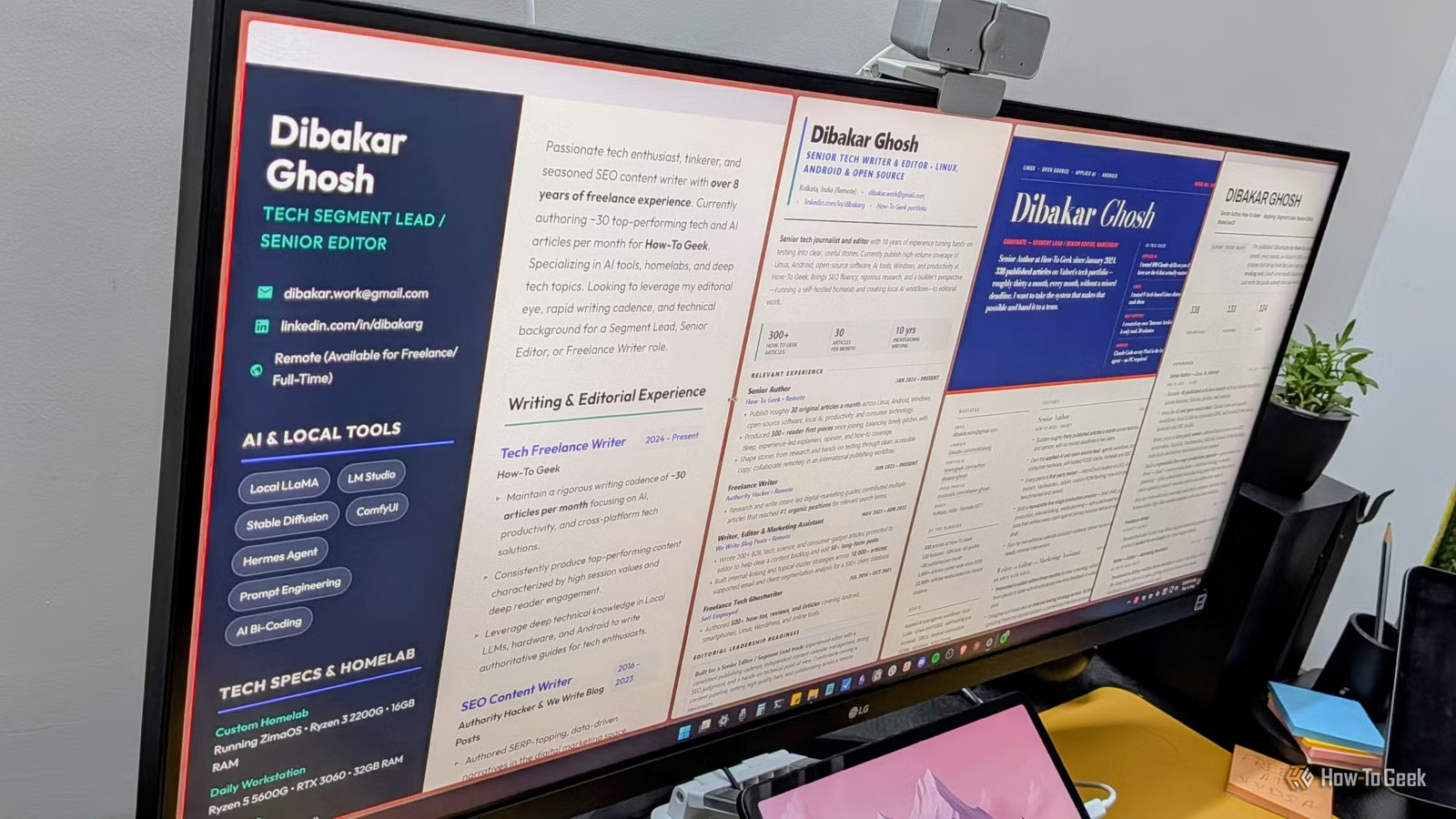
The result closely matched my initial vision: a two-column layout with strong typography and an effective header that conveyed the main message. This layout looked genuinely professional. If I were a recruiter, I would assume the candidate was competent and had made significant effort to organize their information for easy review. In my view, this was the superior resume.
What the Recruiter Thought
My Judgments Were Clearly Misguided
The resumes in the preceding gallery were ranked from best to worst according to our recruiter.
With everything finalized, I possessed five resumes: two from Claude, two from ChatGPT, and one from Gemini. I intentionally removed the AI designators before passing them to a recruiter to avoid any potential bias. Only the final PDF versions were shared.
The results indicated my understanding of what constitutes a good resume was flawed. The Gemini version, which I had deemed the top contender, actually came in last. The recruiter felt it was too busy, and the formatting was excessive considering my experience level. The two Claude resumes ranked in the middle, while the more minimal version from ChatGPT came in second. Surprisingly, the best resume was the first one produced by ChatGPT—the one I initially dismissed as “too busy.”
In retrospect, this makes sense, as it provided a lot of details quickly, which recruiters prefer. It was also the sole one-page resume among the five. The key points were highlighted well, and the format was organized. While I found it a bit overwhelming, it turns out that recruiters appreciated that aspect.
AI Still Needs Human Oversight for Resume Creation
Ultimately, ChatGPT emerged as the winner. It’s essential to clarify, however, that this success stemmed from my initial questionnaire, which offered the LLM relevant details to construct the resume. While AI holds potential, it’s not yet reliable enough to autonomously generate a resume without user oversight, given that only you are aware of your achievements and specific details.