Gritt Unveils $34 Million Funding to Empower Robots for Solar Plant Construction and Beyond

A significant development in today’s world is the expansion of solar energy. Globally, organizations and nations are striving to implement solar technology and battery solutions to attain energy self-sufficiency and mitigate climate change impacts.
However, this expansion faces a major hurdle due to a shortage of skilled labor necessary for installations. While robots could potentially provide a solution, traditional industrial robots have often struggled in unpredictable environments—until recent advancements in AI have started to change that.
This is the concept behind Gritt, a startup co-founded by Puneet Puri and Vishal Dugar, both trained in robotics at Carnegie Mellon University. The company emerged from stealth mode recently, announcing a $26 million Series A funding round led by Obvious Ventures, with additional investments from Union Square Ventures and Active Impact Investment. This brings Gritt’s total funding to $34 million after an earlier seed round backed by several notable firms. The startup’s goal is to create an intelligent solution to “assist humanity in accelerating infrastructure development,” according to Puri.
Puri explained to TechCrunch, “To truly enhance construction speed, we need a system that operates effectively in the unpredictable environments typical of construction sites, while also being adaptable enough to function across various conditions.”
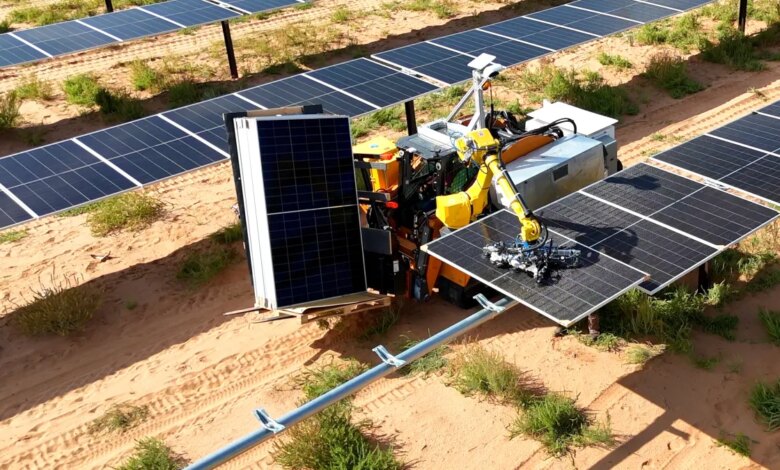
Instead of designing robots from scratch, Gritt employs readily available equipment—such as rented skidders and robotic arms from manufacturers like Kawasaki—to create platforms managed by its AI. The primary task of these systems involves unloading large solar panels, transporting them to designated metal frames, and precisely positioning them for workers to secure.
“There are teams that have experience building rockets with unlimited budgets and those who understand the realities of scaling challenging, unglamorous jobs. Gritt falls into the latter category, embodying a special type of entrepreneur with the right blend of technical skills, AI knowledge, and machine vision expertise,” commented Andrew Beebe, a partner at Obvious Ventures who led the Series A round.
Currently, Gritt has deployed two operational systems in the field, utilizing data collection to refine their performance. According to Puri, a team of eight traditional workers can install about 800 panels daily, but with Gritt’s assistance, they can achieve 3,000 to 4,000 panels in the same timeframe.
The company has secured contracts for installing 2.8 gigawatts of solar panels within the next year and a half, servicing three of the top ten construction companies in the U.S. Gritt aims to have 48 systems operational in the coming six months.
TechCrunch interviewed a Gritt client who wished to remain anonymous but expressed excitement about the system’s efficiency. This client anticipates that the technology will ease operations at remote locations where it is hard to find labor, while also reducing the risk of injuries as workers will no longer need to lift heavy panels manually.
Gritt’s competitors include companies like Luminous Robotics, Cosmic, and Trinabot, which are developing their own robotic solutions for panel installation. Unlike Gritt, these companies focus on proprietary hardware, a distinction that may influence their scalability and cost efficiency as market demand rises.
In the near future, Gritt plans to expand its capabilities to not only place solar panels but also perform tasks such as fastening panels, drilling post holes, and constructing the supporting structures. Ultimately, Gritt seeks to apply its technology to other labor-intensive construction processes, like tying rebar before concrete is poured.
What has enabled Gritt to pursue this ambitious vision? According to the founders, advancements in AI technology have been crucial.
“Five years ago, developing a solution for one specific task was feasible,” said Puri, “but now AI allows us to create generalizable systems that can adapt and improve across various functions.” He noted that while it once took weeks to train a system to stack cinder blocks, a similar task, like tying rebar, can now be accomplished in just a day using the same algorithms.
However, the goal of training new tasks is only the beginning of Gritt’s vision. The founders believe that the combination of sensors and intelligence within their systems can enhance not just installation but also management and decision-making on construction sites. For example, they envision scenarios where the system alerts workers to cover an open trench if a storm is approaching, preventing potential damage to materials.
“Gritt thus serves as a layer of physical AI, efficiently performing labor-intensive tasks while also aiding in decision-making at the site,” Puri concluded.