Google Launches Its Inaugural Data Center Satellite with a Flair for Poetry

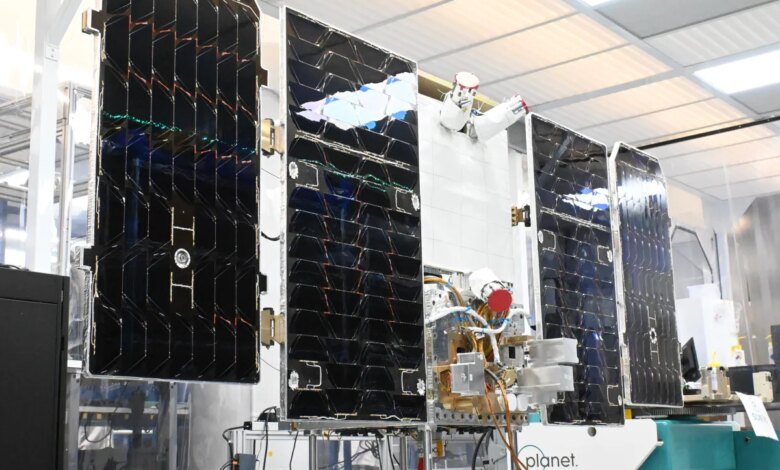
The prototype space data center developed by Google, known as Suncatcher, has successfully become operational after its recent launch aboard a SpaceX Falcon 9 rocket, joining over 100 other spacecraft.
Equipped with four Google Tensor Processing Units (TPUs) and capable of generating up to 1 kW of power, the satellite aims to set the stage for networks of satellites operating in close proximity to handle large data processing tasks in space. However, the high power requirements of the TPUs restrict their operation to approximately 20 minutes at a time, complicating the necessary communication between the satellite and ground control.
Following a three-week commissioning period to test its subsystems, the satellite became ready for its mission. Recently, engineers sent the first prompt to the onboard model, Google DeepMind’s Gemma 4, requesting a haiku about the experience of being in space. The result was:
Blue marble below
Data streams in silent grace
Starlight feeds my core. ✨
In their testing, Google assessed the model using space-themed verses and also inquired about the orbital conditions surrounding the satellite.
A company representative confirmed to TechCrunch that the satellite was functioning as expected.
The current testing phase will analyze the performance of the chips under thermal stress and the effects of space radiation. Although Google has conducted extensive evaluations of its TPUs in controlled environments on Earth, they now aim to observe how actual space radiation influences the hardware. Radiation can lead to “bit flips,” potentially corrupting data without triggering conventional monitoring systems.
Ground testing indicated that radiation would likely have a minor impact on inference tasks but may pose challenges when training models. The Google team will now assess these effects in a realistic setting instead of a simulated one.
If the TPUs on this mission demonstrate adequate performance, plans are in place to launch two additional satellites featuring these advanced chips by 2027. These forthcoming spacecraft are expected to support greater power generation and facilitate optical connections between satellites.
Google’s Suncatcher initiative stands out among concepts for space data centers, as it envisions high-speed communication links between satellites to collaborate on distributed workloads efficiently. In contrast, while SpaceX’s data centers will also utilize laser connections, those satellites will be positioned too far apart for effective processing collaboration. Other companies, such as Starcloud and Cowboy Space, intend to conduct inference tasks on single satellites.
The objectives of Google and SpaceX are closely intertwined. Alphabet, the parent company of Google, has made substantial investments in SpaceX. To realize their orbital data center ambitions, both organizations will depend on the Starship, a heavy-lift rocket still under development that is pivotal to Elon Musk’s vision for space exploration, needing to be fully reusable and capable of frequent flights.
In a recent peer-reviewed study, researchers involved in the Suncatcher project estimated that SpaceX would need to execute 1,800 launches of the Starship to replicate the cost savings driven by learning from its previous rockets.
Suncatcher is emblematic of Google’s ambitious projects; the company is targeting the development of infrastructure that will be cost-effective by the 2030s. However, achieving this goal may hinge on how the broader company navigates the challenges and prospects of AI in the immediate future. Recently, Alphabet experienced a decline in stock value following reports that its integration of AI into its search functions is negatively impacting ad revenue growth.
Correction: The Suncatcher satellite carries four TPUs, but only one can operate at any given time.