Amidst the race to uncover revolutionary advancements in artificial intelligence, one innovative firm is seizing the opportunity to overhaul computing architecture entirely.
Headed by Naveen Rao, the former AI leader at Databricks, Unconventional AI aims to significantly enhance the efficiency of inference processing. Their unique approach hinges on a novel oscillator-based computer architecture.
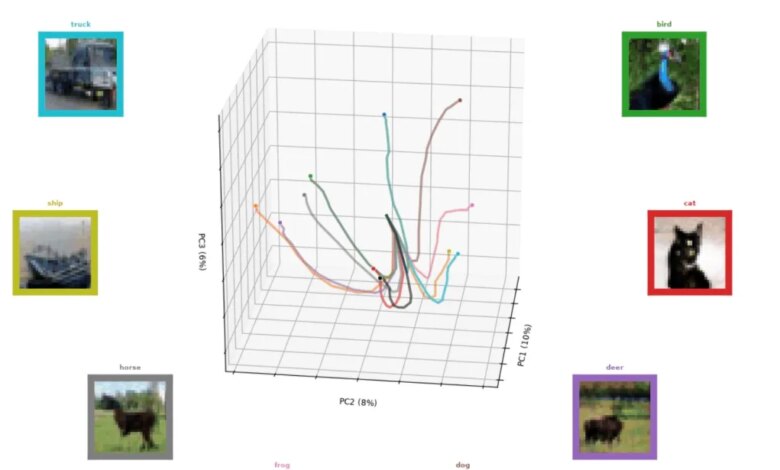
Recently, the company launched its inaugural AI model, designated Un-0, an image-generating tool that marks the first demonstration of how their technology can mirror traditional AI systems. In a recently published research paper, the team discusses their successful creation of a fully operational image-generation model through a software simulation of this new architecture, achieving results comparable to cutting-edge diffusion models.
“This is the initial step towards a new type of computer,” Rao stated. “Expect to see some fascinating developments over the next year.”
The output generated by the Un-0 model is akin to that produced by image-generation models like Stable Diffusion or OpenAI’s GPT Image 1. What sets it apart is the architecture behind it; the model leverages an oscillator-based framework that diverges from the traditional computing chips used in typical models. Rao believes that this innovative computing technique could ultimately decrease power consumption significantly, potentially by a factor of 1,000.
While much of the necessary infrastructure is still in development, the current version of Un-0 operates on a software emulation of Unconventional’s oscillator chips. The company is set to unveil schematics for an actual chip in the near future. Their long-term vision includes constructing a comprehensive inference stack from scratch, with Unconventional AI eventually functioning as a compute provider just like others in the field.
“We are creating a new type of system with our chips,” Rao explained. “AI models will run on this system, where prompts will be input and inferences will be output, all while consuming just 1/1000 of the power.”
This ambitious vision is particularly striking for a startup with fewer than 50 employees. However, given the immense demands of AI development and the expected costs to meet rising inference needs, it may represent one of the few viable solutions to this looming challenge. Rao believes that energy availability will become a critical constraint for AI in the coming years, and Unconventional is poised to tackle this issue head-on.
“Scaling AI is challenging due to energy constraints. This is going to be a fundamental limit in the near future. Ultimately, it’s going to come down to an energy-limited scenario,” he emphasized.