Evaluating Robotaxi Trends: China Emerges as the Front-Runner in the Latest Scorecard

Welcome to TechCrunch Mobility, your go-to destination for developments and insights into transportation’s future. To receive updates directly to your inbox, subscribe to TechCrunch Mobility for free!
Today, we observe Juneteenth, a federal holiday in the United States commemorating the abolition of slavery.
Approximately a decade ago, discussions were rampant about the competition in the autonomous vehicle sector. However, a significant issue with this dialogue was the flawed assumption there would be a singular victor, coupled with a lack of reliable metrics for evaluation. The earlier phase of this industry saw plenty of demonstrations and investments but offered little tangible information available to the general public and analysts.
Advisory and research firm Autnmy AI has launched an innovative AI-driven benchmarking platform designed to assess and rank autonomous vehicle companies in real-time. This week, they unveiled their Road to Autonomy Index, which compiles data from various global public sources, such as federal and state documents, SEC filings, and other public records. The platform evaluates companies based on criteria including operations, scale, revenue, partnerships, manufacturing capabilities, and safety standards, providing updates every 12 hours. It features four indices that categorize and rank robotaxis, autonomous driving licensing firms, self-driving trucks, and delivery robots.
Notably, co-founder Rob Grant emphasized that the AI platform avoids indiscriminate data scraping, stating, “We decided early on that we don’t scrape information. We will utilize publicly available or Creative Commons licensed data, along with some licensed data for which we pay.”
The indices take a global perspective, revealing noteworthy trends. One surprising initial observation was the superior ranking of China’s companies across multiple categories.
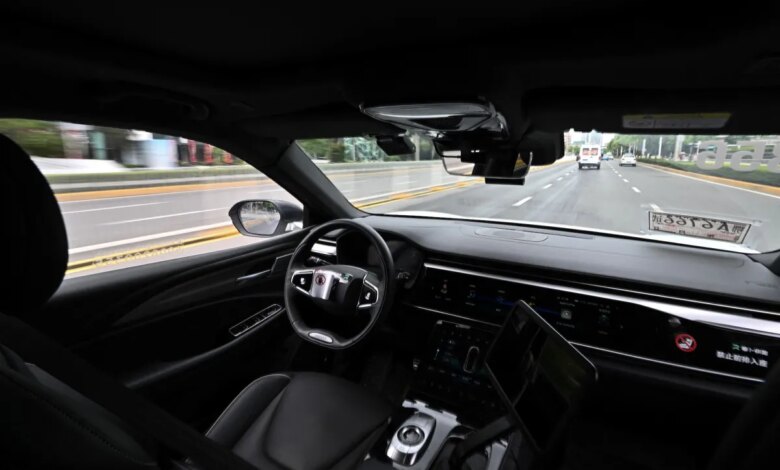
As of recent updates, the leading robotaxi service isn’t Waymo—instead, it’s Baidu‘s Apollo Go in China, closely trailed by Waymo, with Chinese firms Pony.ai and WeRide following. Tesla ranks fifth.
A little bird
A recent tip prompted me to check the Texas automated vehicle tracker, which was launched in May. The information reveals that Tesla, Waymo, and Zoox are expanding their fleets in Texas. However, it’s important to clarify that this growth doesn’t necessarily indicate commercial operation. For example, Zoox requires a federal exemption for commercial use and can currently provide rides without charging.
As of May 28, Waymo had 577 autonomous vehicles registered in Texas, which has now risen to 620, reflecting a 7.5% increase. Tesla’s numbers jumped from 42 to 69, marking a 64% increase. Zoox’s fleet grew from 35 to 43 vehicles.
Avride, Nuro, and Volkswagen’s MOIA maintained their fleets at 317, 47, and 12 vehicles, respectively.
If you have any tips to share, feel free to reach out via email or Signal.
Deals!

Cargofy, focusing on AI to optimize logistics, successfully raised $11 million in a Series A funding round led by u.ventures and supported by other investors.
Carro, an online car marketplace from Singapore, has acquired the Australian used-car platform CarPlace, with the terms remaining undisclosed.
Gatik, which specializes in self-driving trucks for short distances, announced a multi-year collaboration with PepsiCo. The financial specifics of this partnership haven’t been disclosed, but it underscores PepsiCo’s investment in Gatik as they already operate driverless trucks for their products across specific states.
QuantumScape has established a joint research agreement with Honda R&D Co. to expedite the advancement of solid-state batteries and their manufacturing methods.
A partnership between automaker Stellantis, self-driving startup Wayve, and ride-hailing company Uber has been created to co-develop and implement driverless robotaxis.
XDOF, specializing in robot training datasets, secured $70 million from various prominent investors.
Notable reads and other tidbits

A video on Reddit depicted a driver ignoring a stop sign and colliding with an autonomous vehicle in Dallas, which has been confirmed as an Avride robotaxi, called through the Uber app. Avride reported no injuries occurred and stated that incident data is currently under review to enhance their technology and processes.
Tesla owners in China have ingeniously found a way to bypass the company’s distracted driving monitor using small plastic heads.
In other news, a Tesla spotted with a limousine permit sticker for San Francisco County has caught attention. A representative from the San Francisco International Airport clarified that “Teslas have been granted a permit for traditional limousine operations, which require a human driver, and not for autonomous operations.”
Mobileye is transitioning from being an autonomous vehicle tech supplier to stepping into the role of a robotaxi operator, planning to launch a service in an undisclosed U.S. city by 2027. Founder and CEO Amnon Shashua previously emphasized the importance of pursuing robotaxis to achieve true passenger car autonomy.
Uber is preparing to introduce a premium robotaxi service in Houston by mid-2027, marking its second U.S. market venture in collaboration with electric vehicle manufacturer Lucid and autonomous vehicle startup Nuro.
Waymo recently recalled nearly 4,000 robotaxis to prevent them from entering highway construction zones. They previously removed their robotaxis from freeways following the identification of at least 13 incidents where they drove into closed construction areas. A software update is reportedly in development to address this issue.