Enterprises Experience Temporary Setback with Claude Fable 5; New Insights Reveal Two-Thirds Had Already Established Their Hedge Strategy

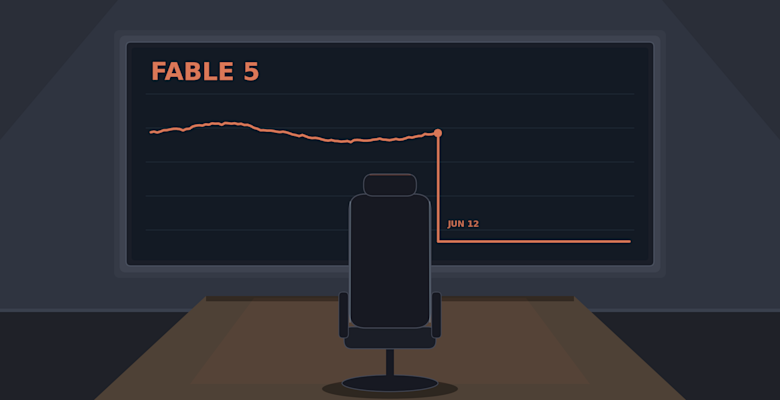
Recent developments in artificial intelligence have highlighted a significant shift in how businesses approach their AI model strategies. A notable case occurred when the U.S. government issued an export control order that abruptly took Anthropic’s Claude Fable 5 model offline without prior notice. This incident underscored the risks associated with vendor dependency in AI, prompting many companies to rethink their strategies.
Following the June 12 order, the Fable 5 model—considered the most advanced in the market—was reintroduced with additional safety measures shortly after a rival, China’s Z.ai, released its own open-weight model, GLM-5.2. Research from VentureBeat Pulse, which gathered responses from 145 enterprises during this tumultuous period, revealed that two-thirds had diversified their AI model strategies prior to the export controls. Specifically, 51% of respondents combined proprietary models with open-weight alternatives hosted on their own infrastructure, while an additional 16% transitioned core processes away from closed APIs entirely.
This disruption spotlighted the broader issue of vendor dependency, raising questions about the ability of companies to monitor the performance of their AI systems once they are active. Alarmingly, only 10% of enterprises reported having automated monitoring systems capable of detecting when an AI model begins to malfunction. Approximately 25% would only become aware of failures if internal or external users flagged them, while 79% of organizations indicated they had already suffered tangible financial or operational impacts due to unmonitored autonomous agents—often stemming from unauthorized AI usage by employees.
This phenomenon has been termed the “Control Gap,” highlighting the disparity between rapid AI deployment and the insufficient oversight and governance structures in place. The incident with Fable 5 served as a real-world stress test for organizations.
About the research: VentureBeat Pulse conducted a survey in June 2026 involving 145 qualified respondents from organizations with at least 100 employees during the Fable 5 blackout era. The respondents included senior technical professionals, directors, and enterprise architects, with more than half working at companies with 2,500 employees or more.
While the sample size is limited, consistent trends in the data underscore a pattern where deployment outpaces governance and visibility. Detailed methodology can be found in the complete report.
How the Fable 5 export order has transformed enterprise AI risk
Launched on June 9 to impressive reviews and unexpectedly high costs, the Fable 5 model quickly faced regulatory intervention just three days later, leading to its suspension for all users—an action Anthropic deemed necessary as it could not confirm users’ nationalities in real-time. Meanwhile, competitors like Z.ai gained traction by launching an open coding environment, Zcode, with OpenAI also teasing advancements in its GPT-5.6 line.
During the preceding spring, many companies began to grasp the financial implications of AI dependencies. For instance, Uber reportedly exhausted its entire AI coding budget for 2026 within just four months due to overwhelming adoption of Claude Code by its engineers. Similarly, Microsoft made adjustments to its internal licensing strategies, shifting focus back to its own tools.
The blackout in June added an important realization: the AI models that underpin essential workflows could suddenly become unavailable due to external circumstances, elevating the urgency for companies to reassess their dependencies. Notably, Chinese firms, such as DeepSeek, continued to release impactful models at significantly lower costs, compounding the competitive pressure.
Brian Craig, Senior Director of Architecture at Liberty IT, shared his real-time learning experience with the export order during a June 24 event. He recognized both the initial excitement and costs associated with Fable, but noted they were fortunate to have minimal prior reliance on it before its abrupt removal.
Mitigating risks before the blackout occurred
Liberty IT is structured to adapt to such disruptions, employing what they refer to as an AI backbone, consisting of around 50 interchangeable components that address security, governance, and orchestration. “In today’s landscape, it’s crucial not to become locked into a single vendor or framework,” Craig emphasized, advocating for flexibility in selecting AI models based on their reliability over time.
Echoing Craig’s sentiments, survey data revealed that a significant portion of enterprises (51%) operates under a hybrid model, using proprietary solutions alongside open-weight alternatives, while 16% are transitioning to fully self-hosted open-weight models. Another 32% acknowledged their commitment to closed platforms due to perceived benefits despite the rising concerns highlighted by recent events.
In terms of vendor reliability, trends suggest companies are more willing to make cutbacks. When asked which primary AI vendor they might downsize over the next year, 30% identified Microsoft, primarily citing a shift away from Copilot and Azure frameworks. Notably, OpenAI and Anthropic also faced scrutiny, while Google remained largely unaffected.
Detection failures in production AI models
Understanding how organizations ensure their production AI models remain effective is critical. When queried about their confidence in detecting unnoticed model failures, a prominent 40% of enterprises expressed assurance, mainly relying on manual reviews by team members. Only 10% of enterprises employed automated systems for monitoring model performance. The remaining respondents displayed weaker positions, with many acknowledging reliance on eventual discovery by users or lacking any visibility altogether.
The reliance on manual reviews poses challenges, as it does not capture the entirety of an AI model’s outputs and suffers from inherent delays and inconsistencies. Automated monitoring, in contrast, continuously evaluates AI outputs for anomalies, representing a more robust strategy akin to how enterprises upgraded their approaches to operational stability and security a decade ago.
Industry leaders emphasized the importance of integrating human oversight within a framework of automation. Despite some organizations opting for manual clearance processes, the disparity in foundational tools suggests a gap in governance for many, particularly those lacking observability capabilities.
Organizational barriers to AI governance
Respondents highlighted insufficient organizational structure as a primary obstacle in AI governance. The most frequently cited barrier was the lack of a designated owner for AI governance (32%). Additional concerns included vendor opacity and inadequate tooling. A significant majority (38%) indicated the presence of a central team for AI governance, while others experienced unclear ownership or no designated accountability.
The complexity intensified as most enterprises operated multiple AI platforms, each claiming to be the principal layer. A mere 8% had consolidated their AI initiatives under one umbrella, leading to fragmented oversight. In free responses, many expressed desires for a centralized owner to manage AI governance comprehensively.
Financial repercussions from lack of control
The financial impact of these discrepancies is evident in corporate expenditures. Shadow AI—unauthorized and unmonitored AI usage by employees—was cited as the most noticeable operational failure by 49% of enterprises. Some reported incidents of unregulated AI use leading to significant, unexpected expenses due to excessive token consumption.
Only a minority reported systems with adequate controls to mitigate such risks. Overall, 79% of respondents confirmed they had incurred financial losses due to AI governance failures.
Importantly, the cost efficiency of AI workloads is also decreasing, which may fuel future financial pressures. Experts advocate right-sizing workloads by ensuring models are appropriately tailored to their purpose, thus avoiding unnecessary expenses on high-capacity processing.
The survey results indicate a rapid shift towards addressing model dependency issues. While two-thirds of enterprises are taking steps to diversify their AI strategies, substantial gaps remain in internal governance frameworks, including accountability and monitoring systems. As companies continue to evolve their AI practices, the implications of these findings could pave the way for more thoughtful governance and operational strategies.
A forthcoming research initiative aims to evaluate whether organizations have made strides in establishing ownership and installing sophisticated monitoring systems in response to recent challenges.