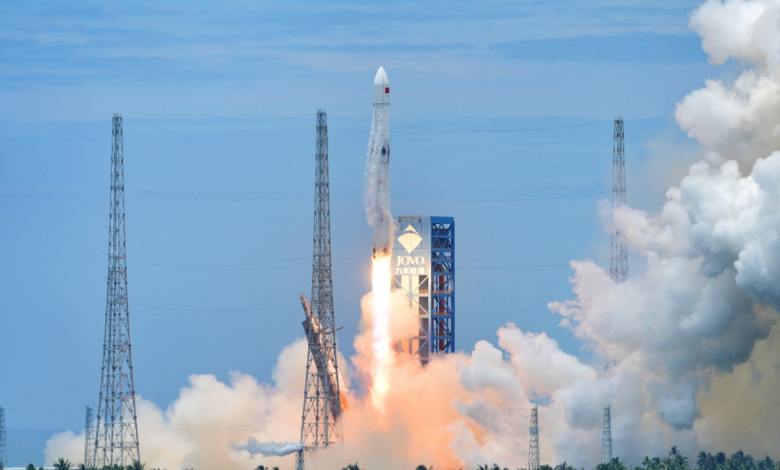
China’s state-run aerospace organization has successfully launched a Long March orbital rocket and successfully landed the booster on a maritime recovery vessel, making it the second nation to accomplish this milestone.
This operation, conducted on Friday, demonstrates that the China Aerospace Science and Technology Corporation (CASC) is preparing to achieve a significant advancement in space technology similar to that of SpaceX: the reuse of rocket boosters to significantly reduce the costs of spacecraft launches. CASC plans to attempt reusing the booster, which has a payload capacity comparable to SpaceX’s Falcon 9, by the end of this year.
Unlike SpaceX, which deploys landing legs to guide its rockets onto a floating platform, China utilizes netting stretched across a large frame on a recovery ship to catch the descending rocket. Successfully landing the rocket back on the ship relies on advanced guidance software, reliable sensors, and engines that are robust enough to withstand the challenges of re-entering the atmosphere.
SpaceX continues to set launch records each year with its fleet of reusable Falcon 9 boosters. This vehicle supports not just the company’s Starlink satellite system—essential for economical and frequent access to space—but also its contracts with NASA and the U.S. Space Force.
Victoria Samson, the director for Space Security and Stability at the Secure World Foundation, referred to the launch as a “significant game changer.” She noted that once China masters booster reuse, it could drastically lower launch costs, allowing the country to use this technology for diplomatic outreach by offering inexpensive launch options for prospective allies.
China is unlikely to compete directly with SpaceX for commercial launch clients due to national security regulations that largely divide the global rocket market between the U.S. and Europe on one side, and Russia and China on the other.
However, the capability to reuse rockets could position China’s satellite communication systems and potential orbital data centers as competitors to SpaceX services.
Such competition would pose a challenge to Starlink’s growth in international markets, particularly in regions like Africa, the Middle East, and Southeast Asia. For the U.S. military, this development could lessen its advantages in space operations. This booster recovery occurs shortly after reports indicated that China and Russia are collaborating on strategies to undermine Starlink’s effectiveness, particularly highlighted by its role in Ukraine.
In contrast, SpaceX is also preparing to fly its much larger Starship rocket, despite previous attempts yielding mixed results. Musk’s company is expected to make another launch attempt this month, following a seemingly successful static fire test of the massive booster.
In the U.S., other companies are also in the race to develop reusable rockets. Notably, Blue Origin, founded by Jeff Bezos, successfully recovered a booster in 2025, reusing it early this year, although it faced a setback when one of its rockets exploded on the launch pad in May, putting further attempts on hold. Rocket Lab is working on its Neutron vehicle, designed to operate with a reusable booster, while Stoke Space is developing a fully reusable rocket that it aims to test within the year.