Beyond Size: 4 Midsize Pickups That Handle the Heavy Lifting Better than Full-Size Trucks

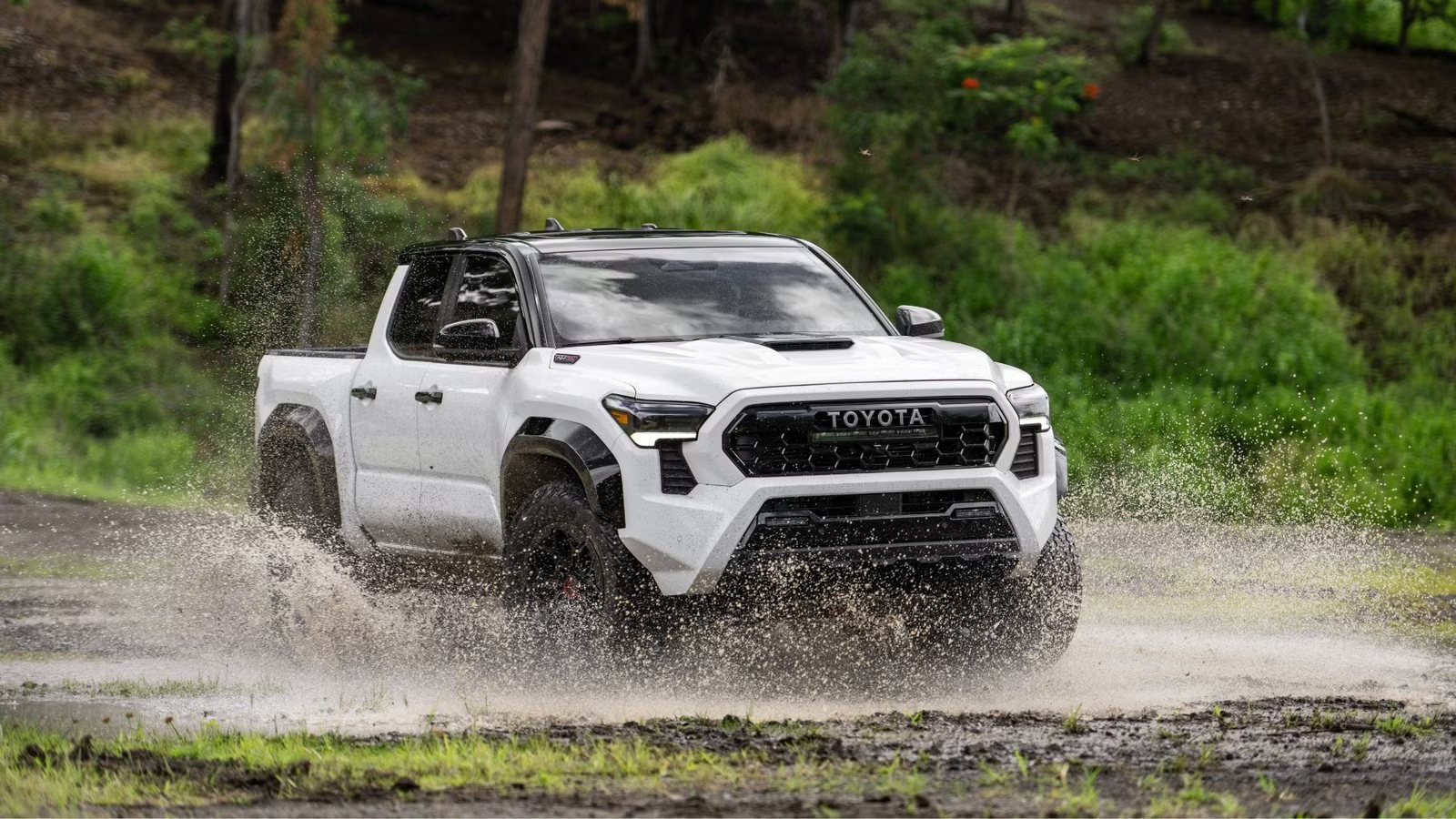
The midsize pickup market finds itself in an interesting position, being both widely popular and somewhat overlooked. In the year 2025, Toyota reported sales of nearly 275,000 Tacomas in the U.S., even surpassing the Corolla in sales. However, it’s the larger full-size and heavy-duty trucks that attract the most attention, often due to their impressive towing capabilities and robust power outputs.
In the past, opting for a midsize pickup meant making significant compromises. Customers needing substantial payload capacity, spacious interiors, or enough power for towing typically turned to full-size models. Midsize trucks were often seen as less capable or merely budget-friendly versions of their larger counterparts. Fortunately, this perception has changed.
To demonstrate that larger is not always synonymous with better, we spotlight four exceptional midsize pickups that provide impressive capabilities without requiring the jump to a full-size truck. Each vehicle takes a unique approach, but all convincingly argue for the benefits of downsizing while retaining the utility and versatility beloved by truck owners.
4
Toyota Tacoma
Robust capability without the drawbacks of larger trucks
Toyota’s Tacoma is a perennial favorite, consistently selling over a quarter-million units annually. Its strong reputation for durability plays a crucial role in its appeal, but it’s the combination of essential capabilities and everyday usability that secures its title as America’s top midsize pickup.
The base SR model can easily manage over 1,400 lbs. in the truck bed and boasts a towing capacity of up to 3,500 lbs., accommodating weekend projects, motorcycles, and small trailers effortlessly. Upgrade to the TRD PreRunner, and that tow rating increases to an impressive 6,500 lbs., suitable for many campers and boats, all while remaining competitively priced compared to many full-size options.
For off-road enthusiasts, the Tacoma TRD Pro offers even more. Its i-FORCE MAX turbocharged hybrid setup generates 326 horsepower and an impressive 465 lb-ft of torque, achieving a commendable EPA rating of 23 mpg combined. The vehicle’s specialized FOX QS3 shocks and off-road enhancements allow it to navigate challenging terrains where many larger trucks might struggle. Plus, it doesn’t compromise on comfort, featuring heated and ventilated seats, dual-zone climate control, and numerous premium amenities.
In many cases, a recent Toyota Tacoma can fulfill all the requirements for truck ownership and more.
3
Ford Ranger
A midsize truck with the spirit of an F-150
My fondness for the Ford Ranger runs deep, stemming from high school memories when a friend drove us in his 1988 model to graduation. The 2026 iteration, however, brings substantial advancements in comfort, efficiency, capability, and technology.
While the Ranger Raptor is appealing, the focus here is on the XL, XLT, and Lariat models. Each of these configurations can tow an impressive 7,500 lbs., rivaling capabilities of older full-size trucks. With payload capacities ranging between 1,513 and 1,767 lbs., this midsize truck proves to be remarkably maneuverable, despite being approximately two feet shorter than an F-150 Super Crew with a 5.5-foot bed.
For most owners not regularly pushing a half-ton truck’s limits when towing, the Ranger delivers ample capability without the added size, cost, or inconvenience of larger rivals.
2
Chevrolet Colorado
The king of capability
Under the hood of every 2026 Colorado is Chevrolet’s TurboMax 2.7-liter turbocharged four-cylinder engine, which produces an impressive 310 horsepower and a robust 430 lb-ft of torque. When equipped correctly, it can tow up to 7,700 lbs., surpassing the capacities of all the other trucks mentioned. Additionally, it can handle a payload of 2,046 lbs., making it a standout in this category.
Beyond raw capability, the Colorado is user-friendly and offers a comfortable ride. Its size allows it to fit where larger trucks struggle, and it is available in various trims, from practical work variants to the capable ZR2 model designed for off-road adventures. This versatility makes it a strong contender for buyers seeking significant towing and hauling capacity without the bulk and fuel consumption of full-size pickups.
1
Honda Ridgeline
The smartest choice for daily life
Among this selection, the Honda Ridgeline stands out as the most car-like truck. However, its payload and towing capacities are relatively modest; it maxes out at 5,000 lbs. for towing and a payload range of 1,509 to 1,583 lbs. For many, though, these specifications are just enough.
The Ridgeline offers limited configuration options, coming with a standard 5.3-foot bed, four doors, five seats, and a 280-horsepower V6 engine. It also delivers respectable on-road performance, with a 0-60 mph time of about six seconds. For weekend escapades, Honda’s innovative in-bed trunk provides secure, weatherproof storage, while the dual-action tailgate simplifies loading and unloading tasks.
If your truck is more frequently engaged in commuting, errands, and weekend projects rather than heavy towing, the Ridgeline could very well be the optimal choice within this segment.
Why opting for less truck can be smarter
Modern midsize trucks are capable of towing impressive weights, carrying substantial payloads, and tackling challenging terrains while serving as comfortable daily drivers. They offer benefits such as lower purchase prices compared to full-size models, easier parking, and better maneuverability in tight spaces. While full-size trucks are excellent choices for some, they can often be more than what buyers truly need.
Whether you appreciate the Tacoma’s reliability, the Ranger’s towing capabilities, the Colorado’s overall versatility, or the Ridgeline’s practicality, these four models showcase that bigger does not always mean better.