For those looking to create products in space and bring them back to Earth, options are limited: travel to the International Space Station or collaborate with select start-ups that operate spacecraft in orbit before returning.
Currently, the most frequently used vehicle for space travel and return is the SpaceX Falcon 9 rocket booster, which completed 163 round-trips last year and has already surpassed 100 missions this year. A new start-up has managed to engage with Elon Musk’s company to test an orbital semiconductor manufacturing facility over a series of flights using this booster.
Besxar, created by ex-OpenAI employee Ashley Pilipiszyn, aims to produce essential components for advanced semiconductors by utilizing the vacuum of space. One of the significant challenges in creating chip fabs on Earth is the need for carefully controlled cleanrooms to eliminate microscopic dust that could compromise semiconductor quality. Pilipiszyn believes that using the conditions in space could alleviate this requirement, and to pursue this aim, she has secured nearly $14 million in funding, including a $9 million investment led by Dauntless Ventures and Overture VC.
“We are at a point where operating in space is becoming more cost-effective,” she stated. “Instead of battling earthly physics, let’s utilize the environment that already favors our objectives.”
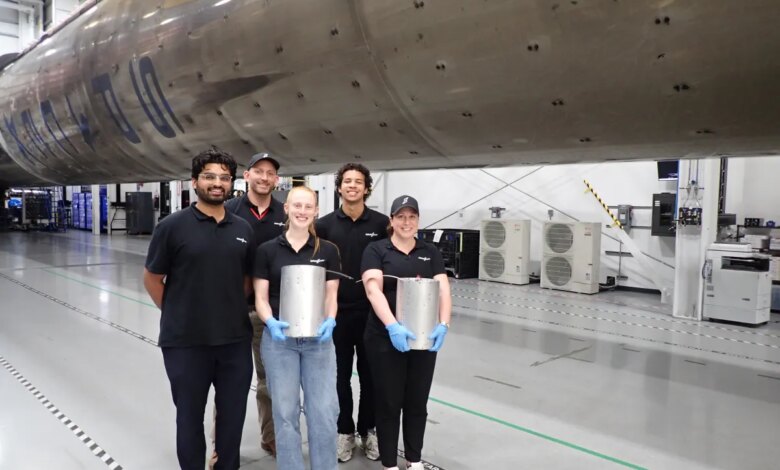
The company’s initial “fabships”—small containers designed for testing semiconductor materials in orbit—successfully launched on a Starlink mission in July. Their primary goals were to ensure the canisters could survive launch, shield wafer samples from contamination, and expose them to the vacuum of space. Despite facing a technical issue with one canister’s flight data system, Besxar confirmed the success of their objectives.
“The samples from our flights maintained superior cleanliness, showing less particulate matter than those produced on Earth, which is encouraging as we continue to scale,” Pilipiszyn remarked.
Besxar plans to keep refining its approach over the next two years, with aspirations of deploying larger fabs aboard SpaceX’s next-generation vehicle, Starship, currently under development. Pilipiszyn reached out to SpaceX three years ago to negotiate flights on Starship and eventually opted for the booster payload strategy to mitigate risk. The subsequent steps include heating the wafers and incrementally adding different materials.
Once capable of producing qualification samples, Besxar—named after “beskar,” the fictional metal from Star Wars used in Mandalorian armor—wants to supply top chip manufacturers with wafers essential for advanced chips that manage electrical power in data centers, robotics, and electric vehicles.
Several companies are exploring the unique benefits of the space environment for producing higher-quality semiconductors, including United Semiconductors and Space Forge. However, all face similar challenges concerning the ability to return significant product quantities to Earth. Pilipiszyn envisions ramping up production to hundreds and eventually thousands of wafers per fab, contingent upon the availability of affordable rocket launches. This may hinge on the prompt operational readiness of SpaceX’s Starship or the successful launches of next-gen rockets from competitors like Rocket Lab and Stoke Space.
“We believe we now have a reliable transport layer, allowing us to concentrate on manufacturing and swiftly delivering our products back to market,” she concluded.