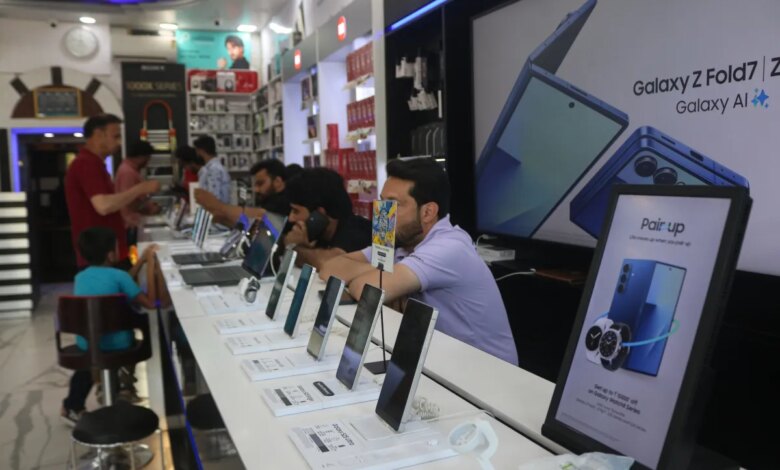
In response to analysts predicting the impact of AI-driven demand for memory chips on consumer electronics, India is now showcasing the reality of this disruption with smartphone prices on the rise.
The memory chips in focus—such as RAM and storage components—are essential for tech giants that need them in large volumes for AI data centers. Companies like Samsung, SK Hynix, and Micron are reallocating production capacity to high-bandwidth memory, which proves to be significantly more profitable than standard memory used in mobile devices and laptops. This shift is resulting in reduced capacity for everyday electronics, leading to increased prices.
As the second-largest smartphone market globally, India has experienced a 10% year-over-year decline in smartphone shipments during the April to June quarter, according to market research from Counterpoint Research. This represents the most substantial June-quarter drop in six years, driven primarily by rising memory costs which have inflated handset prices.
India’s decline stands in stark contrast to China, where smartphone shipments only fell by 2% in the same period. A significant factor for India’s steeper decline is that 60% of its smartphone market falls within the sub-₹20,000 (under $210) category, where the impact of increased memory costs hits hardest, according to Tarun Pathak, vice president of research at Counterpoint.
India has been a significant market for many global smartphone brands, housing over 1.4 billion residents and more than 700 million smartphone users. This makes it a critical indicator of consumer trends in price-sensitive markets, which attracts attention from device manufacturers, chip suppliers, and investors observing the overall health of the AI supply chain.
Pathak mentioned that although consumers are unlikely to completely forgo smartphones, many may postpone upgrades, extending replacement cycles from 3.5 to around four years. Premium brands like Apple and Samsung appear to be better shielded from this slow down.
The current market conditions are reshaping competition among smartphone manufacturers. Samsung is one of the few major brands to report shipment growth in India during Q2, with a 2% increase year-over-year. In contrast, Apple experienced a 3% drop in shipments, mainly due to supply chain constraints and limited inventory.
Consumers opting for higher-end smartphones seem less affected by price hikes, as financing options make these devices more accessible, according to Prachir Singh, a senior analyst at Counterpoint.
However, the situation is dire for budget smartphones, with shipments below ₹15,000 (under $150) plummeting by 45% compared to last year. This has significantly reduced the market share of Chinese brands that heavily target entry- to mid-tier smartphones.
In light of these conditions, strategic adjustments are underway. Recently, Chinese smartphone maker OnePlus announced plans to halt new product launches in Europe and North America while focusing on its Indian market after analyzing current performance. Data indicates that China’s share of OnePlus’ global shipments rose to 74% in Q1, while India’s share dropped from 30% to just 19%.
Essentially, OnePlus is retreating to markets where profitability is feasible, and this trend may be replicated by other budget-conscious brands as their profit margins diminish.
Pathak emphasized the challenge of maintaining multiple sub-brands, pointing out that without sufficient volume to cover shared expenses, this strategy becomes untenable. “Profitability is crucial in defining market operations,” he explained.
Consumers Feel the Squeeze
The pressures on brands are directly affecting consumers. Kiranjeet Kaur, IDC’s associate research director for mobile phones, noted that India’s smartphone market is transitioning from volume-driven growth to value growth, meaning fewer phones are being sold overall, yet each device yields higher revenue due to increased component costs rendering lower-priced smartphones less viable.
This rise in component costs is manifesting in price increases for consumers, with smartphone prices in India climbing between 4% and 68%, as reported by Pathak. As a reaction, buyers are opting for higher-end models, delaying upgrades, or exploring secondhand options.
Financing has become crucial for making expensive devices manageable, adds Kaur, noting that brands and retailers are stocking up in anticipation of the festive season to secure lower prices before further hikes.
According to IDC, India’s smartphone shipments are projected to decline by double digits in Q2, which is a sharper decrease than the 4.1% decline and the 5.3% drop in the previous quarters. However, Kaur remarked that their estimates are still in progress.
Kaur anticipates that memory shortages and inflated smartphone prices will likely continue until at least late 2027, although the rate of price increase may slow down as consumers become accustomed to the new pricing landscape.
“Indian consumers are facing a dual challenge, as a weaker currency exacerbates import costs, adding to pressure on market players who are passing these costs onto customers,” Kaur emphasized.