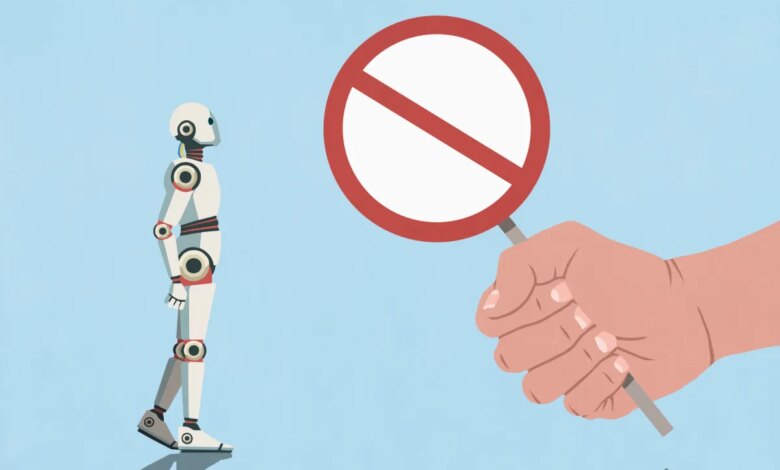
Pope Leo XIV has expressed concerns about artificial intelligence (AI) as a potential threat to human dignity, prompting discussions beyond religious circles. David Durman, a Humanist who does not adhere to any theistic beliefs, has recently obtained a religious exemption allowing him to avoid using AI in his workplace.
“Humanism encompasses a philosophy centered on the human condition and our interactions with the world,” stated Durman, who serves as an administrator at the University of Kentucky. He emphasized that it focuses on enhancing “human well-being and flourishing—individually and collectively” and encourages individuals to strive for the betterment of themselves and those around them.
As AI’s presence in everyday life continues to rise, Durman approached the American Humanist Association (AHA), a nonprofit that promotes secular humanism, to explore how he might obtain legal safeguards against the mandatory use of AI in his job. He believes that employing such technology contradicts his core beliefs.
“Our moral actions towards ourselves and others are cultivated through the active use of our intellect, and relying on AI diminishes our ability to do so,” he remarked, noting concerns about the potential impact on critical thinking from excessive dependence on AI.
In a recent AHA statement, Durman asserted, “AI disrupts people’s ability to earn a living, poses significant environmental threats to humanity and our planet, and its encroachment on human creativity jeopardizes vital cultural facets like art and literature that help society thrive.”
Humanism is not opposed to religion; rather, it often resonates with individuals who are skeptical of a deity or supernatural entities while seeking a scientific and ethical framework for their lives.
“Concerns regarding AI and human dignity traverse various faiths and philosophies, including Catholicism, Universalism, and Humanism. We want Humanists and nontheists to realize they also hold legal protections in the workplace,” remarked Alexandria Huiskens, Staff Attorney at the AHA.
Durman is pioneering in securing workplace exemptions that permit him to refrain from using AI technology, becoming one of the first individuals to publicly share his quest for such protections. His inspiration came from Erin Maus, a Unitarian Universalist software engineer who successfully obtained similar accommodations.
“This matter pertains to my beliefs,” Durman explained. “I’m not prescribing how others should think or feel… but I hope this motivates others with similar concerns to seek resolutions tailored to their needs.”
A spokesperson for the University of Kentucky, Jay Blanton, stated that the institution evaluates requests for religious accommodations one by one, taking into account the nature of the job and the circumstances surrounding each request.
“In this instance, the university decided that it could provide an accommodation that would allow the employee to fulfill the core responsibilities of their role,” Blanton affirmed. “As technology and job duties evolve, accommodations may be reassessed to ensure they remain practical and effective.”
Maus’ experience is particularly noteworthy as it is becoming uncommon for software developers to write code without AI tools. However, in Durman’s administrative capacity, which involves assisting researchers with grant applications, he has not been required to adopt AI. Since some colleagues and supervisors have encouraged experimenting with these technologies, he sought his exemption preemptively in case such suggestions become compulsory.
“I hope others with similar sentiments feel inspired to seek solutions,” Durman expressed.