Introducing PNOE’s Innovative Face Mask: Revolutionizing Lab-Quality Breath Testing for Personal Use

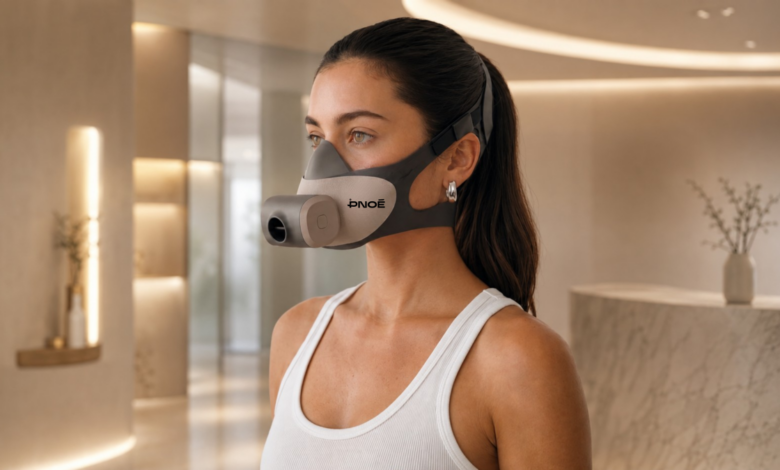
Upon first glance, the latest gadget from PNOĒ might remind one of a superhero movie villain. This mask, which covers the nose and mouth and fastens around the head, bears a resemblance to Bane’s mask from Batman. However, its objective is quite straightforward: it tracks oxygen intake and carbon dioxide output, translating these metrics into guidance on diet, exercise, and ultimately, longevity.
Based in Malden, Massachusetts, with operations in Athens, Greece, PNOĒ is set to release the PNOĒ 2.0 on October 1. A significant upgrade from its predecessor is the ability for users to perform the metabolic test independently. Co-founder and CEO Apostolos Atsalakis mentioned that one can simply enter a gym, wear the mask, press a button, sit down, and breathe for eight minutes. “It’s that simple,” he explained during a recent video call from Athens.
This is a crucial improvement because the existing model necessitates a trained operator, which restricts its availability. A self-administered option could make it viable for gyms without specialized staff and even pharmacies, according to Atsalakis.
The principles behind PNOĒ are not novel. For over a century, metabolic testing has been utilized to analyze respiratory gases to understand how the body generates energy. It has long been regarded as the benchmark for assessing VO₂ max, the highest rate of oxygen consumption during exercise, serving as a key indicator of cardiorespiratory fitness. Historically, such tests relied on hefty and costly machinery typically found in sports laboratories and hospitals, which is why they were mostly used by elite athletes and executive wellness programs.
What PNOĒ brings to the table is similar accuracy in a portable format, accompanied by software that converts results into actionable insights. “We aimed to make it accessible to everyone,” Atsalakis said.
The company claims its test identifies 23 biomarkers, assessing factors such as resting metabolic rate (the amount of calories burned at rest) and metabolic flexibility (the capability to switch between fat and carbohydrate burning). Atsalakis believes these data can address queries that blood tests cannot, such as determining caloric needs or optimal training methods.
The timing for PNOĒ is fortuitous, as VO₂ max has gained traction among those interested in longevity due to research connecting improved cardiorespiratory fitness with reduced mortality rates. Atsalakis describes VO₂ max as a vital predictor of human lifespan, and views his company’s data as an indicator in the rapidly growing wellness sector.
The new device is designed to be more compact and reliable than previous versions, featuring fewer components. According to Atsalakis, this reliability stems from extensive collaboration with Milan’s Design Group Italia, given that a self-administered metabolic testing device was unprecedented.
Additionally, it tackles a potential concern for post-pandemic users regarding mask hygiene. The electronics can detach from the silicone mask and straps, allowing different users to share the expensive hardware while each maintains their own personal mask.
In spite of its health-oriented goals, PNOĒ is cautious with its claims. The device hasn’t received clearance from the U.S. Food and Drug Administration, and Atsalakis specified that “we do not provide medical recommendations.” Instead, the device is categorized as a wellness tool. “It’s akin to a body composition analyzer or a scale,” he remarked. “Doctors cannot prescribe medication based on our findings.”
However, future developments could alter this landscape. Ongoing research delves into how components in human breath may indicate diseases like cancer, and Atsalakis is optimistic that the growing repository of data could help identify health concerns eventually. Yet he recognizes that achieving full diagnoses is “definitely a couple of years away,” given the potential regulatory challenges extending this timeline. “We’re not there yet,” he acknowledged.
PNOĒ’s origins trace back to Atsalakis’s doctoral studies in sensing technologies at the University of Cambridge, where his interest in wearables and breath analytics began. He co-founded the venture with childhood friend Panos Papadiamantis, who now serves as the company’s chief product officer.
Participating in Y Combinator’s Winter 2019 batch was significant for the startup, especially as interest in “longevity” was less pronounced at the time. Since then, the company has raised approximately $22 million, including a recent $11 million funding round from investors such as 50 Years and Google Maps co-founder Lars Rasmussen, who is currently based in Athens.
PNOĒ sells to businesses, enabling them to offer the test to consumers. Its clientele includes Equinox, with the service available at nearly all its locations, in addition to Four Seasons hotels, Red Bull, the NBA, the Mount Sinai Health System, and the med spa Restore Hyper Wellness.
About 85% of PNOĒ’s revenue is derived from the U.S., which Atsalakis described as the most advanced global market for longevity. The company is now looking to expand within Europe and through partners in Latin America and Asia.
Subscriptions for businesses range from $400 to over $1,000 per month, covering hardware, software, training, and promotional materials— a comprehensive package Atsalakis refers to as a “business in a box.” PNOĒ also connects its findings with the services businesses offer, allowing gyms or spas to recommend specific treatments based on customer tests. Many clients utilize the test during initial onboarding, placing it between comprehensive clinical assessments and smartwatch estimations.
This niche is becoming increasingly competitive. Companies like Apple, Garmin, and Whoop provide VO₂ max estimates using heart rate metrics, while devices like Lumen assess breath to estimate fat and carb usage. Meanwhile, traditional metabolic carts maintain their position as the gold standard in laboratory and hospital settings.
PNOĒ, which employs 110 staff members, reports that it has recently become profitable and is growing at a rate exceeding 100% annually. Atsalakis mentioned plans for a Series B funding round in the next six to twelve months as the company aims to place its mask in front of more users.