Nexterity Aims to Revolutionize Pipefitting by Automating Its Most Challenging and Hazardous Aspects

Lindsey Elliott has a keen interest in bolting technology. At last year’s 13th annual Bolting Symposium, she noted that a standout moment was engaging in “Bolting Bingo” with fellow enthusiasts, affectionately dubbed “torque dorks.”
A former engineer and planner with ExxonMobil, Elliott has dedicated many years to enhancing the systems that transport oil, gas, and petrochemicals. Her focus has turned to bolts, specifically those that secure pipe sections, known as “bolted flange joints.” The process of tightening and loosening these bolts is labor-intensive and is a common source of injuries among pipefitters. Additionally, as in many trades, the industry is currently facing a shortage of skilled labor.
“Working 12-hour days for three consecutive months can be exhausting for these workers,” she shared. “Interviews with pipefitters across the U.S. and Canada have revealed that productivity in North American pipefitting is notably low.”
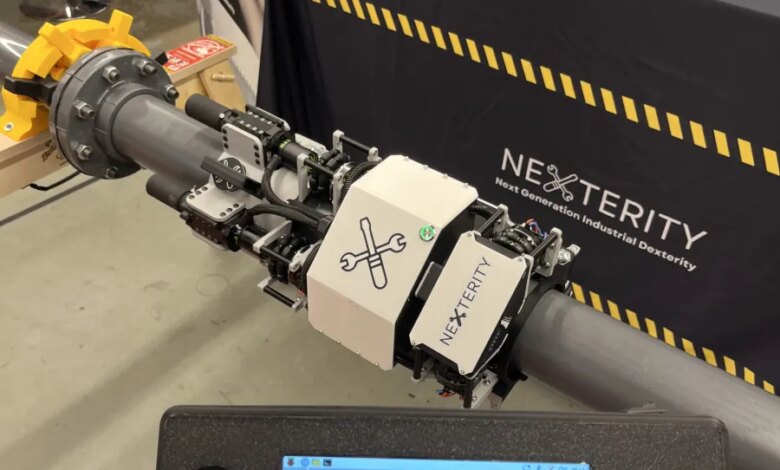
At her startup, Nexterity—selected for the Startup Battlefield 200 at TechCrunch Disrupt—Elliott has developed a solution: a remote-controlled robot designed to perform this challenging work. If adopted widely, this innovation could significantly enhance job safety and efficiency in this labor-intensive field.
Essentially, think of it as increasing intelligence while reducing manual torque.
The robot comprises two main sections that can be attached around a pipe. Powered by batteries, it can maneuver along the pipe and efficiently loosen and tighten up to four bolts simultaneously.
Elliott mentioned that Nexterity has created several robot configurations to accommodate different standard pipe sizes, all compact enough to fit in a Pelican case for easy transport by a single worker. This portable design aligns with Nexterity’s strategy of treating the robot as rental equipment for construction tasks.
The design of the robot emerged from discussions over several years—not only at the Bolting Symposium but also with the Pressure Vessels & Piping Division of the American Society of Mechanical Engineers.
“Conversations with these torque dorks have revealed that a significant 80% of our pipes range between two to eight inches in diameter, referred to as NPS2 to NPS8,” she explained. “Such consistency makes it an ideal candidate for automation.”
Elliott considers this concept straightforward yet believes it holds considerable potential.
“I think many would be surprised by the size of this market,” she stated. “We may not think about piping infrastructure in our daily lives, but it’s essential across various sectors, including water services, wastewater management, food and beverage, mining, nuclear energy, and any form of sustainable manufacturing—all of which rely on the same piping systems.”