Central Eurasia Unveils 2026 Battlefield Champions: Cerberus, WeGlobal AI, and LOOQ Take the Crown

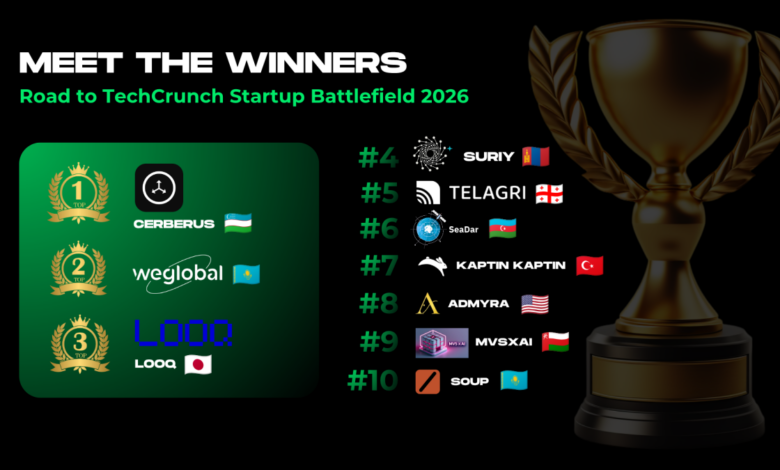
Cerberus, WeGlobal AI, and LOOQ have secured the top three positions in the regional final of the Road to TechCrunch Startup Battlefield 2026. These startups will represent Central Eurasia at the Startup Battlefield 200 during TechCrunch Disrupt 2026, taking place in San Francisco from October 13-15, where over 10,000 tech leaders will be present. The trio was selected from 22 finalists, which were among a record 726 applications submitted from 39 different nations.
The Road to TechCrunch Startup Battlefield was organized by Silkroad Innovation Hub in collaboration with TechCrunch, Freedom Holding, Astana Hub, and IT Park Uzbekistan. This year’s event saw nearly 50% more applications compared to its debut in 2025, which had 485 submissions from 27 countries. Various national competitions led to 22 finalists who pitched live before a panel of 47 judges from eight countries, with an AI judge, AI-Dana, also participating for the second consecutive year.
“This year’s Road to Battlefield experienced an unprecedented number of applications and represented more countries than ever before. The pitch presentations covering diverse areas such as health tech, education, productivity, enterprise, and cybersecurity were both innovative and impressive,” stated Isabelle Johannessen, the head of the Startup Battlefield program at TechCrunch. “These founders are gaining international visibility at TechCrunch Disrupt, which sends a powerful message: Local building can lead to global scaling. This visibility acts as a catalyst. Road to Battlefield illustrates that this ecosystem is flourishing and that local founders have a legitimate chance to compete globally.”
This year’s competition was dominated by AI-focused startups, with 84% of the 726 applicants developing AI solutions. The winners exemplify this trend: Cerberus focuses on security vulnerabilities; WeGlobal AI addresses mental health and career guidance for students; and LOOQ creates hardware to analyze the engagement with advertising displays.
“The caliber of applications was notably high this year, making the selection process extremely challenging,” commented Asset Abdualiyev, founder and CEO of Silkroad Innovation Hub. “From the outset, Road to Battlefield’s goal has been to provide talented innovators a platform for visibility, feedback, and connection to opportunities beyond their regions. We involved seasoned VCs and tech leaders to facilitate these interactions. The best teams emerged to the finals, and we are thrilled to have TechCrunch alongside us in establishing this global pathway.”
Other notable finalists included Suriy (Mongolia), TelAgri (Georgia), SeaDar (Azerbaijan), Kaptın Kaptın (Turkey), Admyra (U.S.), MVSxAI (Qatar), and Soup (Kazakhstan).
The Winners
Cerberus (Uzbekistan)
Cerberus, the first-place winner, is a cybersecurity startup utilizing AI to autonomously identify weaknesses in corporate IT infrastructures. The company aims to tackle the challenges present in current AI-based security tools, which often rely on general language models prone to errors that could lead to serious issues in corporate settings. Cerberus has participated in 500 Global Eurasia and secured a place in the Alchemist Silkroad — Silicon Valley Residency program.
“We were grateful to be part of Road to Battlefield. Competing against such a large number of applications was rewarding in itself, regardless of the result,” remarked Aziz Akhmedkhodjaev, founder and CEO of Cerberus. “Our pitch stood out because we address an urgent market issue: As AI becomes ubiquitous in coding, vulnerabilities arise faster than they can be identified. We believe the judges recognized this urgency, and we see it as a significant responsibility to represent our region well.”
This win signifies Uzbekistan’s first champion at the Road to TechCrunch Startup Battlefield, as the nation strives to enhance the visibility of its burgeoning tech industry on a global platform.
“Uzbekistan’s startup landscape has evolved considerably over recent years,” stated Sherzod Shermatov, the Minister of Digital Technology of Uzbekistan. “Founders are now developing sophisticated technology products with a global mindset. Cerberus advancing to TechCrunch Startup Battlefield 200 exemplifies this growth and provides a vital opportunity to showcase what Uzbek founders can create to the international tech community.”
WeGlobal AI (Kazakhstan)
Our second-place title went to WeGlobal AI, which aims to address the shortage of school psychologists in Kazakhstan. They provide AI-driven tools for educational institutions to monitor student mental health and offer career guidance on a large scale that traditional hiring cannot match.
“Participating in the Road to Startup Battlefield was an enriching experience for our team,” shared Bolat Ashim, co-founder and CEO of WeGlobal AI. “The national and regional rounds compelled us to refine our narrative and engage with outstanding fellow founders. Securing second place and the chance to participate in TechCrunch Startup Battlefield 200 is a significant milestone for us. We’re eager to present what we’re developing at WeGlobal AI to the global tech community.”
WeGlobal AI’s achievement aligns with Kazakhstan’s strategic digital agenda, which emphasizes AI and aims to connect more tech enterprises with international markets.
“AI offers countries like Kazakhstan opportunities to compete globally in ways previously unimagined,” noted Zhaslan Madiyev, the Deputy Prime Minister and Minister of Artificial Intelligence and Digital Development in Kazakhstan. “Our goal is to ensure that talented founders have the necessary infrastructure, skills, and international connections to seize these opportunities. The Road to Battlefield serves as a vital link between Kazakhstani entrepreneurs and the worldwide tech ecosystem.”
LOOQ (Japan)
LOOQ, co-founded by Ayan Sakenov and Yudai Ishida, took the third place spot with their innovative camera-based hardware and an “attention API” designed to assess how many people notice billboards and other outdoor advertisements. This technology aims to provide advertisers with clearer insights into real-world audience engagement.
“LOOQ began with a straightforward yet ambitious concept: If we can track clicks online, why not measure interactions in the physical world?” explained Ayan Sakenov, the founder and CEO. “We’ve advanced this idea from prototype stages to tangible deployments and are now thrilled to have achieved third place at Road to Battlefield. Gaining entry to San Francisco marks a significant beginning for us. The startup journey entails continuous building, testing, and learning, and we look forward to showcasing LOOQ in the U.S.”
The winners will share a $100,000 investment pool generously supported by Astana Hub Ventures, IT Park Ventures, and Silkroad Innovation Hub. Cerberus will receive $50,000, WeGlobal AI $30,000, and LOOQ $20,000, allocated under standard market terms in exchange for equity.
OpenAI also provided $280,000 in API credits amongst the 22 finalists, with the three winners receiving a total of $100,000 in credits, paralleling the investment prize structure, while the remaining 19 finalists each obtained $10,000 in API credits.
“Founders throughout Central Eurasia displayed remarkable ambition and a solid focus on resolving real challenges while showcasing strong technical aptitude in AI development,” said Thomas Jeng, Head of Startups APAC at OpenAI. “It’s encouraging to witness competitions like this connecting them with global networks essential for transforming their ideas into products that impact audiences beyond their region.”
For the three winners, the regional final concludes their journey with Road to TechCrunch Startup Battlefield 2026 but signifies the beginning of a much larger challenge in San Francisco.
Check out the broadcast of the final round:
When you purchase through links in our articles, we may earn a small commission. This doesn’t affect our editorial independence.