Robert Triggs / Android Authority
Mobile graphics technology has significantly advanced, bridging the performance gap with high-end integrated GPUs typically found in desktop setups, while also emulating advanced features usually reserved for gaming consoles and PCs. A prime example of this evolution is ray tracing, which has been adapted for mobile devices, providing impressive lighting effects with minimal power consumption.
In addition, desktop GPUs have rapidly advanced with features like neural network-driven upscaling and frame-rate optimization, achieving 4K at 120 fps without the intensive rendering load normally required. Fortunately, mobile technology is also beginning to catch up with these capabilities.
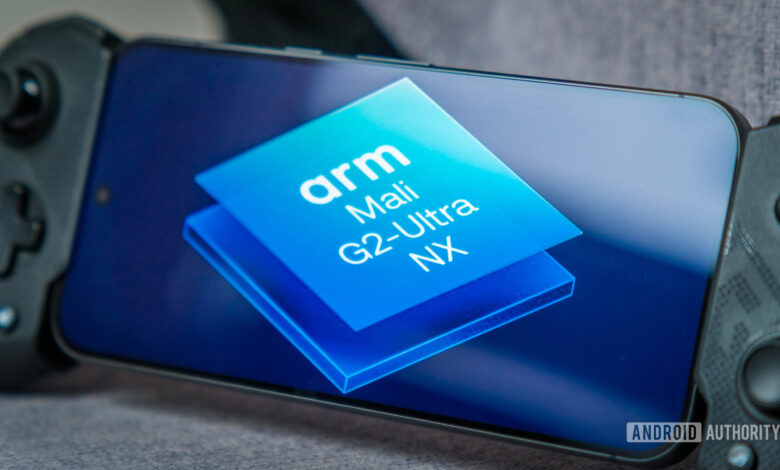
Upcoming smartphones may soon feature AI-supported upscaling thanks to the newly introduced Arm Mali NX GPU.
Introducing the Arm Mali G2-Ultra
Before delving into the AI features of this year’s Mali graphics series, it’s crucial to explore the architectural innovations and changes in the G2 lineup.
For those interested in raw performance, Arm provides a range of benchmarks. Gaming performance is reported to increase between 9% (in Honkai Star Rail) and 14% (in Fortnite) when comparing the 14-core Mali G1-Ultra with the G2-Ultra, which operates at a shader core clock speed of 1.70GHz compared to 1.53GHz. In certain challenging graphics tests, performance gains could reach 17-20%.
Modest advancements have taken place in general rasterization performance, but significant improvements are evident. The revamped execution engines now accommodate larger desktop-oriented shaders, featuring up to double the registers per warp, and enhanced dynamic allocation capabilities. This allows for advanced graphical technologies, such as Unreal Engine 5’s Lumen and Nanite, to function without performance penalties related to memory access. These developments represent the most substantial revisions to the Mali series in seven generations.

The G2 architecture also integrates Arm’s third-generation ray-tracing unit, which introduces a compact triangle representation that minimizes data duplication and optimizes geometry caching. This generation’s enhancements help reduce DRAM traffic by 13%, alleviating bottlenecks and improving energy efficiency.
Additionally, the G2 series marks the first implementation of hardware-accelerated opacity micromaps, facilitating the creation of desktop-quality environments using ray tracing in mobile devices. Collectively, these features promise an 18-24% performance boost in ray tracing compared to earlier versions, depending on the benchmark.
NX Technology – AI Inside the GPU

While performance metrics are promising, Arm’s most significant announcement is the introduction of native AI capabilities through the new NX neural accelerator. This optional hardware component is integrated within the GPU’s shader core, designed to execute neural graphics tasks efficiently with minimal power consumption.
The NX core is capable of performing INT8 and INT16 operations and features its own motion engine. Additionally, the NX operates at a clock speed that can be twice that of the main GPU, all while sharing memory resources for coherent memory access.
The potential is impressive. For instance, the NX can elevate Arm’s Neural Dawn demo from an unplayable 15fps to a steady 60fps, while maintaining a power budget slightly above 2W. That represents a fourfold improvement in frame rate and a 70% cut in DRAM memory traffic compared to previous generations.
However, achieving this performance requires implementing 2x Neural Super Sampling and Denoising (NSSD), which scales from 540p to 1080p and integrates ray-tracing denoising. Subsequently, Arm introduces Neural Frame Rate Upscaling (NRFU) to double the frame rate from 30 fps to 60 fps. The outcome purportedly delivers enhanced image detail, improved frame rates, and reduced power usage, though specific details on latency and possible visual artifacts have not been provided.

Unlike standard upscaling methods like TAA, Arm’s Neural Super Sampling utilizes real-game data for training. This approach allows the neural network to reconstruct finer details with only a fraction of the traditional input data. Similar concepts are seen in NVIDIA’s DLSS and AMD’s latest FSR. Arm claims that their methodology enhances temporal stability, minimizing jitter and ghosting while integrating anti-aliasing to eliminate the need for a separate processing step. The enhanced version, NSSD, incorporates denoising into the upscaling process.
Neural Frame Rate Upscaling effectively doubles the input frame rate but requires complex implementation to prevent distracting visual artifacts. This technology utilizes depth and motion vectors from frame pairs and employs hardware to enhance “optical flow” estimation. The G2 architecture introduces a motion engine to capture movement direction between frames, borrowing techniques from video encoding.
Arm is continuously developing its neural models with NSS recently launched, NRFU just announced, and NSSD currently in early access, set to be playable in 2026. All models will necessitate GPUs equipped with NX technology, making them incompatible with the previous Mali G1 series.
Arm aspires to make AI-supported graphics a viable option across its platforms, endorsing Vulkan ML to cater to a wide range of applications. The upcoming iteration promises flexibility in model utilization across games. Time will tell if these advancements can attract more developers to embrace AI-driven upscaling and ray-tracing for next-gen mobile gaming.
Crafting a Next-Gen Mobile Processor

In summary, the Mali series now supports a wider variety of configurations than ever before, complicating the landscape. The Ultra range targets high-performance setups with core counts varying from 10 to 24 shader cores, achieving near-laptop caliber performance. The Ultra designation must include at least one NX core. A mid-tier G2-Premium series features 6-9 shader cores, with optional NX branding and ray tracing capabilities. The more budget-friendly “Pro” segment includes configurations with five cores or fewer, again optionally featuring AI enhancements.
In total, there are five configurations available: G2-Ultra NX, G2-Premium NX, G2-Premium, G2-Pro NX, and G2-Pro, each with its own variations. With a likely offering of around 12-core options for premium smartphones, it’s expected that approximately half will be NX cores, along with ray tracing support.
While the introduction of “fake frames” for mobile gaming might spark debate, I remain cautious about developers relying solely on AI solutions to mask traditional optimization and hastily release products. Nonetheless, mobile platforms stand to benefit significantly from AI-driven graphics, especially given their limited power availability for intense rendering tasks.
If Arm proves its claims that games can achieve superior visual quality while maintaining smooth performance and extended battery life, I’ll gladly support the initiative.