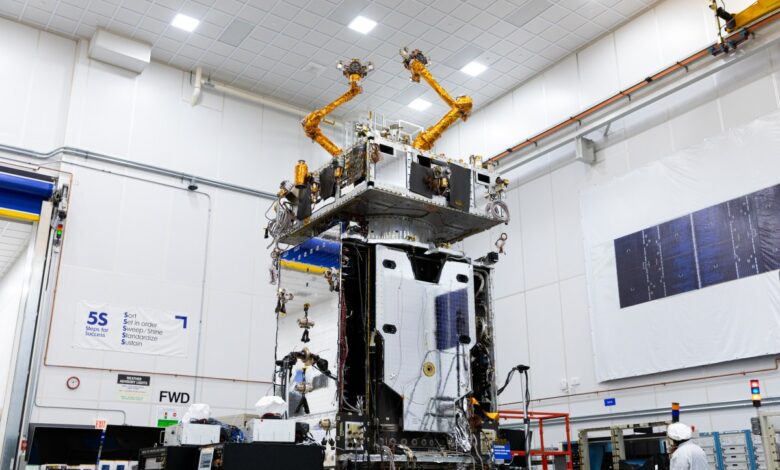
A new generation of robotic technology is taking to the skies, designed to extend the operational lives of satellites, quite literally replacing older models.
Recently, a spacecraft known as the Mission Extension Vehicle (MEV), crafted and managed by Northrop Grumman, detached from a communications satellite operated by the Australian company Optus. For over a year, this innovative MEV has attached to the Optus satellite, ensuring it remained in optimal position in space for its ongoing service.
The MEV is now making way for its successor. In July, Northrop launched four new spacecraft into orbit via a SpaceX Falcon 9 rocket. Among these is the Mission Robotic Vehicle (MRV), a highly capable satellite outfitted with two state-of-the-art robotic arms developed by DARPA, the U.S. military’s research agency. The other three units are designated as Mission Extension Pods (MEPs), smaller and simpler satellites serving primarily as modular propulsion systems.
All four spacecraft are en route to operations approximately 27,000 miles above Earth. In 2027, the MRV is expected to employ its robotic arms to attach one of the MEPs to the Optus satellite, potentially keeping it operational for several additional years.
Satellites that facilitate communication or conduct planetary-scanning activities have a limited lifespan, often failing once they exhaust their fuel for maintaining proper positioning, rather than due to faults in their onboard systems. The Optus satellite, which launched in 2009, was designed for a 15-year operational period. With this new intervention, it could remain functional and continue generating revenue for an estimated six more years.
Advances in launch technology and the reduced costs of components in the space industry are now paving the way for spacecraft repair missions.
As articulated by Northrop’s logistics and servicing director, Cassie Wong, the aim is to achieve “a paradigm shift” in space, fostering sustainability and robust infrastructure that allows for repairs, life-extension, and upgrades to satellites.
Currently, two MEVs orbit the Earth, launched in 2019 and 2020, delivering ten years of extended service to three clients, which include two Intelsat satellites alongside the Optus satellite. MEV-1 is awaiting another assignment in a designated orbit, while MEV-2 is currently engaged with its Intelsat client through 2030.
The MRV symbolizes a shift in business dynamics. Operators of satellites will purchase and own the MEPs, which will remain attached to their equipment, allowing the MRV to service more satellite systems at a lower cost.
This innovation demands sophisticated technology, as the spacecraft must autonomously maneuver and dock with each other, a complex process given their high-speed trajectories. The MEVs deploy a docking probe to connect with satellite thruster nozzles, while the MRVs will utilize their robotic arms to secure the MEPs.
In an unusual move, the MRV is designed for in-orbit refueling—serving as a proof of concept for future satellites that may require similar capabilities if in-orbit service becomes more prevalent. However, the additional cost and weight associated with such features currently deter operators from embracing them.
Modern trends favor deploying numerous low-cost, easily replaceable satellites in lower orbit as exemplified by Starlink and Amazon. Conversely, larger satellites continue to be deployed, which could significantly benefit from life-extension solutions. Wong is optimistic about the MRV taking on broader missions, potentially adding new components to existing satellites and altering their orbits.
Defense-related customers may likely be included in the MRV’s future clients, given the substantial investments in high-orbit satellites and DARPA’s role in developing the robotic technology. The U.S. Space Force has even labeled a similar Chinese spacecraft with robotic capabilities as a potential threat, due to its capability to physically engage rival satellites. Northrop emphasizes that its vehicles are focused solely on servicing missions.
Wong also notes that the MRV has potential applications in low Earth orbit, where it could enhance the longevity of valuable assets. For instance, Katalyst Space is pursuing a mission to salvage a NASA space telescope that has been malfunctioning, with a plan already in place to achieve this objective.