This ‘Counter-Surveillance’ Technique Can Help You Evade Detection by Cameras

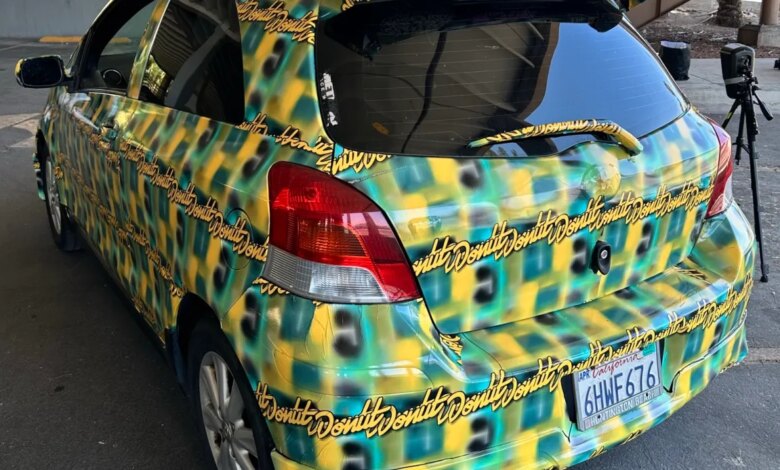
For the past year, Bill Swearingen has been performing repetitive tests aimed at creating a pattern that can evade the surveillance cameras spreading across the United States.
After conducting approximately 31 million tests, Swearingen claims to have developed on-demand patterns that, when applied to clothing and other objects, can render them undetectable by many common license plate readers and surveillance cameras.
His initiative, known as noRecognition, empowers individuals to escape the automatic detection and algorithmic monitoring proliferating in the U.S. and beyond.
Recently, the capabilities of modern surveillance cameras have been enhanced, enabling them to analyze recorded footage for various activities, from tracking speeding vehicles’ license plates to employing facial recognition technology to identify suspects, although results can vary and sometimes produce alarming outcomes. The algorithms driving contemporary surveillance systems can effectively navigate vast amounts of footage, assisting law enforcement in identifying specific activities of interest.
Swearingen’s patterns do not prevent cameras from capturing video; instead, they disrupt the cameras’ ability to recognize objects and individuals, thereby reducing the likelihood of triggering detection alerts. By camouflaging what the pattern conceals, the individual effectively becomes a ‘needle in a haystack’ — until actively sought out.
“Privacy is a fundamental right,” Swearingen expressed in a recent interview. He emphasized that his patterns represent a way for individuals to “opt-out of being tracked.”
In his first public demonstration at the Def Con cybersecurity conference in Las Vegas, Swearingen showcased a vehicle adorned with one of his patterns, confirming its effectiveness in rendering it undetectable by surveillance systems.
Training a Model
From his Kansas City home, where he co-founded the cybersecurity meetup SecKC, Swearingen shared his profound understanding of the privacy and security implications linked to surveillance.
He noted the overwhelming presence of surveillance cameras in his community, often clustered closely together, and pointed out that neither he nor his neighbors consented to this monitoring, including the government’s use of their driver’s license images for facial recognition.
Identifying as a middle-aged white male living in the center of the country, Swearingen acknowledged that he has not personally faced adversity related to his appearance. He recalled feeling apprehensive about attending a protest last year due to the pervasive surveillance cameras potentially tracking individuals exercising their constitutional rights.
Recognizing that others likely share this concern, Swearingen took action.
Efforts to counteract detection technology have been ongoing for as long as surveillance cameras have existed. Various art initiatives and clothing brands have emerged with products aimed at undermining facial recognition, with some eyewear brands also attempting to join this movement, though not all have proven effective.
Swearingen stated that his work builds upon earlier research demonstrating the feasibility of obstructing camera detections.
Last year, he began his project with a proof-of-concept test lab, gradually overcoming one open-source video detection algorithm at a time. Over the year, he enhanced the patterns by leveraging advanced computing power, crediting the community for providing hardware support.
His initial concept progressed into a reinforcement learning model, enabling the system to autonomously learn which patterns succeed or fail against the specific camera algorithms tested. In simpler terms, he trained his model in the art of “painting.”
Whenever a pattern fell short and was detected, the model would attempt again repeatedly until it ultimately defeated multiple algorithms simultaneously.
The model was soon able to generate optimal patterns capable of thwarting all 11 open-source detection algorithms it encountered, including those powering Flock license plate readers and Axon body cameras.
Currently, the model creates new patterns every minute, each batch demonstrating improved mathematical quality, according to Swearingen.
During the Def Con cybersecurity conference, Swearingen conducted a real-world test involving a 2009 Toyota Yaris enveloped in one of his patterns to assess its invisibility to Flock camera detection.
“We confirmed its effectiveness,” he noted, though he mentioned that the wheels posed a challenge. Footage from the demonstration is forthcoming.
With this demonstration in Las Vegas, Swearingen’s project has shown initial evidence that algorithmic detection can be evaded in public areas. The next step involves making these patterns accessible to those interested.
The noRecognition initiative is also developing a crowdfunding campaign to facilitate the sale of initial merchandise featuring the patterns, such as T-shirts and hoodies, with plans for vehicle skins in the future. Swearingen emphasized the importance of ensuring the quality and visual appeal of the patterns to make them functional from a distance.
He has opted to keep his most effective patterns off the internet to prevent camera manufacturers from counteracting them, but he confirmed that the work continues as his models persist in developing new patterns.
“Every failure refines my model, making the patterns continuously better,” he concluded.