Stanford Launches 37,000 AI Agents in Virtual Biotech Venture—Merck Validates One of Its Drug Innovations

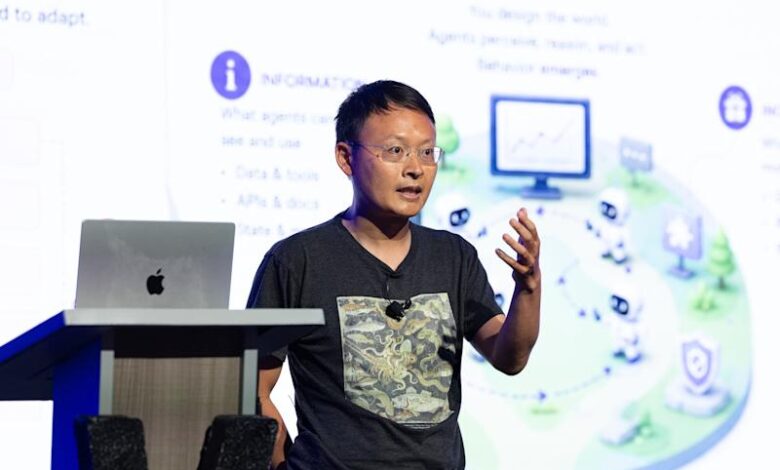
In the realm of technology development, a significant shift is underway as experts predict a move away from the traditional model of a single engineer collaborating with one agent, represented by tools like Claude Code. During a recent conference, James Zou, an associate professor of biomedical data science at Stanford University, highlighted that the future lies in a multitude of agents working together rather than relying on just one enhanced agent.
The key insight from Zou’s presentation for developers is the method of orchestrating these extensive systems. The research from his team provides a valuable framework for linking older databases with artificial intelligence orchestration systems, facilitating an environment where numerous agents can work in tandem.
Creating a simulative biotech environment
The inception of Zou’s project took the form of a “Virtual Lab” that comprised between five to eight agents, designed to replicate his physical laboratory at Stanford. This arrangement showcased an AI professor acting as the lead investigator, alongside AI students with specialized expertise who convened regularly for discussions.
“We also established a parallel to Stanford, an agent school, where these agents could undergo supervised fine-tuning to enhance their knowledge in their specific areas,” Zou explained.
The virtual lab achieved notable success, having engineered new nanobody proteins targeted at the latest COVID variants. “What excites us is how these AI-generated nanobody proteins exhibited superior performance compared to those designed by humans in binding to various recent viruses,” Zou added.
With this initial success, the team broadened their scope, evolving their model from a single research unit to a comprehensive corporate framework.
The resulting entity, known as the Virtual Biotech, consists of tens of thousands of specialized AI agents managed by a Chief Scientific Officer (CSO) agent. The system functions through distinct divisions, akin to those found in conventional biotech and pharmaceutical companies, encompassing areas like target discovery, molecule design, and clinical trial processes.
“The CSO agent collaborates with various divisions that reflect those in typical human biotech firms,” Zou clarified. One division is dedicated to drug target identification, another to molecule design, and yet another to safety and clinical trials. Within each division, agents are further specialized, with some focusing on genetics, others on genomics, and still others on single-cell data analysis.
Benefits of a multi-agent approach
As foundational models advance in capability, developers confront a crucial design choice: why distribute tasks among numerous specialized agents instead of concentrating all resources into a single, all-knowing model?
Zou’s team performed a direct comparison between a multi-agent system and a solitary agent addressing the same scientific problem. They discovered that the multi-agent format generated constructive friction and interactions that resulted in more effective and durable solutions.
“In these scientific virtual labs, agents engage in debates and disagreements. They must convince fellow AI scientists of their concepts, leading to much more innovative and sound reasoning compared to a solitary model tackling the issue alone,” Zou remarked.
Overcoming orchestration challenges
Scaling operations to tens of thousands of agents introduces a primary challenge in orchestration. A unified context layer is essential to enable agents to integrate knowledge from various tools, datasets, and historical information.
Many enterprises strive to address data integration by enclosing existing databases with a management control platform (MCP). Nevertheless, traditional systems pose difficulties for agents; for example, integrating a PDF into an agent’s context is impractical, and standard text models often fail to accurately interpret intricate figures and tables, leading to misinformation.
“Wrapping an MCP around outdated databases and APIs doesn’t resolve the core issue: the interfaces and APIs are not designed for agents,” Zou pointed out, emphasizing that existing databases cater to human users or pre-AI algorithms.
To tackle this issue, Zou’s team developed Paperclip. This platform takes advantage of the core competency of modern large language models (LLMs)—writing code and navigating file structures. Instead of compelling agents to interact with fragile, database-specific APIs, Paperclip digitizes unstructured data and organizes various databases into a cohesive, AI-compatible virtual file system.
This arrangement enables agents to access information from millions of documents using standard file system commands. “Using Paperclip leads to significantly improved accuracy and reduces both time and cost dramatically compared to agents lacking these AI-focused scientific infrastructures,” Zou confirmed.
Validation in practical settings
In order to assess the effectiveness of this setup, the Virtual Biotech activated 37,000 “clinical trial agents” to compile scattered trial information. These agents were able to identify specific cell features predictive of trial success—drug targets associated with these features were approximately 50% more likely to be developed successfully than others without them.
Furthermore, the system autonomously crafted an antibody-drug conjugate (ADC) aimed at the CD276 protein for lung cancer treatment, based purely on data available before January 2025.
Months later, pharmaceutical giant Merck independently validated the same therapeutic development, which later received breakthrough designation from the FDA. Zou interprets this as “an external validation of the therapeutic design by the virtual biotech agents.”
Shifting focus to ecosystem development
As multi-agent frameworks continue to scale, leaders must reassess their approach to managing these digital teams. Zou recommended a transition from creating rigid workflows to establishing flexible environments. Rigid workflows stipulate specific actions for agents similar to directing junior staff, while environments furnish the necessary infrastructure, guidelines, and incentives for agents to tackle open-ended challenges collaboratively.
“In workflows, we dictate what agents should do and how they should accomplish their tasks. In contrast, environments provide the necessary frameworks and incentives, allowing more freedom for collaboration,” Zou explained.
Optimizing large-scale systems involves engineering the ecosystem rather than merely fine-tuning individual models. While standalone agents can enhance their capabilities through reinforcement learning or supervised fine-tuning in the agent school, the effectiveness of a large multi-agent system hinges on refining the parameters governing their collaboration. “In the multi-agent context, we’re not just enhancing individual models, but optimizing the entire environment,” Zou concluded, emphasizing that the environment itself is what we refine to improve agent performance.