Introducing the Blazing-Fast Drone That Whirls Beyond the Limits of Human Perception

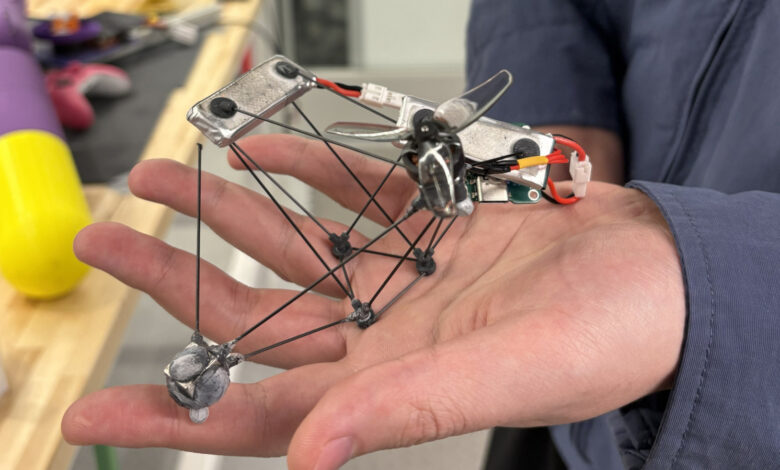
Researchers from Northwestern University have made significant strides in drone design, potentially achieving a form of invisibility. This innovative device, called the Phantom Twist, leverages the limitations of human visual perception to render itself nearly imperceptible. By spinning at an impressive rate of up to 25 revolutions per second, it creates an optical illusion akin to that of conventional propellers, turning so rapidly that it is difficult for the human eye to track. Unlike traditional quadcopters, which have stable components that are visible, the Phantom Twist’s propeller and body rotate in opposite directions. Its creators claim that this drone is about ten times less visible than standard models, marking a significant step toward achieving visually invisible aircraft.
While this does not equate to full invisibility, the drone’s appearance is described as “a ghostly smudge” that effectively conceals it against various backgrounds. A helpful analogy can be drawn from the Predator films, where a faint shape can be discerned. However, locating this sophisticated drone won’t require extreme tactics, as the Phantom Twist does have limitations. It emits a noticeable whirring sound while in flight, alerting anyone nearby to its presence. Additionally, its wires and supporting structures remain somewhat visible, which hinders its overall stealth capabilities.
The Phantom Twist was showcased at the Robotics: Science and Systems conference in Sydney, Australia, where the team presented their work in a talk focused on designing low-visibility UAVs using human perception metrics. This project has received partial funding from the National Science Foundation and involved experts from the McCormick School of Engineering’s Center for Robotics and Biosystems.
Creating an Invisible Drone
The quest for invisible flight has been ongoing for many years. The team at Northwestern began with a computational approach, generating around 20,000 designs for drones. They employed artificial intelligence to refine and improve these models, optimizing them to minimize visibility during flight. After narrowing down their options, they ran simulations that tested the drones’ visibility against various landscapes, using a model to emulate human vision. Once they focused on the 500 least-visible designs, the team moved on to build a physical prototype. Michael Rubenstein, an associate professor in computer science and mechanical engineering leading the project, stated that the entire design process was automated and built upon the criteria established by the researchers.
This resulted in a drone that cleverly manipulates visual perception. Rubenstein noted, “Unlike most attempts to camouflage drones by mimicking their surroundings, we designed the drone with human visual motion in mind.” The design features components such as the propeller, wiring, circuit boards, batteries, and counterweights strategically placed at varying heights to create ample space between them. This ensures that their rotations do not synchronize during flight, preventing the human eye from fixating on any specific part.
Emma Alexander, an assistant professor who specializes in computer vision and co-authored the study, elaborated on how the design takes advantage of our eyes’ processing time. She likened it to camera exposure time, explaining that “when an object spins rapidly, it appears to blur and lose its distinct features. Since this drone is nearly transparent, its few solid parts blend visually with the background, creating an overall impression of a subtle haze.”
The Future of Invisibility?
It’s challenging to predict the future of the Phantom Twist and its influence on drone stealth technology. For the time being, the Northwestern team plans to enhance their designs, with Rubenstein confirming ongoing efforts to achieve greater functional invisibility through the incorporation of transparent materials and quieter propulsion systems.
The researchers envision various civilian applications for their invisible drones. For example, they believe these drones could play a role in wildlife surveys, as traditional quadcopters can be too loud and visible, disturbing animals in their natural habitats. Such disturbances can compromise the integrity of scientific observations, as seen in studies involving nesting birds. The same principles apply to infrastructure inspections, where real-time monitoring without disruption is crucial.
However, the potential military and surveillance implications of this advancement in drone technology cannot be overlooked. Many countries are rapidly advancing toward fully automated drone warfare, driven by advancements in artificial intelligence and robotics that are changing the landscape of modern combat. These developments have already altered the nature of conflicts worldwide, allowing for more cost-effective drone deployments while raising concerns about increasing civilian casualties.
The drone industry is characterized by swift innovation cycles. Because they are relatively inexpensive, manufacturers can quickly test and deploy new technologies. In places like Ukraine, the pace of technological advancements has accelerated dramatically, reducing learning curves to mere weeks. Thus, the pressing question may not be whether invisible military drones will become commonplace, but rather the timeline for their integration into existing military frameworks. Ultimately, this trajectory will be influenced more by practical considerations than ethical dilemmas. The hope remains that the benefits of this research can be harnessed for peaceful applications while mitigating the risks posed on the battlefield.