Tesla’s Expenditures Surge Amid Delays in Cybercab, Semi, and Megapack Production Timelines

Tesla has revised its timeline for achieving “volume production” of three of its latest offerings—the Cybercab, the Tesla Semi, and the Megapack 3 commercial energy-storage unit—pushing the target beyond 2026, as stated in a recent shareholder update. Additionally, the company has omitted previous mentions of its Optimus robot hitting “volume production” milestones.
On Wednesday, Tesla announced its focus on ramping up battery manufacturing, specifically targeting the company’s 4680 cell, to support large-scale production of the Cybercab and Tesla Semi. While no explanation was provided for the delay concerning the Megapack, CEO Elon Musk highlighted the significant hurdles involved in producing the Optimus robot.
“This will be the toughest product we’ve ever had to manufacture at scale, as everything about the robot is novel,” Musk remarked during a conference call.
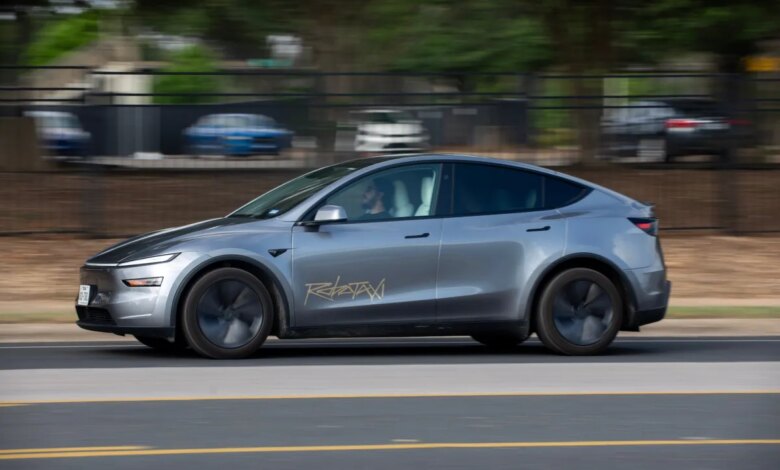
Earlier this year, Tesla began producing initial Cybercabs at its Austin, Texas facility, but the recent update indicates that work is ongoing to establish the necessary manufacturing lines for the Semi and Optimus. Just a few months prior, the company indicated that all three products would hit “volume production” this year.
This delay comes as Tesla invests heavily in next-generation products while aiming to transition from simply an electric vehicle (EV) manufacturer to a contender in AI and robotics. The company’s recent report showed a 5% year-over-year decline in net income, totaling $1.1 billion, despite a significant increase in capital expenditures and negative free cash flow. Nonetheless, revenue showed a positive trend, though not enough to balance expenses and the costs of developing new products.
Tesla’s revenues climbed to $28.2 billion, marking a 26% surge from $22.5 billion during the same quarter in 2025, and up from the previous quarter’s $22.38 billion.
A significant portion of that revenue stemmed from the sale and leasing of electric vehicles, with automotive revenue reaching $20.5 billion in the second quarter, a rise from $16.6 billion a year ago. The company delivered over 480,000 vehicles in the quarter, improving by more than 120,000 units compared to the first quarter.
This marked Tesla’s strongest sales performance since the third quarter of the previous year, when nearly 500,000 vehicles were delivered. The increase was fueled by record sales in various international markets, including South Korea, Australia, Japan, and several others, as detailed in the shareholder letter.
Tesla also reported an increase in revenue from energy storage and solar projects, which rose 13% to $3.1 billion. Furthermore, subscriptions to Tesla’s Full Self-Driving (Supervised) system reached 1.48 million, a 56% increase year-over-year.
Despite the rise in revenue, Tesla’s profitability faced challenges due to substantial investment in new products, leading to squeezed gross margins.
Net income for the quarter was $1.1 billion, down 5% compared to last year, while operating expenses soared by 47% to $4.3 billion. Tesla also reported a negative free cash flow of $1 billion, a notable drop from the $1.44 billion in positive free cash flow noted last quarter and the $146 million from the same period last year.
Operating income plummeted to $398 million, a 57% decline from the previous year’s figure of $932 million.
A year earlier, Tesla described the second quarter of 2025 as a pivotal moment in its history, initiating a shift toward leadership in AI, robotics, and related services beyond just electric vehicles, solar, and energy storage.
This transition is ongoing, with Musk indicating that the company plans to significantly increase its spending to reach this objective. Tesla’s capital expenditure is projected to be $25 billion in 2026, which is about three times its historical spending levels.
Earlier this spring, Tesla halted production of its Model S sedan and Model X SUV at its Fremont, California facility to facilitate the development of its Optimus humanoid robot. The company is also expanding its Tesla Robotaxi service into new urban areas, albeit with a limited fleet, while continuing to promote its Full Self-Driving (Supervised) product, ultimately aiming for full autonomous driving capabilities.
This article has been updated following Tesla’s earnings call.