Meta Develops an AI Detection Tool to Recognize Images and Videos Generated by Its Latest Models

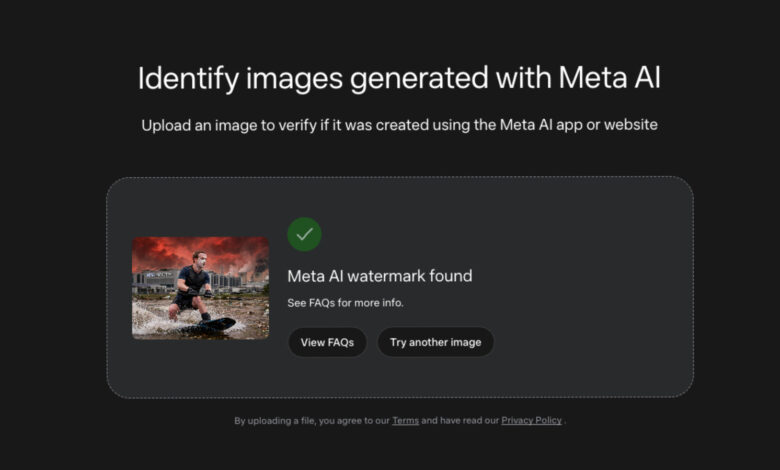
Meta is developing a new tool designed to identify images and videos generated by its latest model, Muse Image. The company recently showcased a preview of an online tool that can detect invisible watermarks embedded by this model.
This watermarking method, termed Content Seal, remains intact “even when cropped, compressed, resized, or screenshotted,” as detailed in a company blog. “We are introducing a detection tool that allows you to verify if an image contains a Content Seal watermark, offering an initial means to ascertain whether an image was produced using Meta AI.”
Content Seal represents a relatively innovative strategy for Meta. While the version incorporated in Muse Image is proprietary, the company has previously released open-source alternatives. Unlike earlier iterations of Meta AI that employed visible watermarks—a small logo in the corner—this new model uses invisible markings.
Currently, the detection capabilities of Meta AI focus only on images generated or modified using Muse Image, with plans to extend Content Seal to AI-created and edited video content in the future. Additionally, Meta is working on a distinct video generation model named Muse Video, which will be introduced shortly.
I tested the new detection feature on images I created using Meta AI, and the web-based tool successfully identified watermarks in both edited and fully AI-generated images (such as the one above). It even detected watermarks in screenshots of my works. “A positive result indicates that the image was created or modified using the Meta AI platform,” the company states in its FAQ. “Conversely, a negative outcome suggests that it is improbable that the image was processed with Meta AI.”
Interestingly, the detection features of Meta AI don’t yet appear to be integrated within the Meta AI app. When inquiring about an image that the web tool recognized as AI-generated, the app-based assistant stated it lacked this capability. “I can’t definitively tell you if this specific image was created with Meta AI just by observation,” it noted. “Meta AI does not automatically watermark images, and I don’t possess a tool to determine which AI model produced a given image.”
Meta has previously received criticism over its labeling and identification of AI-generated content within its applications. Earlier this year, the Oversight Board expressed concern over Meta’s inconsistent implementation of digital watermarks on AI content created using its tools.
Despite its advancements, the new feature has notable limitations. Content Seal does not work with established watermarking standards like SynthID or C2PA Content Credentials. During my tests, the web-based tool failed to identify images produced or edited with earlier versions of Meta’s AI models. When I uploaded images from past interactions with Meta AI, it could not verify if those images were AI-generated. Additionally, the feature seems to be subject to Meta’s rate limits; after a few uploads, I reached my “daily limit on identification checks.”