Even Realities Achieves $1 Billion Valuation Through $150 Million Investment by Meituan and Tencent

Meta and Snap launched new smart glasses last month, signaling the industry’s swift movement towards embedding cameras and AI assistants into eyewear. As this rapidly expanding market gains momentum, newcomers like Even Realities are making their mark alongside major players.
Even Realities, a startup based in Shenzhen and founded three years ago, has secured $150 million in a pre-Series B funding round led by Meituan and its previous investor Tencent, bringing its valuation to $1 billion. Founder and CEO Will Wang informed TechCrunch that while competitors focus on camera-centric devices built around content capture and AI, his company prioritizes display-first glasses that deliver information directly into the wearer’s field of vision while ensuring privacy.
Even’s previous investors include notable Chinese firms, among them Sequoia China.
Founded by former Apple engineers in 2023, Even’s leadership team includes CEO Wang, who has experience with the Apple Watch and iPhone, as well as co-founders from tech backgrounds, including two with experience in luxury eyewear from brands like Lindberg. The company quickly launched its first offering, the Even G1, in 2024, which Wang describes as the lightest waveguide smart glasses available at that time.
Even surpassed its initial sales target of 10,000 units, becoming the first company in this category to do so, according to the CEO. The startup raised capital faster than anticipated and expanded its workforce from 30-40 employees in 2024 to 300-400 currently.
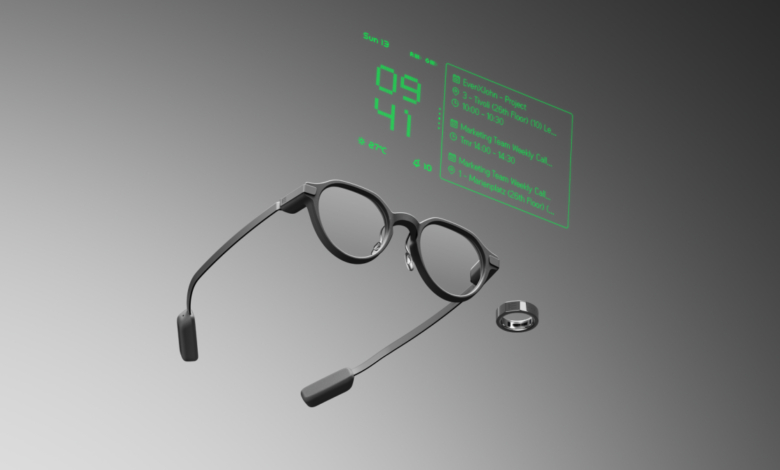
The latest flagship product, the Even G2, launched last November and eliminates the camera entirely. Instead, it features a heads-up display integrated into the frames that provides information to the wearer. The display is controlled via a companion ring, the Even R1, which users can tap or swipe to navigate.
Omitting the camera is a crucial aspect of Even’s commitment to privacy, which Wang emphasizes. He notes that smart glasses are likely the most intimate computing devices one can wear all day. Thus, they must be comfortable for both the user and those nearby, integrating privacy into both hardware and software. Features like audio translation convert speech to text without storing recordings; user data is encrypted, and the infrastructure complies with Europe’s stringent privacy regulations, Wang explained.
Even’s dedicated users heavily utilize Conversate, a feature that reads conversations in real-time, clarifying unfamiliar terms and providing follow-up suggestions, then syncing a summary to their mobile devices.
However, Even has focused much of its investment on optics (display and overall optical performance), which Wang believes sets smart glasses apart from other consumer electronics.
“Unlike a phone or a watch that uses standard OLED or LCD screens, smart glasses introduce optical displays, demanding a distinct technological approach; the microchip, optics, and waveguide must be designed in tandem. That’s where our main investment lies,” Wang stated.
The startup has created a unique optical technology named Even HAO, or Holistic Adaptive Optics, which provides an integrated design that includes the microchip and waveguide while also accommodating prescription needs from the outset, rather than piecing together separately designed components.
Over half of Even’s user base is located in the USA, its fastest-growing market, which also hosts the majority of its developer community. Although Even manufactures in China, it is not yet selling there, focusing instead on markets including the U.S., Japan, South Korea, the Middle East, and Europe. “The demand in those regions is substantial, so we want to ensure we’re adequately prepared first,” Wang noted.
Even offers its products at the higher end of the market yet manages to sell well, establishing itself as a profitable entity in the sector. “Most of our clientele consists of male professionals aged 30 to 50. In a recent survey, we discovered that a third of our users are executives,” he added. The glasses are priced at $599 before tax, with additional costs for prescription lenses or the ring adding another $200-$300, averaging the total purchase to around $1,000.
This article has been updated with information regarding previous investors in the company.