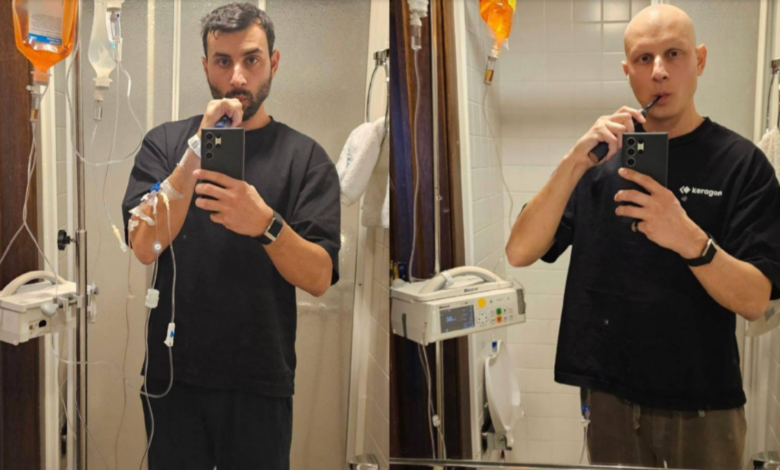
Conno Christou is meticulous about his health. He monitors his sleep patterns with a Whoop band, corroborates data using an Oura ring, and undergoes nearly 100 biomarker tests each year. Following the guidance of longevity experts, he has been consistently doing comprehensive blood tests for the past four years, focusing on refining his supplements, circadian rhythms, and protein consumption.
At 35, while launching his second startup, he was well-informed about the latest health research. By 2025, his checkup results were outstanding. “It was the best I’d had in years,” he remarked.
However, an unexpected problem arose after a workout when he noticed swelling in his arm.
Initially, he dismissed it. A week later, a doctor discovered two blood clots in his veins and scheduled him for surgery. Yet, the pre-surgery tests shifted the course of his life drastically. A physician entered the room with troubling news.
“There’s an 11-by-11-by-8 centimeter mass behind your sternum,” he explained.
A biopsy revealed the shocking reality: Christou had a rare, aggressive form of non-Hodgkin’s lymphoma — occurring in about one in 420,000 individuals — stemming from an unforeseen genetic mutation unrelated to his lifestyle, diet, or stress levels.
The tumor had appeared just three months prior, and had it gone undetected for another three weeks, it would have progressed to stage four.
“I consider myself lucky amidst this misfortune,” Christou shared during a recent conversation from Athens, where he resides part-time. “The tumor was discovered while investigating another issue.”
What followed was a lesson in the limitations of the medical system and how a proactive patient can leverage available resources.
His initial oncologist, a leading expert, suggested a milder chemotherapy option. Christou scheduled the first treatment three days later, but on the eve of the infusion, he sought a second opinion.
The second specialist had a different approach. He advocated for a more intense treatment plan — continuous in-hospital chemotherapy every three weeks for six months — based on the specific pathology of Christou’s cancer. The first option had about a 60% success rate, while the more aggressive one offered closer to 85%. Two elite doctors presented conflicting recommendations.
“As entrepreneurs, we take charge,” Christou commented regarding the tendency of many to simply accept medical advice. “There’s a lot of information out there. You don’t have to take the first suggestion you receive.”
Instead of solely going with the second doctor’s advice, he sought out twelve opinions over the next two days. Tapping into his professional network, he consulted hematologists and oncologists both domestically and internationally. Eleven out of twelve favored the more aggressive treatment, and he decided to pursue it. For Christou, the decision was less about bravery and more about rationality, especially given the critical nature of his situation.
Throughout the six months of chemotherapy, he applied the mentality he used in business: viewing it as a marathon made of sprints — each with a definite timeframe filled with data. Drawing on his experience from a mandatory military service at age 18 in Cyprus, he committed to being a disciplined soldier. He would trust the journey, complete six cycles, and endure.
He continued to wear his Whoop device, which accurately predicted the days when his immune system would falter, often alerting him before symptoms appeared. By utilizing voice transcription, he maintained a symptom journal, documenting every change, side effect, medication, and counter-treatment. His focus narrowed to three crucial elements: sleep, nutrition, and primarily, his mental state. “This is the most impactful factor,” he noted. “I never once asked, ‘Why me?’ because that question serves no purpose.”
He integrated his health data — blood results, imaging scans, and journal entries — into a chat-based AI tool. He’s not alone in seeking AI for medical advice; recent surveys indicate that a third of American adults use such technology for health-related inquiries. Numerous success stories suggest that AI is providing insights that traditional systems often fail to deliver.
Experts caution about relying too heavily on these tools; for instance, Danielle Bitterman, a clinical data science lead at Mass General Brigham, has recently expressed concerns about general-purpose chatbots’ accuracy, noting they haven’t undergone rigorous assessments for personalized diagnoses.
Christou agrees with this perspective. “It didn’t replace doctors,” he stated, “but it helped me formulate the right questions.”
Given the rarity of his diagnosis — something an oncologist might encounter only once a year — having access to comprehensive medical literature through AI was invaluable, far superior to a simple online search.
This advantage proved critical at the end of his treatment. His concluding PET scan results were vague, prompting his oncologist to discuss potential alternative therapies, including radiation near vital organs. This was understandably concerning.
Again, Christou took it upon himself to research. He discovered that the false-positive rate for PET scans in patients with his specific lymphoma type is approximately 60%, a statistic that still astounds him. “It’s 2026,” he remarked. “Sixty percent.”
He inputted data from all three PET scans and his MRI into the AI, which pointed out a common yet often overlooked phenomenon: for individuals under 40 recovering from this lymphoma form, the thymus gland can reawaken post-chemotherapy, mimicking active disease on scans. Given his age and specific imaging characteristics, the AI indicated a 90% likelihood that this was his situation.
After seeking three additional opinions, the fourth physician validated—thymus rebound. There was no active disease, eliminating the need for radiation therapy. He was in the clear.
Now, Christou is reflecting on the past year’s implications for his health, work, and perception of time. He established Keragon, his current venture, prior to this ordeal; it’s an AI-driven platform aimed at streamlining administrative tasks in healthcare settings.
Experiencing the system as a patient, however, has shifted his viewpoint. He observed healthcare professionals overwhelmed with non-care-related tasks, and noted how he was treated with a chemotherapy regimen designed for an elderly patient, managing side effects with a complicated sequence of medications, each introducing new issues. He confidently asserts that future generations will look back at this treatment approach and feel dismayed.
Now, he often takes Sundays off, striving to be present in daily moments — enjoying lunch with friends, spending time with his dog, and engaging in conversations that previously felt like distractions from work. A friend once advised him, “Be happy now,” an adage that resonated deeply during treatment. He admits it’s challenging but now recognizes its significance.
Christou is open to sharing his experience with others navigating similar challenges, eager to exchange insights and support. “The advancements AI offers to patients are not a distant future,” he emphasizes. “They are happening right now.”