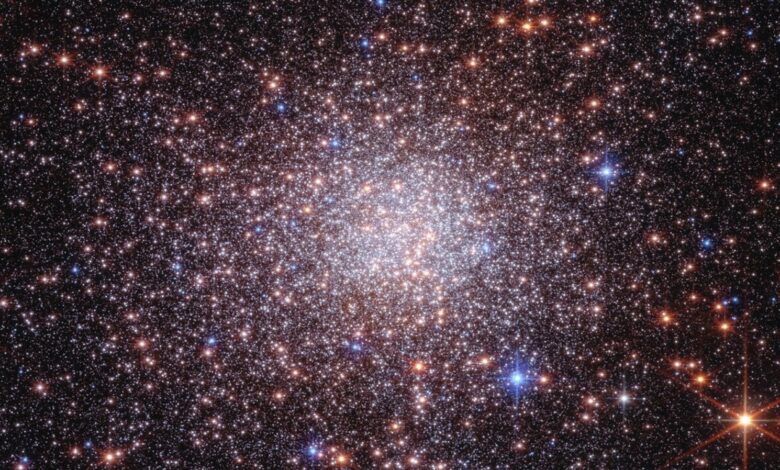
The intriguing name provides fresh perspectives on galaxy formation.
Recent discoveries made by astronomers utilizing the James Webb Space Telescope focus largely on deciphering the history of our galaxy. The newest findings reveal a concept referred to as “bulge fossil fragments,” which could shed light on the formation processes of the Milky Way.
The study’s focal point, Terzan 5, resides in the galaxy’s central region, commonly known as “the bulge,” and has posed challenges for researchers due to its dense star population and significant amounts of interstellar dust. By combining observations from the Webb telescope with older data from the Hubble Space Telescope, the research team has determined that Terzan 5 is not a typical globular star cluster, as was previously thought. While globular clusters typically feature a single ancient star population, Terzan 5 showcases at least four separate epochs of star formation. The study revealed two ancient populations, formed approximately 12.5 billion and 4.7 billion years ago, alongside two younger groups that emerged 3.8 billion and 2.5 billion years ago.
“For some reason, this unusual grouping of stars formed independently from the bulge and avoided destruction during the bulge’s formation,” explained Francesco R. Ferraro, a professor at the University of Bologna and the lead investigator of the Webb observations. “We now classify Terzan 5 as a bulge fossil fragment because it mirrors the early clumps that played a role in the bulge’s creation.”
“From our observations and thorough simulations, we hypothesize that early galaxies contained vast gas disks that broke into clumps, which then formed stars. These clumps eventually moved toward the galactic centers, with many merging to create the bulges,” added Barbara Lanzoni, an associate professor at the University of Bologna and co-author of the study.
The results of this research were published in the journal Astronomy & Astrophysics.