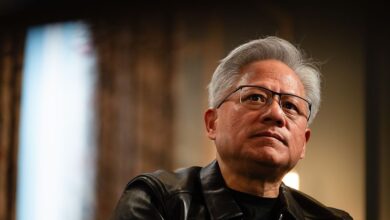
China’s Top AI Models Powered by Export-Banned Nvidia Chips—Jensen, We’ve Got a Situation!


Recent research reveals that many open-weight AI models created by Chinese firms have been trained using Nvidia chips, which are under export restrictions imposed by the U.S. government aimed at countering its largest geopolitical competitor.
The prevalent use of Blackwell GPUs in Chinese advanced laboratories highlights significant challenges for Nvidia, the leading chip manufacturer. Recently, Nvidia CEO Jensen Huang left the company following revelations of his affair with Alice Huang, a Megaspeed executive alleged to have facilitated the illegal transfer of Nvidia chips into China, raising questions about potential ties to Chinese intelligence.
While the public has been focused on Huang’s personal relationships, the company’s concerns about possible legal repercussions related to export controls may have influenced its decision for his departure. U.S. export regulations are designed to safeguard the country’s advancements in AI from Chinese competition, although Huang has long advocated for expanding market access. The export of Blackwell GPUs to China or Chinese-affiliated entities is prohibited, while the Trump administration allowed shipments of the less advanced H200 model, albeit under strict and circuitous regulations that included substantial tariffs.
Will DePue, formerly of OpenAI and now leading the nonprofit Unemployment Labs, assessed the architecture of large language models released by companies including DeepSeek, Moonshot AI, MiniMax, and Ant Group. His findings suggest that some of the prominent models, like Moonshot’s Kimi K3 and DeepSeek’s V4, exhibit signs of having been trained using Blackwell chips.
Earlier this year, White House tech adviser Michael Kratsios indicated that Moonshot utilized Nvidia chips that are banned from export, according to U.S. intelligence sources. The nonprofit Epoch AI estimates that approximately two million sophisticated chips have made their way into China in 2024 and 2025 through diversion tactics.
However, this does not necessarily imply that these models were exclusively trained on Nvidia products or that export regulations were outright breached. The chips may have been housed in offshore data centers, a common strategy among Chinese firms to access computing resources and which has spurred an industrial boom in Malaysia. Epoch’s research has tracked about 275,000 Nvidia AI accelerators being imported to Malaysia during the same two years.
Despite the intended purpose of the export restrictions to prevent Chinese AI labs from using the most powerful chips, calls for more stringent controls have emerged. Some experts argue that prohibiting Chinese companies from accessing chips in their own country, while allowing access through other routes, undermines the effectiveness of the restrictions.
Alice Huang’s company, Megaspeed, has been entangled in this trade for years and faces scrutiny from both U.S. and Singaporean authorities. Recent reports suggest that a company connected to Huang was involved in illegally transporting Nvidia chips to a Shanghai data center.
In May, the research firm Culper released a report stating that Nvidia is grappling with issues related to its dependence on Chinese demand, either through indirect routes or violations of export laws. The report discussed Megaspeed’s connections with Nvidia and claimed that Alice Huang’s ventures are funded by Chinese companies barred from U.S. chip access.
Notably, Culper’s short-selling strategy against Nvidia was not based on an anticipated crackdown from the U.S. government but rather on the assumption that China’s response would be to bolster its domestic chip industry.
If China is successful in developing its own chip capabilities, it may drastically reduce the demand for Nvidia products. Reports indicate that around 600,000 H200 chips are currently stockpiled in Hong Kong, awaiting clearance for entry into China, but the reasons for the clearance delays remain unclear.
Graham Webster, a Stanford researcher with a focus on U.S.-China technology relations, expressed skepticism about the effectiveness of restraining chip exports to stimulate domestic production due to high demand. Alternative explanations for the slowdown include preparation for a possible trade agreement involving substantial imports of U.S. goods, or apprehensions about surveillance functionalities integrated into the chips.
Presently, U.S. companies have minimal responsibilities to monitor their customers’ activities regarding controlled items, such as AI chips. However, Jensen Huang’s personal and professional connections with Alice Huang present a complex dilemma for Nvidia, particularly if investigations reveal any involvement in chip smuggling and it is proven that he was aware of it. Both Nvidia and Huang have endorsed Megaspeed’s data centers, asserting that Nvidia representatives have visited them to verify their legitimacy.
The U.S. government’s handling of both Nvidia and Megaspeed is also being examined. Reports suggest that Secretary of Commerce Howard Lutnick, who oversees chip export licensing, may face consequences due to perceived failures in identifying dubious chip buyers and maintaining too close a relationship with Nvidia officials.