Edgar Cervantes / Android Authority
Google has introduced a range of features not yet fully launched but available for experimentation. While some may not be worth diving into, a few address common browsing frustrations effectively.
Do you often use Chrome flags?
350 votes
Tab Audio Muting Control
Pankil Shah / Android Authority
Chrome allows you to mute tabs to avoid noisy websites, but the process requires two steps: right-clicking the tab and selecting “Mute site.”
The Tab audio muting UI control simplifies this process. By enabling it, the audio indicator on the tab becomes a mute button, allowing for direct muting or unmuting with a click. This feels like a feature that should have been included by default.
Parallel Downloading
Pankil Shah / Android Authority
Chrome typically downloads files in a single stream, which can slow down the process for larger files if server speeds fluctuate.
The Parallel downloading feature resolves this by partitioning the file into smaller segments, allowing all segments to be downloaded simultaneously. This approach can significantly accelerate the completion time for larger downloads.
Auto Dark Mode for Web Content
Pankil Shah / Android Authority
Even in 2026, some websites, like Amazon, still lack a dark mode option. This can be frustrating for users who prefer a dark interface. Although there are various third-party extensions available, the Auto dark mode for web contents flag is a preferred option as it also functions on Android.
This flag enables Chrome to evaluate every visited page and invert its light elements. Images remain unchanged, but everything else transitions to a darker theme, offering a decent experience, albeit with occasional quirks.
Smooth Scrolling
Pankil Shah / Android Authority
If scrolling through webpages feels disjointed in Chrome, the Smooth scrolling flag enhances the experience by adding animation. This feature creates a more fluid transition when scrolling, making it noticeable shortly after activation.
Experimental QUIC Protocol
Pankil Shah / Android Authority
Each time a page loads, Chrome communicates with the server, creating a slight delay. This is due to the handshake required in standard TCP connections.
The Experimental QUIC protocol allows Chrome to replace TCP with UDP, minimizing latency and resulting in faster page loads. While the speed enhancement may not be staggering, it is present for many popular domains.
GPU Rasterization
Pankil Shah / Android Authority
Rasterization involves converting webpage code into viewable pixels. While the CPU typically handles this task, GPU rasterization delegates it to the GPU, enhancing performance on devices equipped with dedicated GPUs.
GPUs are optimized for visual data, enabling them to render pages significantly faster, especially on media-rich sites. This approach also frees up CPU resources for other tasks.
Partial Swap
Pankil Shah / Android Authority
When changes occur on a webpage, Chrome updates only the specific section, known as a partial swap, instead of reloading the entire page. However, this can lead to issues, especially if a page initially loads incorrectly.
Turning off the Partial Swap flag may alleviate this problem, although it might slightly slow down loading times.
Incognito Screenshot Feature
This feature is exclusive to Android. By default, Chrome disables screenshot functionality during Incognito mode to protect privacy, but this can be a drawback for users who want to capture information without linking it to their account.
Activating the Incognito screenshot flag allows users to capture screenshots while browsing privately, making it more convenient.
Managing Chrome Flags
Edgar Cervantes / Android Authority
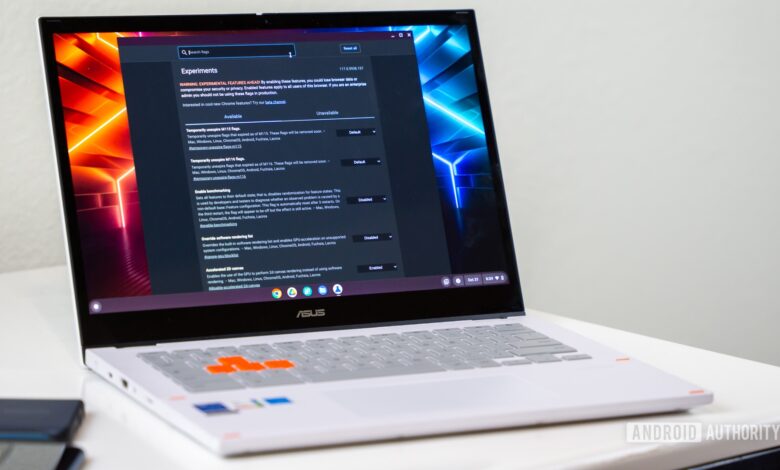
While Chrome flags are experimental, enabling them is quite easy. Simply go to chrome://flags in your address bar, where you’ll find an extensive list of flags. You can search for specific flags and enable or disable them using the dropdown menu. Chrome will restart automatically to apply these changes while restoring your previous tabs.
If any issues arise after activating a few flags, you can revert all changes with the “Reset all” button available on the flags page. Keep in mind, Chrome updates may occasionally reset some flags, and since they are experimental, your preferred flags could be removed at any time.
The flags mentioned here are personally recommended, but there are numerous others available, each designed to address various issues. Do you have a favorite Chrome flag you use regularly? Share your thoughts in the comments below.
Thank you for engaging with our community. Please review our Comment Policy before participating.