In a recent argument, Waymo asserted that achieving fully autonomous vehicles necessitates a combination of sensors, claiming that purely end-to-end AI systems lack safety—implying criticism towards Tesla, although it did not specifically name the company.
This critique came through a blog post and an interview with Axios, shortly before Tesla’s anticipated unveiling of its two-seater Cybercab on September 3, which would mark an expansion of its emerging robotaxi service. On the same day, Waymo also revealed the addition of three new cities to its robotaxi network, which now caters to customers in over a dozen cities across the U.S.
Waymo’s technical assertions ignited a heated discussion on social media throughout the weekend.
“Their arguments are weak,” stated Pierre Ferragu, an analyst and managing partner at New Street Research, who covers Tesla, on social media. “In my view, Waymo has constructed a driving infrastructure that scaled AI can make obsolete, and now resorts to typical incumbent tactics. Classic innovator’s dilemma.”
Ethan Teicher, a Waymo spokesperson, responded by emphasizing the importance of data and success in safe, fully autonomous driving, illustrating his point with a dramatic image often associated with action films.
The rivalry intensifies because if Tesla’s Cybercab can demonstrate robust performance, it may instigate a significant conflict between the two companies over their differing strategies for autonomous vehicle development, with the potential for a market worth billions at stake.
Historically, these discussions had been more theoretical. However, last week, Waymo showcased its real-world expertise.
According to Srikanth Thirumalai, a VP overseeing Waymo’s driving software, “While cameras are excellent, they alone aren’t sufficient.” He pointed to the accumulated data from over 200 million miles of real-world driving, asserting that safe and scalable fully autonomous operations require a combination of inputs from cameras, radar, and lidar, creating a comprehensive view that no single sensor can achieve.
Thirumalai further criticized Tesla’s pure end-to-end neural network model, warning that it leads to potential risks associated with unpredictable failures.
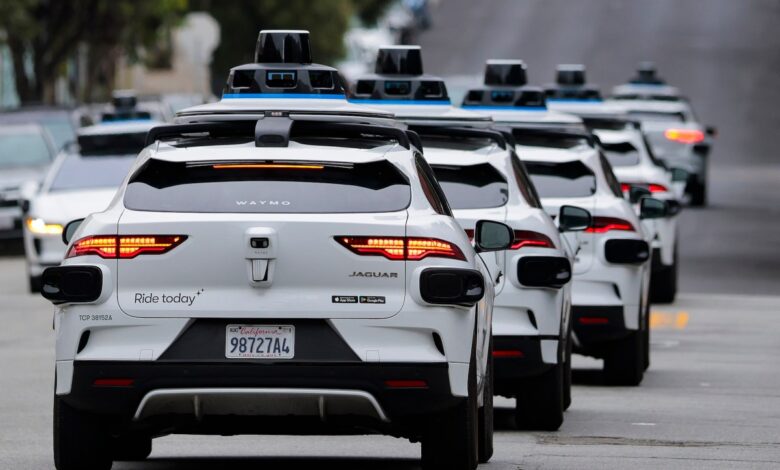
Waymo has consistently opted for a strategy combining various sensors in vehicles created by other manufacturers. This more measured technological approach has enabled the company to expand to a fleet of around 4,000 robotaxis across 14 U.S. cities, resulting in 500,000 paid rides each week.
In contrast, Elon Musk has historically dismissed lidar technology, labeling it a “crutch.” Tesla has dedicated its efforts to achieving full autonomy using only cameras and AI. The Cybercab, a specialty two-seater sedan designed specifically for autonomy, is a result of this commitment.
The Cybercab is devoid of a steering wheel or pedals and features a relatively compact battery. Tesla plans to manufacture thousands of them annually, aiming for production of over 125,000 units as per recent filings.
However, Tesla must still prove that its self-driving technology can achieve full autonomy. The company has faced significant delays, having once projected one million robotaxis on the road by 2020; it has spent the past year testing its limited robotics network in select Texas and Florida cities using modified SUVs.
While those trials remain small-scale as Tesla prioritizes safety, it has recently begun removing safety drivers from most of the vehicles involved.
Changes may be on the horizon, as Tesla is now registering Cybercabs with the state DMV in Texas ahead of the upcoming unveiling. Although it’s unclear how quickly it intends to deploy the fleet, multiple sightings of these vehicles in various locations suggest growing activity.
If Tesla can validate its AI-centric approach to self-driving at scale, it would mark a significant success for the company, highlighting the capabilities of its software engineers.
Nonetheless, the company must also tackle other challenges associated with running a robotaxi network, issues that Waymo is continually navigating with its fleet of autonomous vehicles, such as dealing with inclement weather and ensuring safety in school zones.
In addition to technological contrasts, another key point of competition lies in costs. Waymo’s method inherently incurs higher expenses due to its reliance on multiple sensors and vehicles from different manufacturers, which requires purchasing vehicles and possibly paying import taxes before integrating self-driving technology.
Conversely, Tesla manufactures its own cars and is betting that its AI will be advanced enough to rely solely on cameras for navigation. This strategy is a significant risk, one that Waymo doubts will succeed; however, if Tesla proves its efficacy, it could position itself favorably against Waymo and even Uber in terms of pricing.