US Claims ASML’s Premier Chip Equipment Might Be in China; ASML Denies Allegations

U.S. Commerce Secretary Howard Lutnick recently expressed his worries to senior executives at ASML, the Dutch semiconductor manufacturer, regarding the potential unauthorized presence of one of their extreme ultraviolet lithography machines (EUV) in China. This concern arises from export controls that have prevented ASML from selling these critical systems to China since the administration of former President Trump.
This allegation carries significant weight. Senior officials have suggested they possess evidence indicating ASML sent EUV-related components and transport equipment to China, but they have consistently refrained from presenting this evidence, both to the media and seemingly to ASML. The company maintains that no EUV machine has ever been in China. Furthermore, the Commerce Department has not commented on whether it has proof of an actual EUV system in China.
Although ASML may not be well-known outside the semiconductor sector, its role is crucial. As the primary producer of EUV lithography machines—the sole tools capable of creating the intricate patterns needed for cutting-edge semiconductor technology—ASML plays a vital role in the global expansion of artificial intelligence beyond major companies like Nvidia.
Every advanced processor produced by foundries such as TSMC, which manufactures chips for Nvidia and Apple, relies on ASML technology, which took decades and billions in investment to develop. Currently, there are no competing suppliers, which has made ASML Europe’s most valuable publicly traded company, with a market cap around $700 billion, largely spurred by the soaring demand for AI-driven chips.
The implications of any EUV machine reaching China cannot be overstated. Such a development would mark a significant violation of the export control measures the U.S. has put in place to inhibit advanced AI technologies from being accessible to China’s military and industry.
Approximately six weeks ago, I had a conversation with ASML’s CEO, Christophe Fouquet, about this very issue. He asserted that ASML meticulously tracks every machine it has ever shipped, confirming they are either actively in use by monitored customers or have been returned to the company. Fouquet explained that ASML implemented an internal firewall years ago to ensure that only specific employees can access EUV technology, isolating staff in China outside this access. He emphasized that developing an EUV machine relied heavily on existing technology, and nobody in China has actually possessed one.
There’s also a practical business reason that counters the notion that ASML would jeopardize its export license to serve a Chinese client. While ASML does supply older deep ultraviolet tools to China, it maintains this is a strategic choice to preserve a generational gap, allowing them to conduct business without creating future competitors. The company anticipates that around 20% of its revenue in 2026 will come from China, and jeopardizing the EUV license would put that revenue—and ASML’s position as a leading monopoly in Europe—at risk over a potentially illegal transaction.
While these factors lend support to ASML’s claims, they do not definitively disprove the allegations. The government has not yet made its evidence public, warranting caution before forming conclusions.
Recently, the Commerce Department, under Lutnick’s direction, pledged up to $150 million of taxpayer funds to xLight, a startup working on next-generation light-source technology seen as a potential challenger to ASML’s EUV monopoly. However, xLight’s CEO views the firm as a future collaborator with ASML, rather than a direct competitor. When I asked Fouquet about this perspective last May, he respectfully disagreed, asserting that ASML does not consider itself reliant on xLight for maintaining its technological lead.
Whether there’s any connection between Lutnick’s intensified scrutiny of ASML’s practices and this federal investment is unclear. It could very well be unrelated, but the situation merits attention, particularly given the financial interests tied to the startups vying to challenge ASML’s dominance.
Other entities are also exploring alternatives to ASML’s technology. For instance, Peter Thiel, closely associated with Trump’s political sphere, has invested in Substrate, another startup directly targeting EUV technology as a competitor to ASML’s offerings.
As noted in recent reports, a bipartisan bill currently moving through Congress could expand beyond EUV technologies to impose a ban on all of ASML’s deep ultraviolet shipments to China, which represents about 20% of its anticipated revenue for 2026. This legislation has passed a critical committee stage, and its implications remain to be fully addressed.
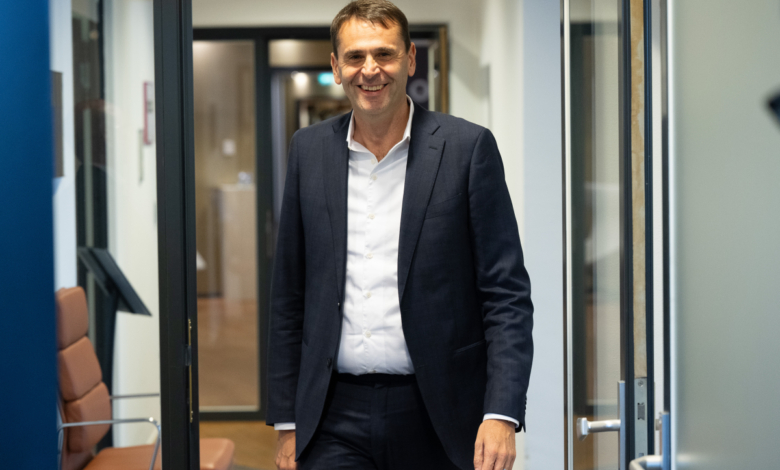
Pictured above: ASML CEO Christophe Fouquet