Unveiling the Secret: How a Rare VW Passat Concealed the Engine Behind Bugatti and Bentley—Until Reliability Issues Took Their Toll

In 1997, aboard a Shinkansen bullet train between Tokyo and Nagoya, former Volkswagen AG CEO Ferdinand Piëch sketched out an engine concept that had been occupying his thoughts. This came after a discussion with Karl-Heinz Neumann, the company’s head of powertrain development, regarding the VR6 engine—Volkswagen’s narrow-angle six-cylinder engine, which was compact enough to fit transversely in a Golf.
Piëch’s drawing combined two of the VR6 blocks by positioning them at a wider angle. This configuration transformed the V-shape of the cylinder banks into a W-shape when viewed from the front. This concept ultimately contributed to Volkswagen’s decision to acquire Bugatti and provided Bentley with a purpose under Volkswagen ownership.
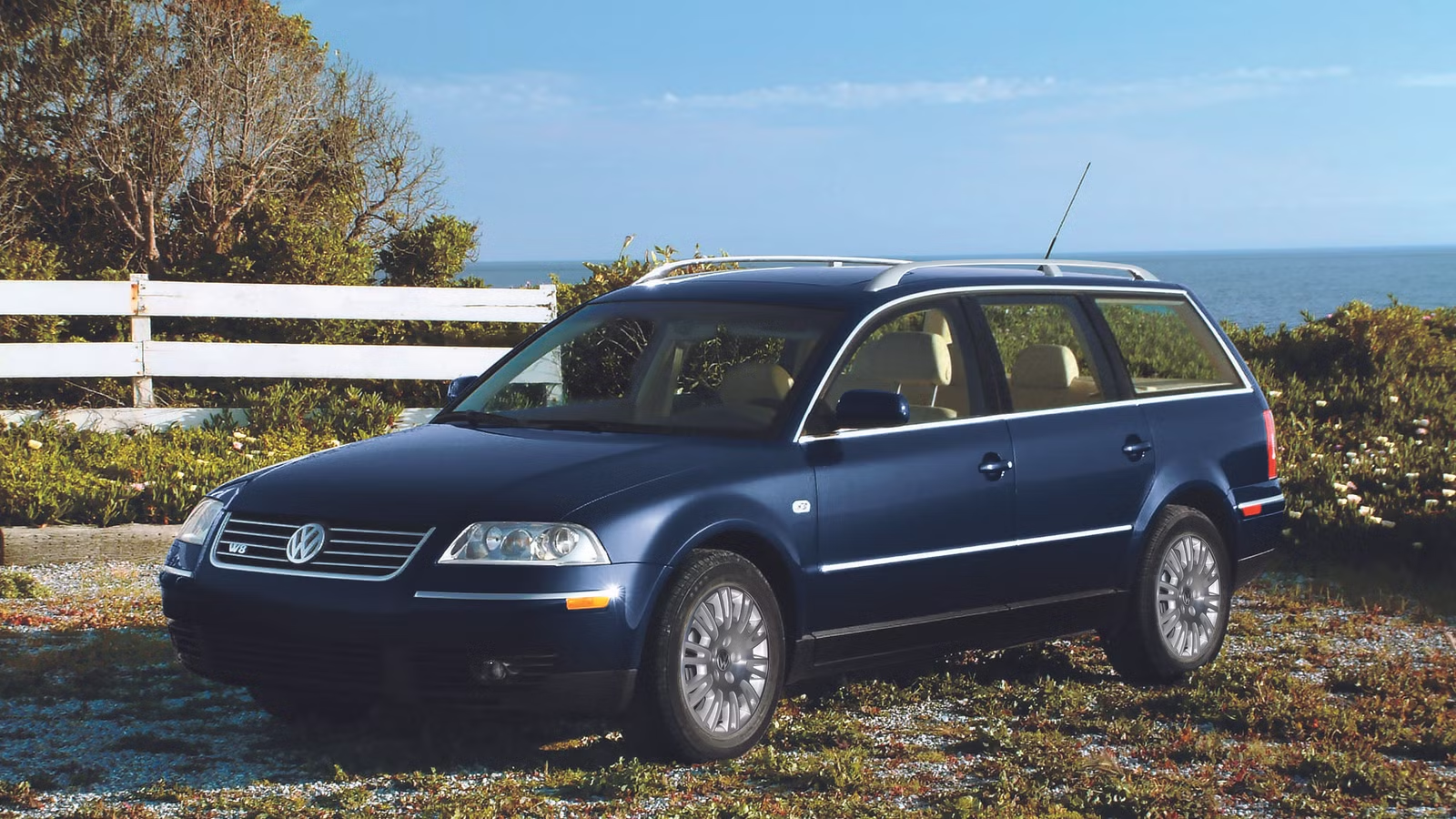
Interestingly, for three model years, this engine also found its place in a standard Volkswagen Passat.
An Engine Designed for a Supercar Family
How Volkswagen Fit Eight Cylinders in Place of a V6
The engine concept on Piëch’s drawing developed into an 18-cylinder, naturally aspirated powerplant producing 555 horsepower from three combined VR6 blocks. This engine was first showcased in the Bugatti EB118 concept at the Paris Motor Show in October 1998, shortly after Piëch finalized the acquisition of Bugatti.
Engineers later refined the idea into a W16, which became the defining engine of the Bugatti Veyron, and a W12 that played a crucial role in reviving Bentley in 2003, as well as powering models like the Phaeton, Touareg, and Audi A8.
The smallest variant, the W8, was created from two VR4 blocks that shared a crankshaft at a 72-degree angle. This resulted in a 4.0-liter W8 engine generating 270 horsepower and 273 lb-ft of torque at 2,750 rpm, which pales in comparison to the later Veyron’s 987 horsepower.
However, the W8’s main advantage was its compact design. Measuring just 16.5 inches in length, it fit under the hood of a vehicle platform that previously accommodated only a V6. Volkswagen utilized the Passat to validate the W-engine concept before introducing it in more expensive models like the Phaeton and Bentley, branding it as the “W8 4Motion” and launching it for the 2002 model year.
Volkswagen’s Leap into the Luxury Market
An Eight-Cylinder Passat Priced at $40,000
Piëch dedicated the late 1990s to elevating Volkswagen’s status in the luxury segment, marked by the acquisition of Bugatti, the revival of Bentley, and the introduction of the Phaeton sedan. The W8 Passat was an extension of this ambition into Volkswagen’s mainstream offerings.
Each W8 model came equipped with 4Motion all-wheel drive and offered a choice between a six-speed manual transmission or a five-speed Tiptronic automatic. Other notable features included tinted heat-insulated windows, bi-xenon headlights, parking sensors, leather seating with wood accents, and an enhanced audio system. A wagon version was also available alongside the sedan, which still appeals to enthusiasts today.
The starting price was around $40,000, making the W8 the priciest Volkswagen at the time, but still several thousand dollars cheaper than comparable European luxury sedans. If it were adjusted for current inflation, that price would translate to about $74,000 today.
Fuel economy ratings for both the sedan and wagon versions estimated 16 MPG city, 23 MPG highway, and 18 MPG combined with the automatic transmission. If owned today, the average yearly fuel expense would be around $4,200, equating to approximately $7.00 for every 25 miles driven.
Early Mechanical Challenges
Reliability Issues Arising from the Unique Layout

Credit: Volkswagen
Fitting eight cylinders into a configuration designed for six cylinders came with its own challenges. Cam adjuster failures—issues relating to variable valve timing—were frequent enough to trigger diagnostic codes P0011 and P0021 depending on which bank malfunctioned. Additionally, oil consumption issues began to surface in the 2002 model year, coinciding with the W8 Passat’s debut.
Automatic W8 Passats often faced torque converter failures within 70,000 miles, according to reports detailing common issues. The tight fit made routine maintenance complicated, as the compact dimensions that enabled installation in the Passat’s engine bay left minimal working space for mechanics.
Volkswagen also had to contend with an internal competitor. Audi launched its B6-generation S4 in 2003, featuring a 4.2-liter V8 that produced 340 horsepower, a lighter chassis, and a sprint time of 0 to 62 mph in 5.2 seconds—all priced about $5,000 above the W8 Passat. Buyers frequently opted for the Audi brand, valuing the more powerful, reliable V8 and the upscale ownership experience it offered.
The Fate of the Other Engines
The engine concept sketched by Piëch evolved into three distinct engines, each serving a unique role within the Volkswagen Group.
The W12 became a hallmark of modern Bentley, remaining in production until 2024 when Bentley replaced it with a new Ultra Performance Hybrid V8. While the W12 has its charms, the new 4.0-liter V8 hybrid powertrain has proven superior in performance, as seen in models like the Continental GT S and GTC S.
Similarly, the W16 has powered Bugatti’s flagship hypercars since the original Veyron launched in 2005, including the limited-edition Destrier, revealed at Monterey Car Week 2026. However, the latest Tourbillon has transitioned to a completely new V16 engine.
The W8, unfortunately, had a less fortunate trajectory. Its mechanical issues led to a limited production run, with only about 11,000 W8 Passats manufactured before production ceased in 2004. No Volkswagen model has utilized this engine since. Today, the W8 Passat enjoys a cult following, viewed not so much as a cautionary tale but rather as an intriguing part of automotive history.
Piëch resigned as Volkswagen’s chairman in 2015, concluding a career that included significant contributions to the Porsche 917 and the Audi Quattro, as well as Volkswagen’s acquisitions of Bugatti, Bentley, and Lamborghini. He received accolades such as Car Executive of the Century in 1999 and was inducted into the Automotive Hall of Fame in 2014. Piëch passed away on August 25, 2019, at the age of 82.