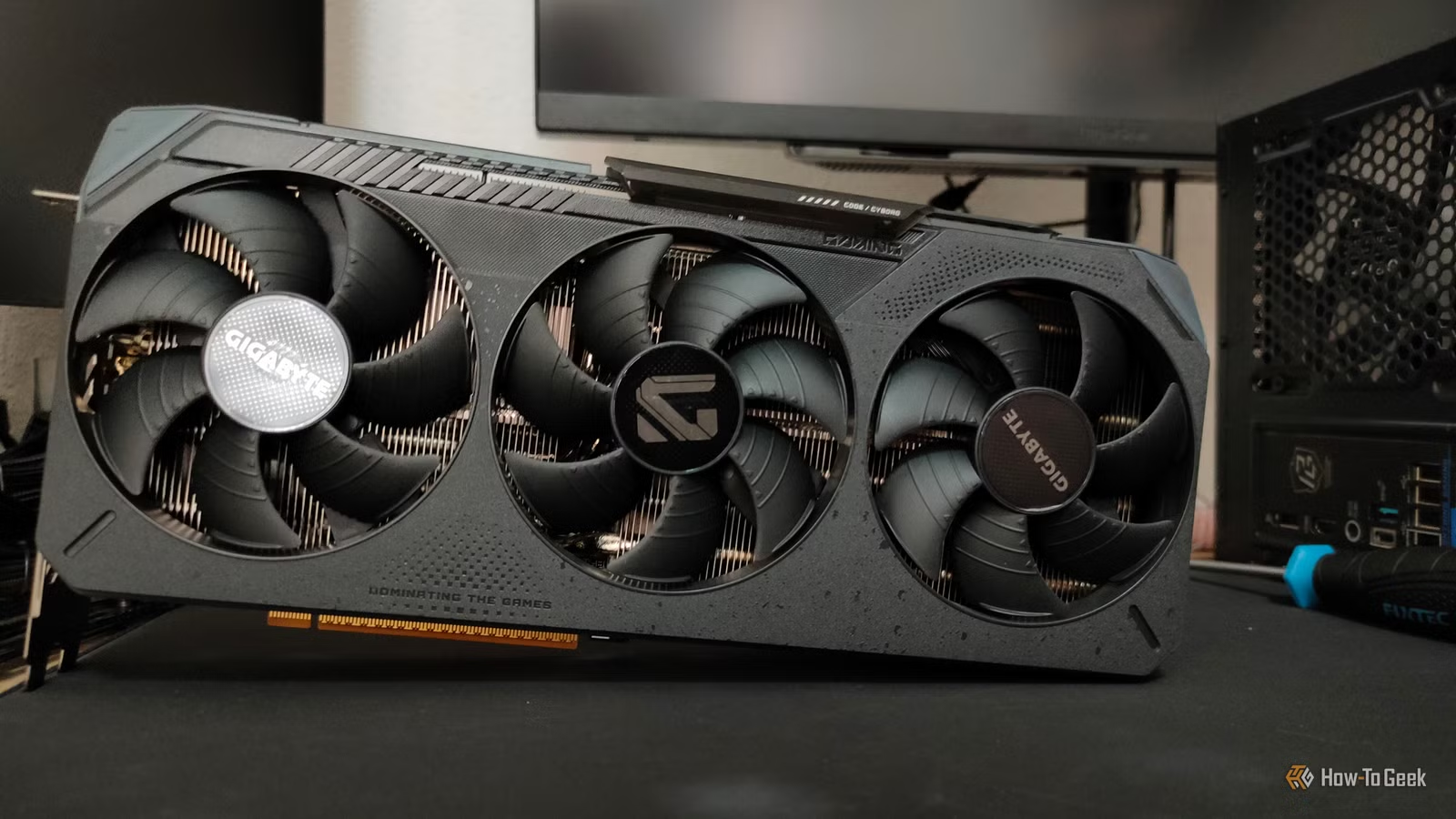
There’s no question that graphics processing units (GPUs) are the standout components in any personal computer, a trend that has persisted for years.
Unfortunately, this makes it even more disappointing when a graphics card falls short of expectations, as history shows there have been some truly terrible GPUs. Below is a rundown of the most problematic graphics cards ever produced, and it might not be what you’d anticipate.
7
Nvidia GeForce RTX 5090
The speed champion that’s tough to endorse
Currently, the RTX 5090 reigns as the top consumer graphics card available, unmatched by any competitor.
So, why does it feature on this list? The primary reason is that it is nearly impossible to recommend.
Initially priced at $1,999, the RTX 5090 now often sells for between $4,000 to $5,000. Such a steep price diminishes any performance accolades it could earn, and it has faced additional issues as well. Its availability has fluctuated significantly, leaving consumers frustrated at times when it was nearly impossible to find in stores. Like the RTX 4090, the 5090 has been reported to suffer from melted connectors. While some of these faults might be overlooked under normal circumstances, the exorbitant price tag makes any positives hard to justify.
6
Nvidia GeForce GTX 480
The GPU with heating issues
When the GTX 480 was launched in 2010, Nvidia faced a critical challenge. AMD had already released the Radeon HD 5870, the first DirectX 11 GPU, and Nvidia took six months to respond with its Fermi architecture. The GTX 480 was designed to re-establish Nvidia’s dominance.
Although it was indeed fast and frequently outperformed the HD 5870 in various games, the lengths Nvidia went to achieve that performance were concerning.
The GTX 480 had a significant maximum board power rating of 250 watts, which was quite high at the time. Its power consumption far exceeded that of its AMD counterpart, resulting in an alarming amount of heat output. In some tests, the GPU’s temperature climbed to 94 degrees Celsius (201 degrees Fahrenheit), and its heatsink reached 67 degrees Celsius. The noisy blower fan struggled to maintain operational temperatures, adding to users’ dissatisfaction.
5
ATI Radeon HD 2900 XT
The massive flagship that couldn’t compete
The Radeon HD 2900 XT debuted at an unfortunate time for AMD, as Nvidia’s GeForce 8800 series had already set a strong precedent in the new DX10 era. AMD needed a competitive response, and the HD 2900 XT appeared, boasting impressive specs on paper.
However, those grand specifications failed to yield satisfactory performance, often falling short against the GeForce 8800 GTX. The card also produced an excessive amount of heat and faltered under anti-aliasing loads.
In essence, AMD invested considerable resources into this ambitious flagship only to miss its mark against Nvidia.
4
AMD Radeon RX 6500 XT
Poor design choices compounded failures
Amid the GPU shortage crisis of 2021-2022, the RX 6500 XT seemed like a potential affordable solution. However, even with an initial $199 price tag, this GPU was underwhelming.
It featured just 4GB of VRAM over a limited 64-bit interface, and it utilized four PCIe lanes while lacking basic H.264 and H.265 encoding support. This structure was derived from a laptop chip (Navi 24), and its limitations were glaring in desktop systems.
The RX 6500 XT frequently fell short against older models like the RX 570 and GTX 1650 Super, leaving AMD’s efforts looking sad in retrospect.
3
Nvidia GeForce GT 1030 DDR4
Confusion caused by branding
The original GeForce GT 1030 wasn’t exactly groundbreaking but served a purpose as a budget-friendly, low-power GPU suitable for compact builds. With GDDR5 memory, it offered decent performance for lightweight gaming.
Then Nvidia released another GT 1030 equipped with DDR4 memory.
These cards shared the same name and came with 2GB of VRAM, leading many customers to mistakenly believe they were equivalent. In reality, the GDDR5 model boasted around 48GB/s bandwidth compared to only 16GB/s for the DDR4 variant, which often had lower clock speeds as well.
As expected, testing revealed that the DDR4 version delivered less than half the performance of its GDDR5 counterpart, highlighting why branding two distinct products with the same name can lead to confusion.
2
S3 ViRGE
The notorious underperformer
During the mid-1990s, dedicated 3D graphics were still an emerging concept, with many PCs relying on standard 2D graphics hardware for 3D visuals rendered through the CPU. S3 was a notable player in this realm, introducing its ViRGE chip as an all-in-one upgrade promising sturdy 2D performance alongside hardware-accelerated 3D capabilities.
While the 2D aspect held up well, the 3D acceleration was labeled a “3D decelerator.” It could handle basic 3D scenes but faltered with more advanced features, with performance sometimes better when rendering on the CPU instead.
This GPU offered some advantages, but given that its main selling point was 3D acceleration—and it struggled in that area—its overall reception suffered significantly.
1
Nvidia GeForce FX 5800 Ultra
The infamous Dustbuster lived up to its name
In a surprising twist, Nvidia once created a video poking fun at one of its own GPUs, the FX 5800 Ultra, also known as Dustbuster.
This card was released late and utilized fast, hot-running GDDR2 memory through a 128-bit interface. It required an enormous dual-slot cooling solution called FX Flow that made a loud noise comparable to a motorcycle or a hairdryer.
All this clamor might have been forgiven if the FX 5800 Ultra had topped performance charts, but it struggled to consistently outperform the Radeon 9700 Pro, turning it into a well-known example for all the wrong reasons.
Despite its flaws, it leaves an impression
As new generations of GPUs roll out, older models often get forgotten. Many of the graphics cards today focus on features like AI-assisted functions instead of pure performance. Yet, these problematic GPUs remain memorable due to their notorious shortcomings.