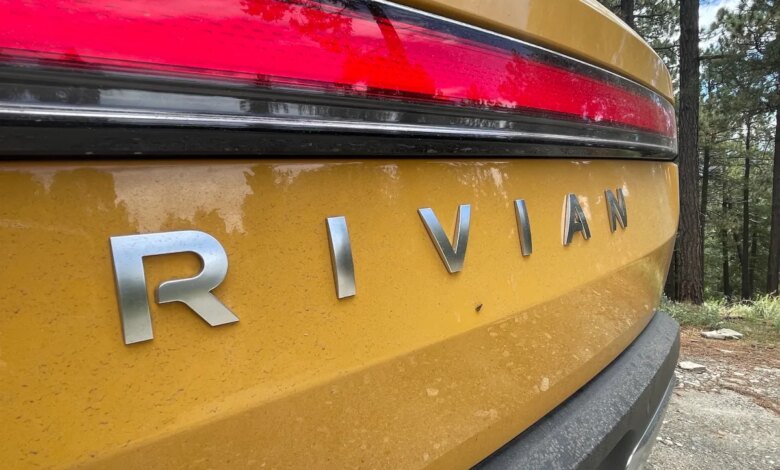
Rivian is facing a lawsuit accusing the electric vehicle manufacturer of misleading consumers regarding the autonomous driving features of its R1T truck and R1S SUV.
The class-action lawsuit, lodged on Wednesday in the U.S. District Court for the Central District of California, targets the initial models of the R1T and R1S, arguing that Rivian claimed these leading vehicles would be capable of hands-free, eyes-off driving.
This ability, known as Level 3 autonomy, as defined by the Society of Automotive Engineers (SAE), means the car can automatically manage steering, acceleration, and braking without requiring the driver to have their hands on the wheel or eyes on the road under certain conditions, such as on highways and at lower speeds. However, it still necessitates that drivers remain alert and be ready to take control when needed.
The complaint asserts that Rivian falsely guaranteed, through a comprehensive marketing campaign over five years, that its driver-assistance system, dubbed Driver+, would be standard in all its vehicles. Notable instances mentioned include remarks made by Rivian CEO RJ Scaringe during TechCrunch Disrupt 2022, where he relayed the firm’s goals regarding self-driving technology.
“No software update—regardless of its sophistication—will enable its Gen 1 Vehicles to perform as promoted,” the lawsuit claims. “Rivian undoubtedly knew that its Gen 1 Vehicles could never achieve Level 3 autonomy or ‘true hands-free driving’ yet persisted in marketing these supposed capabilities to entice consumers into buying them.”
Rivian has chosen not to provide comments on the ongoing lawsuit, citing it as pending litigation.
The suit names three plaintiffs and asserts claims against Rivian including fraud, negligent misrepresentation, and unjust enrichment. The law firms representing the plaintiffs, Coleman Law and Tycko & Zavareei, have called for a jury trial.
This is not the first legal issue for Rivian; the company had previously agreed to pay $250 million to settle a class-action lawsuit from shareholders after it unexpectedly raised prices on its R1 truck and SUV models last year.
Rivian’s first-generation R1T and R1S models do not support hands-free driving. However, the newly refreshed second-generation vehicles introduced in 2024 do. While they may appear similar externally, Rivian has upgraded various internal components, including the battery, suspension system, and electrical architecture, along with the interior layout and sensor array.
The updated second-generation R1 models come equipped with the “Rivian Autonomy Platform,” which features 11 cameras, five radar sensors, and a computing power ten times greater than the previous models, as reported by the company at the time.
Initial advanced driver-assistance capabilities in the second-generation models encompassed adaptive cruise control, enabling speed maintenance and distance management behind other vehicles, as well as a highway assist function that automatically manages steering, braking, and acceleration under specified highway conditions.
Furthermore, Rivian introduced “Universal Hands-Free” driving through a software upgrade for the second-generation R1 vehicles last year. This feature permits drivers to let go of the wheel across more than 3.5 million miles of roads in the U.S. and Canada, consisting of various highways and surface streets, provided visible lane markers are present.
Rivian is not alone in facing legal scrutiny over self-driving feature promises. Tesla and its CEO Elon Musk have long asserted their vehicles would achieve full autonomy through their Full Self-Driving software, and some owners have filed lawsuits against Tesla for failing to provide supervision-free driving options.
Additionally, Tesla has faced regulatory examinations regarding its claims about the performance capabilities of its FSD and Autopilot systems. The California Department of Motor Vehicles has accused Tesla of breaching state law by misleading consumers in its marketing of Autopilot as well as its Full Self-Driving technology. Although a judge ruled in favor of the DMV, the agency opted against suspending Tesla’s sales and manufacturing licenses, instead deciding to forgo a 30-day penalty after the company ceased using the term “Autopilot” in its marketing in California.
This article was first published at 11 a.m. PT.