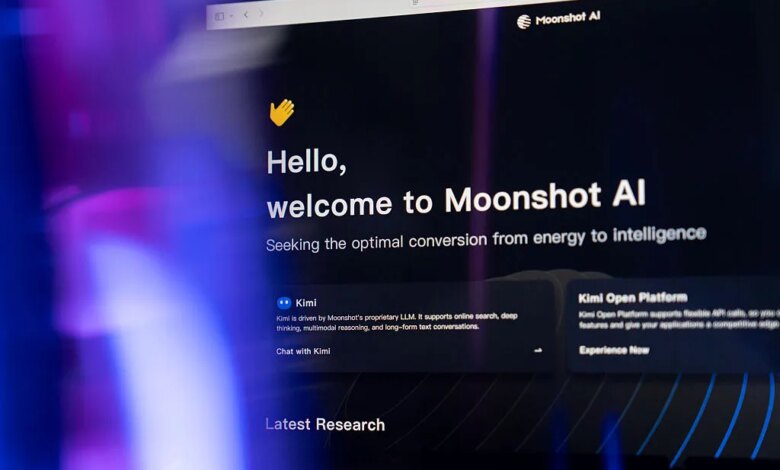
The Chinese firm Moonshot AI unveiled an upgraded version of its Kimi model this week, igniting renewed discussions about China’s role in the realm of open-source AI.
According to Moonshot, despite Kimi K3 being “not as advanced as the leading proprietary models, Claude Fable 5 and GPT 5.6 Sol,” the new open-source version “showed exceptional performance in our evaluation suite, consistently surpassing other evaluated models.” Independent assessments from Arena.ai and Vals AI indicated that Kimi holds its ground against top-tier models.
The timing of this announcement was notable, coinciding with a speech by Chinese president Xi Jinping at the World AI Conference in Shanghai. As a result, Wall Street reacted negatively, with the Nasdaq experiencing a decline of approximately 1% on Friday as investors offloaded shares in semiconductor companies like Nvidia.
The reactions from technology sector experts echoed sentiments from earlier debates surrounding the release of the R1 model by another Chinese company, DeepSeek, in January 2025. This time, the conversation feels more charged, influenced by the ongoing tariff conflict initiated by the Trump administration, recurring concerns about national security linked to companies like Anthropic, and the impending public listings of major AI firms.
David Sacks, a former AI czar for the Trump administration and co-chair of the President’s Council of Advisors on Science and Technology, drew contrasts between Kimi’s advancements and the situation in the United States, stating, “We are tying ourselves in knots: politicians and bureaucrats are imposing bans on new data centers and piling on state regulations, while pushing for new federal agencies to approve frontier models beforehand. This is how you lose the AI race.” He also criticized Anthropic’s Claude model, referring to it as an example of “woke lobotomized models.”
Travis Kalanick, former CEO of Uber, echoed concerns that Chinese firms are “distilling off” American AI models, meaning they are using the outputs from these models for training their own.
He remarked, “If distillation isn’t controlled, then everyone should have the freedom to distill from each other; otherwise, it would be as if one arm is tied behind the backs of American models.” (It’s worth noting that American models have also been constructed using Chinese outputs, specifically Kimi.)
Dean Ball, the head of strategic futures at OpenAI, stated that Kimi is “a very strong model” whose success likely can’t be merely attributed to distillation practices, expressing surprise that the Chinese government allows the public release of such effective models given the potential risks involved.
Ball proposed that “the likely outcome in a world dominated by open-weight models is a form of AI communism,” where AI becomes a “public good” provided by the state and serves as a “digital public infrastructure.”
He characterized this potential future as a “dystopian hellscape,” noting that he has yet to encounter an advocate for open-weight models who doesn’t eventually acknowledge this outcome. Furthermore, he speculated that the Trump administration, with which he has past connections, would eventually recognize the necessity of imposing significant regulatory hurdles around the use of open-weight Chinese models.
“You don’t need to outright ‘ban open source’ (a notion that is quite impractical in AI policy discourse),” Ball mentioned. “You simply have to instruct every agency to create ‘soft law’ that instills fear, uncertainty, and doubt. For example, ‘A Federal Reserve Advisory Bulletin found potential backdoors in Chinese AI models.’ It doesn’t need to be thoroughly substantiated. Just generate enough regulatory apprehension that every regulated entity retreats.”
Conversely, Shakeel Hashim, editor of the AI publication Transformer, countered that much of the concern is exaggerated, both because Kimi “likely does not possess threatening cyber capabilities” and because the Chinese government would encounter “remarkably similar pressures” to limit open Chinese models once those capabilities are developed.