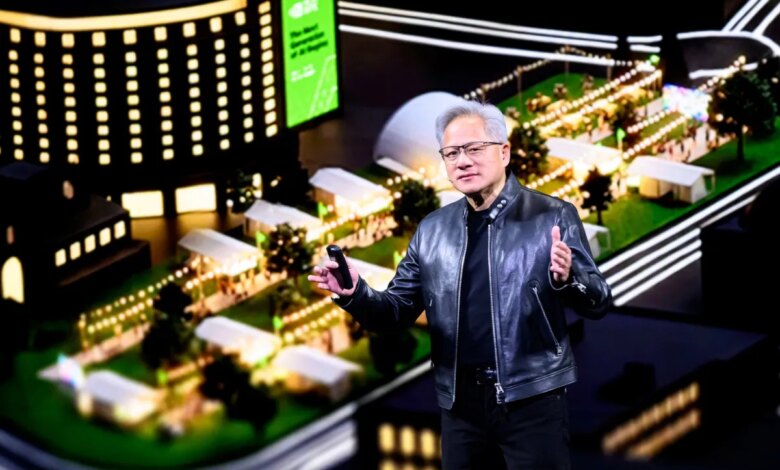
Jensen Huang, the founder and CEO of Nvidia, addressed participants at the Goldman Sachs Communacopia + Technology conference on Thursday, discussing how the company’s leadership in AI and its financial success are poised for continued growth through next year.
He claims to have insight into what lies ahead.
Concerns have been raised regarding Nvidia’s ability to maintain its success amidst rising competition for GPUs and AI chips from major players like Amazon, Microsoft, and Google, each developing their own technologies, as well as AI organizations such as Anthropic and OpenAI, and newer competitors like Cerebras and startups like Etched.
“Many people believe Nvidia only manufactures chips. In reality, our products require aircraft for shipping,” Huang explained, pointing out that the company is overcoming lingering misconceptions from its early days. Nvidia revolutionized the GPU, which initially catered to consumers for enhancing PC gaming. “One GPU today costs not $399, but $8.5 million, comprising 2 million parts and requiring 250,000 kilowatts of power. That’s what we deliver, and we ship thousands of them.”
He also highlighted that demand for one specific system combining 36 Grace CPUs and 72 Blackwell GPUs is witnessing a 27% growth in sales month-over-month.
Huang’s optimism wasn’t confined to present sales; he reiterated Nvidia’s revenue forecasts for the upcoming year, which were shared last month following another record-breaking financial quarter. During that announcement, he estimated revenue could soar by 70% next year.
“I believe we could achieve 70% year-over-year growth. We are confident in this projection,” Huang reiterated on Thursday. Analysts predict Nvidia will wrap up its current fiscal year with approximately $400 billion in revenue, suggesting that a 70% increase could see it reach around $680 billion next year.
Huang elaborated on his confidence by stating that Nvidia is integral to various facets of AI, allowing him to glimpse the future.
“Nvidia supports every model. Every lab can benefit from our technology,” he noted, referencing involvement with models from Anthropic, OpenAI, Google, and open-weight alternatives. “We are a foundational component of the AI ecosystem and industry.”
Nvidia’s scope extends from suppliers, like memory chip manufacturers, to data center initiatives and startups.
“We’re closely monitoring every gigawatt of land, power, and shell worldwide. Literally everything on the planet,” he stated. (Here, “shell” pertains to the structure of a data center before it is equipped with technology).
“Consider all my partners. How many cloud providers are providing updates to us? How many OEMs are engaged with us? Every AI-native organization is in communication with us. We collaborate with everyone, giving us considerable insight into our ecosystem,” he added.
This led to inquiries about Nvidia’s so-called circular deals, wherein the company invests in enterprises that subsequently purchase its products. Such practices contributed to the decline of earlier internet infrastructure suppliers like Lucent Technologies.
In a light-hearted response, Huang quipped, “It’s not circular because while we invest a small amount, we receive much more in return.” He joked further, “I look at the numbers: we invest $1 and get $100 back. Is that circular? If so, let’s do more.”
Despite the humor, he emphasized that Nvidia ensures any investment is warranted by real contracts generating revenue from clients. He noted seeing $100 billion from such agreements, stating, “I’m not taking any risks. … I require certainty.”
Whether Nvidia’s AI dominance can last in the long run remains to be seen. A well-known principle in the tech industry is that significant innovations eventually face disruption. Currently, Huang acknowledges that much of the AI sector’s growth is driven by AI-native startups, which are attracting large investments and primarily allocating funds toward their AI developments. As the industry evolves, firms will likely become more efficient in their use of infrastructure and resources.
However, for now, Nvidia seems well-positioned, anticipating another prosperous year ahead.