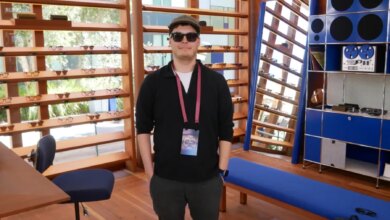
This summer, Alexandru Voica, who leads corporate affairs at Synthesia, a startup specializing in video generation, sent me a link introducing a member of their public relations team. To my surprise, it was an interactive virtual avatar of himself, designed to answer frequently asked press questions about Synthesia’s functionality. Just the day before, I had participated in a panel where PR professionals inquired whether I was comfortable with pitches that incorporated AI-generated content. However, Voica’s avatar seemed to epitomize the advanced use of artificial intelligence in public relations.
In September, I visited Synthesia’s newly established office in New York City. Previously located in the U.K., the company is one of several notable digital avatar startups, including D-ID, HeyGen, and Colossyan. Earlier this year, Synthesia achieved a valuation of $4 billion and announced that it surpassed $100 million in annual recurring revenue the previous year.
The company enables businesses to create interactive training videos featuring AI avatars. They recently launched a new feature called Roleplay Sessions, allowing employees to simulate scenarios, like sales pitches, with an AI avatar that provides feedback and evaluations.
During the office launch, when they asked if I wanted my own AI avatar, I instantly agreed. I was dressed nicely that day, and my hair looked well-groomed.
Before meeting my avatar, I was fairly indifferent towards the concept, although I recognized they would eventually become a part of daily online interactions. I had come across individuals on platforms like Instagram using avatars that resembled them to create social media content. I found this trend intriguing, and I now felt excited to present my digital twin. This marks the first time Synthesia has created a digital avatar for a journalist, outside of Voica, and it has been programmed to respond solely to questions about my article on venture-backed startups and their tendencies toward fraud.
To interact with it, simply click “start in a new window.”
You can inquire about:
- What inspired me to write this story?
- What is discussed in the research paper?
- What findings were presented by the researchers?
Creating the avatar involved entering a small film studio within Synthesia’s premises where they captured numerous photos and recorded a two-minute audio sample of my voice. After consenting to the creation of these avatars, my digital counterpart was formed. I received both a standard avatar that simply reads any script I provide and two interactive avatars capable of conversing and responding to me. Each variant was created in versions with and without glasses.
For training the interactive avatar, we selected an article, and a designated team utilized my voice and image to build the avatar, which works through a combination of voice-to-text, language processing, audio synthesis, and video animation models. Synthesia employs its proprietary technology but also allows clients to integrate tools from others, including Cartesia, ElevenLabs, Google, or OpenAI. Businesses have the option to host their avatars on their own cloud services or through Synthesia’s hosting.
The voice-to-text component transcribes spoken words, the linguistic model interprets and takes actions based on text, the audio synthesis generates voices from responses, and the video model animates the avatar as it communicates.
In summary, Synthesia offers three primary products: a video creation and sharing platform featuring standard avatars, an interaction platform named Sessions for engaging with avatars through surveys or roleplays, and an API platform that incorporates Synthesia’s video and voice models with other technological services to produce interactive avatars or other products.
The creation of my avatars took a couple of days. I first experimented with the standard versions by inputting a simple script to hear how my AI-generated voice sounded. I chose to have it discuss the arrival of fall in New York, my favorite season. I was pleased to learn that the voice was surprisingly accurate, without the hoarseness I had when recording my sample.
I showcased it to some friends who are not tech-savvy, and they found it both fascinating and unsettling.
Next, I demonstrated my interactive avatar, which is deterministic and only gives predetermined responses based on its training. When I asked it questions about my past or my current residence in New York, it consistently redirected me back to my fraud article.
My friends noted that while the voice didn’t closely resemble mine and the likeness wasn’t perfect compared to the standard avatar, it was close enough to evoke a sense of eeriness. My mom called it “amazing,” which is high praise from her. My parents even prompted the avatar with personal questions, but it kept steering them back to the original story.
“I don’t remember giving birth to two of you,” she joked after trying it out.
This experience has made me contemplate the evolving role of journalism. Would individuals be comfortable turning on the news and seeing it presented by an avatar? An investor I spoke with immediately dismissed the idea. There is considerable skepticism today regarding the influx of AI-generated content across social media and other news networks. However, some individuals expressed uncertainty. Could avatars enhance—or potentially replace—journalists? Would corporate executives prefer to engage with an AI avatar representing a journalist instead of a real person?
What appeals to me about journalism is building relationships, telling stories, and delving into new subjects. Yet, trust remains the cornerstone of journalism. That aspect seems unlikely to be effectively handed over to AI.
Beyond journalism, the possibility of replicating oneself could be enticing. Imagine never having to catch up on work following a break since a digital version of you could handle queries in your absence.
It will be interesting to see how the use of avatars progresses in corporate settings. With my own avatar now available to me, my feelings are mixed. After the initial excitement faded, I scrutinized my avatar once it stopped speaking, uncertain what I was waiting for—maybe a blink, a new statement, a smile, or some indication of awareness.
Since my digital twins are deterministic, they will never exhibit those behaviors. However, it’s easy to imagine how someone might develop an attachment to a more advanced AI capable of spontaneous responses.
I shared with an investor that I believe my generation, Gen Z, may struggle to acclimate to digital twins. They seem like a science fiction concept, reflecting everything we’ve seen in movies. However, I find avatars less unsettling than humanoid robots. At least with avatars, if things become awkward, I can simply log off.
In the meantime, here’s my personal avatar giving you an overview of the top stories on our platform this week!
Purchases made through links in our articles may earn us a small commission, but this does not influence our editorial independence.