Mamdani Critiques Federal Inaction on AI, Calls on New Yorkers to Take a Stand

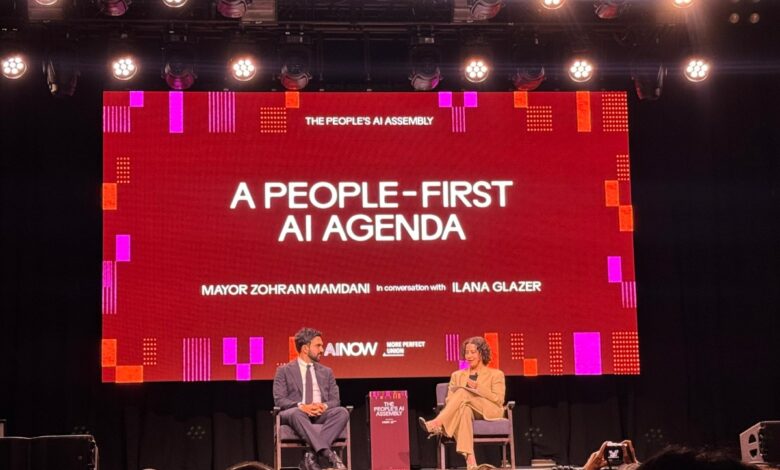
Mayor Zohran Mamdani of New York and Ilana Glazer, known for her activism and role in “Broad City,” addressed the topic of artificial intelligence at Webster Hall in Manhattan this past Monday. Glazer engaged the mayor by asking about the societal implications of AI in the coming years.
Mamdani urged residents of New York City to overcome the anxiety that AI will inevitably disrupt their jobs and their children’s education, advocating instead for the reclamation of control over technology’s influence.
This appeal comes at a time when federal measures to regulate AI are virtually nonexistent, forcing local governments to take action. Speaking at The People’s AI Assembly, an event organized by the AI Now Institute—an organization that examines AI’s social effects—Mamdani insisted that the swift integration of AI is not predestined, and that it is the responsibility of public leaders to hold AI companies accountable.
Recently, the mayor mandated a prohibition on the use of AI tools in elementary and middle schools, a decision that resonates with Glazer, a concerned parent who finds AI’s introduction into classrooms alarming.
“It makes me anxious. It feels intrusive, as if…this must be introduced in schools. It wasn’t a couple of years ago—why is it necessary now?” she remarked.
Earlier this summer, Mamdani also proposed a policy requiring landlords, brokers, and real estate platforms to disclose when property images or videos are created using AI. This measure seeks to protect New Yorkers from falling victim to misleading real estate advertisements.
Both these initiatives challenge the narrative that schools and the public must passively accept AI’s presence.
“Nothing must be,” Mamdani asserted during the event. “There is a subtle pressure with this technology that can overwhelm people, leading them to believe there are no alternatives.”
He pointed out a troubling trend of rapidly adopting technology without a thorough evaluation of its flaws, referencing a tragic incident in February when a U.S. military strike in Iran resulted in numerous casualties, including over 120 children. Investigators have indicated that reliance on AI in targeting contributed to this tragedy.
“There is a tendency to treat AI as if it is flawless, beyond questioning, as if regulation could only come from its creators,” Mamdani noted, recalling similar claims made by Facebook in 2008. “Ultimately, it’s an effort to evade accountability while still aiming for high valuations ahead of an initial public offering.”
Anthropic plans to enter public trading this year, while OpenAI has announced intentions to go public by 2027.
Mamdani criticized the lack of federal action regarding AI regulation.
“On a national scale, discussions about artificial intelligence often revolve around competition with China, sidelining any humanistic concerns in favor of a narrative centered on national rivalry,” he remarked.
The recently established Superintelligence Task Force by former President Donald Trump primarily reinforces the self-regulation of major AI companies instead of implementing stricter federal regulations. This approach fails to address escalating apprehensions about AI’s impact on numerous aspects of human existence, a concern echoed by whistleblowers from organizations like Anthropic, Google DeepMind, and OpenAI, who warn that AI could potentially threaten humanity’s survival.
“As we consider the future beyond this federal administration, we need a fundamentally new framework for how we discuss AI, the accountability we demand, and our overall perspective on the technology,” Mamdani concluded.