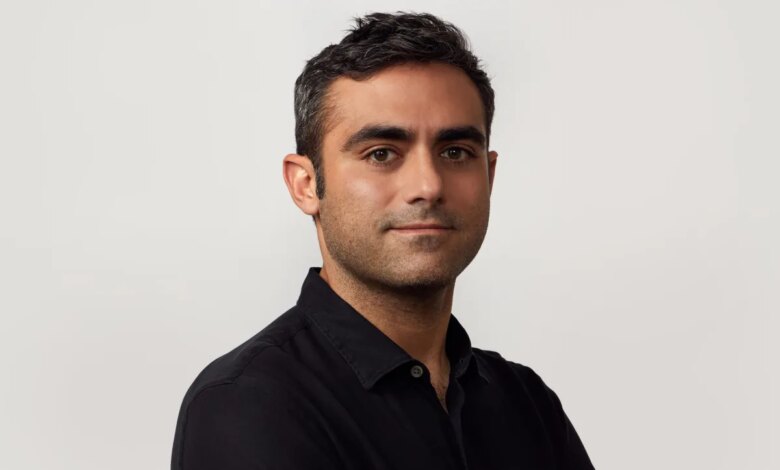
Michael Polansky stands out as exceptionally humble in a milieu often defined by egos.
Enjoying a coffee on a serene patio adjacent to a popular bakery in Mill Valley, just north of San Francisco, Polansky—donning glasses and sporting a youthful visage accented by streaks of gray—resembles a congenial academic.
He is simultaneously the founder of an innovative AI and biology venture named Outer Biosciences and the creative, business, and romantic collaborator of Stefani Germanotta, popularly known as Lady Gaga. This dual existence is intriguing; while the couple navigates the sphere of celebrity, he is also at the helm of a company that has been silently working on keeping living human tissue viable outside the body—currently for more than a month.
The trajectory of his life has been unexpected. Hailing from Minnesota, Polansky attended Harvard, where he earned a degree in applied mathematics and computer science in 2006. He then spent three years at the prominent hedge fund Bridgewater Associates, which he describes as “a very unique place” that provided valuable experiences, albeit not a source of daily excitement.
His migration to Silicon Valley was serendipitous; he learned that Sean Parker’s assistant, who was also his childhood neighbor, was looking to hire someone. At a wedding in 2007, she revealed Parker’s interest in finding a collaborator. Recognizing Parker’s influence, Polansky seized the opportunity, having dinner with him in New York, developing an instant rapport, leading him to resign from Bridgewater the following day and relocate to San Francisco.
Initially, Polansky joined Founders Fund, overseen by its original partners: Peter Thiel, Sean Parker, Luke Nosek, and Ken Howery. He frequently shared an office with another young principal, Brian Singerman, and he recalls that period fondly.
When Parker transitioned from Founders Fund after liquidating his Facebook shares to establish his own family office, he invited Polansky to assist him. There, Polansky oversaw Parker’s business, investment, and philanthropic interests, including the establishment of the Parker Institute for Cancer Immunotherapy, where he has continued to serve as executive director until the pandemic prompted a shift in focus.
This shift was closely tied to Germanotta. The two initially encountered each other at Parker’s birthday celebration in late 2019, thanks to the encouragement of her mother, Cynthia Germanotta, who had collaborated with Polansky on philanthropic efforts.
“She’d been insisting for months, ‘I want to set you up with my daughter,’” Polansky recalls. Initially skeptical, he later found their families’ connection amusing when they subsequently met.
Their partnership extends beyond romance, incorporating professional collaboration. For Lady Gaga’s latest tour, which transpired from July of last year to April, Polansky and Germanotta managed a large-scale operation akin to running a 200-person startup traveling globally.
This also involves Haus Labs, the cosmetics brand Germanotta famously established “on her kitchen floor.” Based in El Segundo, California, this venture has around 70 employees and is reportedly flourishing.
Moreover, Germanotta is a board member of Outer Biosciences, and the two entities engage in cooperative endeavors. For example, Outer Biosciences’ chief scientist is also part of Haus Labs’ scientific advisory board, and they have executed various joint initiatives.
Polansky speaks admiringly of her: “People haven’t yet seen a specific side of her publicly… She’s a remarkable businessperson.”
From Cancer to Tissue in a Dish
Though Polansky is a businessman, he does not identify as a scientist. His foray into the life sciences realm was somewhat accidental, stemming from over a decade of involvement in cancer immunotherapy alongside Parker, a field that was once considered “very fringe.”
Outer Biosciences, which Polansky launched in 2022 and leads as CEO, emerged from frustration with the slower pace of advancement in biology compared to software, largely due to ethical constraints on human experimentation. The traditional proxies utilized—animal models, simplified cell cultures, and lab-grown organoids—often fall short of accurately replicating human organ functionality.
Thus, Outer Biosciences adopted a different strategy. Rather than engineer synthetic organs, the company procures human skin that would typically be discarded following surgeries, mainly plastic procedures, using vetted nonprofit and commercial biobanks under ethical oversight, predominantly from the National Disease Research Interchange and the Cooperative Human Tissue Network.
Polansky clarifies that they do not operate under a centralized government tissue network. Outer Biosciences compensates suppliers based on operational costs rather than purchasing tissue directly, and spent around two years establishing the necessary protocols to obtain tissue promptly—within hours of surgical procedures—while it remains viable.
Regarding donor privacy, he assures that every received sample is fully anonymized before delivery, stripped of any identifying information. An innovative support system developed by his team nourishes the tissue and eliminates metabolic waste, prolonging its viability significantly beyond the industry standard.
Typically, tissue remains viable for merely days, sufficient for acute toxicity assessments but inadequate for observing slower biological processes such as collagen remodeling and pigmentation changes, which occur over weeks. Outer Biosciences’ system can maintain tissue vitality for up to 30 days, retaining its original structure and vital cellular programs, thereby allowing for more comprehensive studies.
For instance, Polansky indicates that researchers can induce UVB damage in live tissue and monitor the biological responses over time. Instead of healing the skin, they study the injury process and subsequent biological responses.
Mindful of potential criticism from the scientific community, Polansky emphasizes that the startup’s significance lies not in any isolated achievement but in the comprehensive interplay of its components: living human tissue maintained for extended periods, diverse donor sources subjected to controlled experiments, and continuous molecular assessments.
This intricate system incorporates an AI model that predicts which untested substances might benefit specific skin functions. These substances are tested using the living tissue, and the results—regardless of accuracy—reinfuse the model, refining future predictions.
Reflecting on the progress thus far, Polansky notes that early phases generated only a few leads over an extended period, but with the incorporation of AI, the company now produces a new candidate every six weeks, with several actively progressing in its pipeline.
The rapid pace of discovery persists, especially given the limited pool of known skin-active ingredients, with regulatory authorities approving only around 120 to 130 active ingredients across various categories.
This situation provides fertile ground for opportunity.
Outer Biosciences focuses on identifying cosmetic ingredients rather than pharmaceutical drugs, sidestepping the need for FDA approval. The process involves standardizing industry names for new ingredients followed by safety testing aligned with OECD guidelines, allowing for acceptance of studies conducted accurately across member countries.
A partner organization then commercializes these ingredients, as Outer Biosciences plans to license or sell its finished products to beauty and pharmaceutical companies for formulation under their brands. Currently, four of the six leads are projected to reach the commercial market.
The firm also secures revenue through collaborative research partnerships, including work with a pharmaceutical entity analyzing skin reactions to certain cancer medications and beauty brands testing whether Outer Biosciences’ findings align with their product development agendas.
Polansky remains discreet regarding current fundraising efforts, noting that the company has already raised approximately $23 million, with initial investors including Calm Capital and Brighter Capital, as well as his own firm, Hawktail. The company, employing 19 individuals, operates primarily near Cambridge, Massachusetts.
When asked about his decision to publicly discuss Outer Biosciences after years of relative silence, he highlights the valuable data they are beginning to accumulate. “Trying to manage this privately has been challenging,” he notes as the bakery prepares to close. “We want to start working more publicly now,” he concludes with a casual shrug.
Outer Biosciences is not alone in pursuing this innovative approach, despite its unique use of actual human tissue.
Competitor Vivodyne, based in Philadelphia, is developing lab-grown human organ tissue integrated with predictive AI for drug testing and recently disclosed its substantial fundraising success, acquiring close to $80 million to date.
Others in the market explore various organ-on-a-chip methods and microphysiological systems for preclinical research.
Polansky appears unworried about these competitors, not out of hubris but simply due to his full plate. There is ample room for various players in this evolving landscape, especially since there is no comprehensive database of biological data comparable to an “internet for biology.”
Additionally, Outer Biosciences benefits from the exclusivity of its data, positioning the firm in a unique spot amid the slower growth typical of traditional software AI startups. Operating costs remain modest in comparison, running all AI systems on-site to maintain data confidentiality.
Polansky remains open to various paths for Outer Biosciences’ future, whether it evolves into a standalone commercial ingredient venture, licenses its discoveries, or develops around a single groundbreaking compound. The principal aspiration is to establish a predictive model capable of identifying promising avenues in skin biology without needing to conduct every experiment physically, thus revolutionizing discovery rates in dermatology.
At present, the work involving the transformation of new compounds into market-ready products—encompassing formulation, scale-up, supply chain, and safety testing—remains a manual effort led by the same scientists behind the discoveries. Building a specialized product development team is the next objective on the agenda.
“I think it’s going to be exciting,” he says, “to share what we’ve been engaged in.”