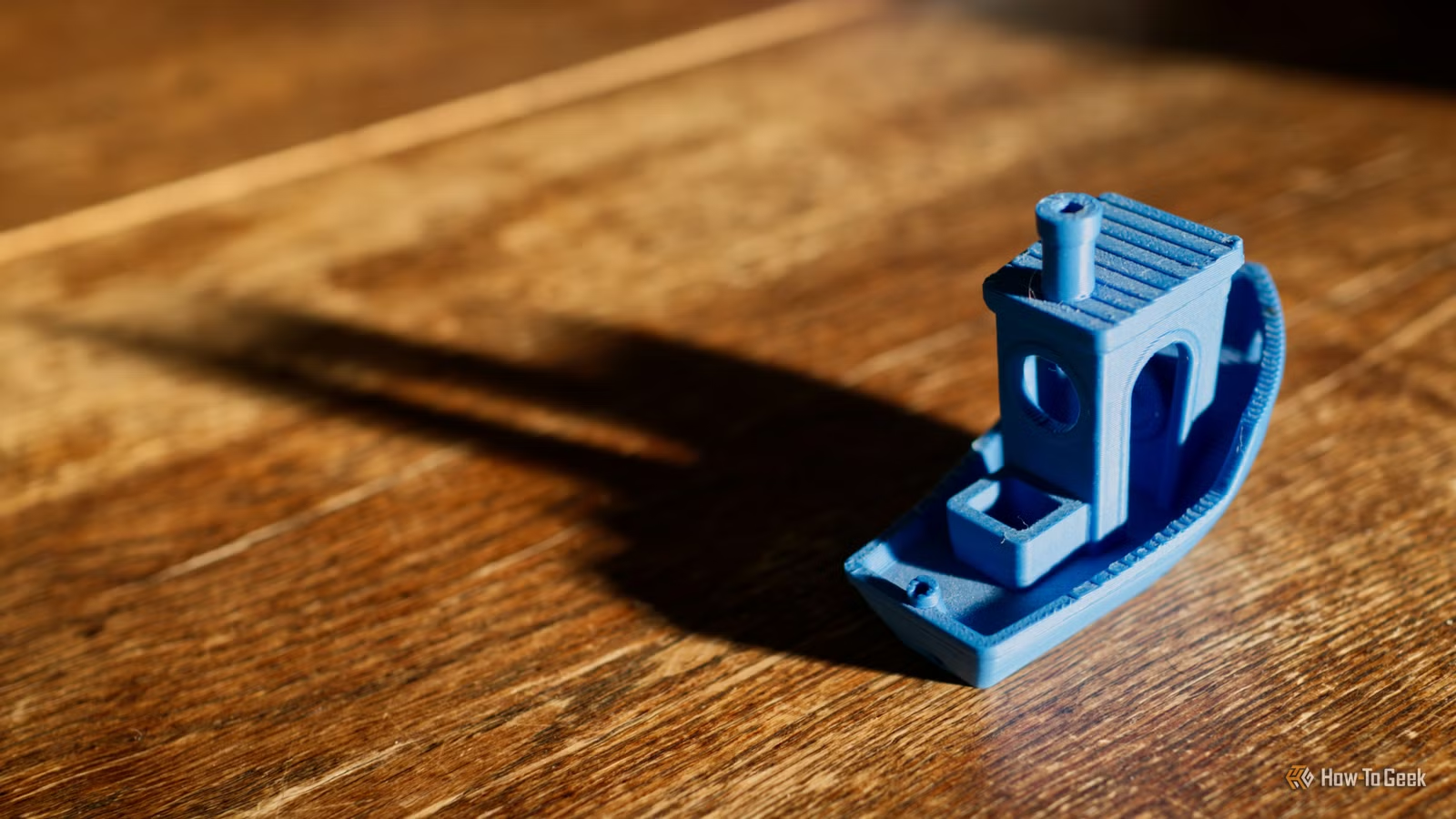
In the fascinating realm of 3D printing, a particular model has gained prominence as a symbol of the hobby. This small toy boat, commonly referred to as Benchy, was initially created as a test print but has rapidly evolved into a hallmark of the 3D printing community. It has earned a reputation as the first item any newcomer to 3D printing should try producing.
Here’s an overview of this charming little boat.
A Brief History of Benchy
Officially Known as 3DBenchy
While most people know this model as Benchy, its actual name is 3DBenchy. It was designed by Daniel Norée and Paulo Kiefe while they were with a Swedish firm called Creative Tools, known for its 3D printing hardware and software. The initial model was first shared on Thingiverse under the CreativeTools account.
More than ten years after its release, the original design remains accessible for download, and the boat boasts its own dedicated website at 3DBenchy.com.
Since its launch, Benchy has been downloaded millions of times from various model repositories. The print is lightweight, requiring only about 12 grams of filament, and typically takes around 30 minutes to complete. Many modern printers include the Benchy model pre-installed, such as those from Bambu Lab.
One of the reasons for its widespread popularity is its endearing design. Originally intended as a test for printer capabilities, Benchy exudes a level of charm that far surpasses that of a standard calibration cube. After printing, users are left with an adorable boat they can display or tuck away on a shelf. It also requires less time and filament than more complicated calibration models.
In 2024, the NTI Group acquired Creative Tools and opted to make Benchy open source. On February 14, 2025, it was officially released into the public domain, with the website handed back to its original designers, Daniel and Paulo.
By April 2025, the model celebrated its 10th anniversary, marked by a series of contests across model repositories like MakerWorld and Printables.
A Calibration Challenge for Printers
Despite its playful appearance, Benchy incorporates a variety of calibration challenges for any 3D printer. Once printed, users can assess their machine’s performance by referring to the official measurement and calibration guide.
The design is meant to pose challenges, as highlighted in the documentation: “the shape and size of this 3D model are intended to test 3D printers.” For instance, the boat’s hull features a smooth, overhanging surface that should print cleanly without supports. Its symmetrical structure can also expose any warping during the printing process.
The model includes several horizontal surfaces that should not exhibit “stepping,” particularly the top of the chimney, the rear box, and the main deck. In contrast, the roof and upper hull feature low-slope surfaces to showcase any layering issues.
Overhangs serve as another critical aspect of the design. The bridge’s interior comprises a flat surface unsupported during printing, alongside various horizontal and arched holes. Additionally, there are multiple cylindrical components, like the angled fishing rod holder at the boat’s rear.
Fine details, such as the text on the back reading “#3DBenchy” and the URL “CY3D.xyz” on the hull’s underside, further enhance the model’s charm.
And yes, it’s undeniably an adorable little boat!
The Benchy Relevance in 2026
Benchy’s Evolution
When introduced in 2015, the original Benchy served its benchmarking purpose well. However, the 3D printing landscape has evolved to a point where many printers no longer need such testing tools straight out of the box. Companies like Bambu Lab have promoted the “plug and print” concept, and automatic bed-leveling has become standard.
While there’s nothing stopping enthusiasts from printing a Benchy, there might be more effective calibration models available. Users might find it more beneficial to print guides for fuzz skin or experiment with different settings for optimal layers.
Nonetheless, Benchy endures as the unofficial mascot of the 3D printing world. It was the first model I printed when I got a Bambu Lab P2S last year, and it has since taken a place on my bathroom shelf. Although I don’t print a new Benchy for every filament roll I use, at just 12g of material, it offers a fun and economical way to use up some filament.
One of the most exciting ways Benchy is being celebrated today is through 3D printing speed runs. As of now, the world record for printing a Benchy stands at 54 seconds, held by Matt The Printing Nerd.
Have you printed an excessive number of Benchys? Here are some creative ideas for utilizing your extra models.