Many commuters face similar challenges daily, from aggressive drivers and heavy traffic to the occasional speeding ticket. In Detroit, where I reside, certain road designs can complicate driving during peak hours.
In recent years, I have discovered three tech tools that help mitigate these issues and may even save money. While they haven’t modified my vehicle in any way, they have altered my approach to driving.
Below is an overview of the radar detector, dash camera, and usage-based insurance program that have significantly impacted my driving experience, along with reasons you might consider incorporating them into your routine.
Radar Detectors Help Me Dodge Speed Traps
My Escort and Uniden Detectors Spot Hidden Police Vehicles
The typical speeding ticket in the U.S. costs about $150, but the long-term implications can be much greater. Data suggests that those with speeding convictions pay about $127 monthly for liability insurance, whereas those without such violations average $98.
A reliable radar detector can help avoid these fines, especially if you know how to utilize it properly in your area.
In the Detroit metro area, police often utilize Ford Explorers and Chevy Tahoes, which are equipped with inconspicuous lights. Their ubiquity means they easily blend into traffic, making them hard to detect. Additionally, there’s the well-known Michigan Left turn, which requires drivers to initially turn right before making a U-turn to proceed left at marked intersections. While this design can improve traffic flow and safety, it can also be exploited by law enforcement to catch speeding vehicles.
For instance, on Telegraph Road, it’s commonplace to find police in the left lane, able to clock your speed while appearing like any other vehicle. Once they have your speed, they can swiftly use the U-turn lane to pull you over. Radar detectors provide an early warning, allowing drivers to adjust their speed before being clocked by police.
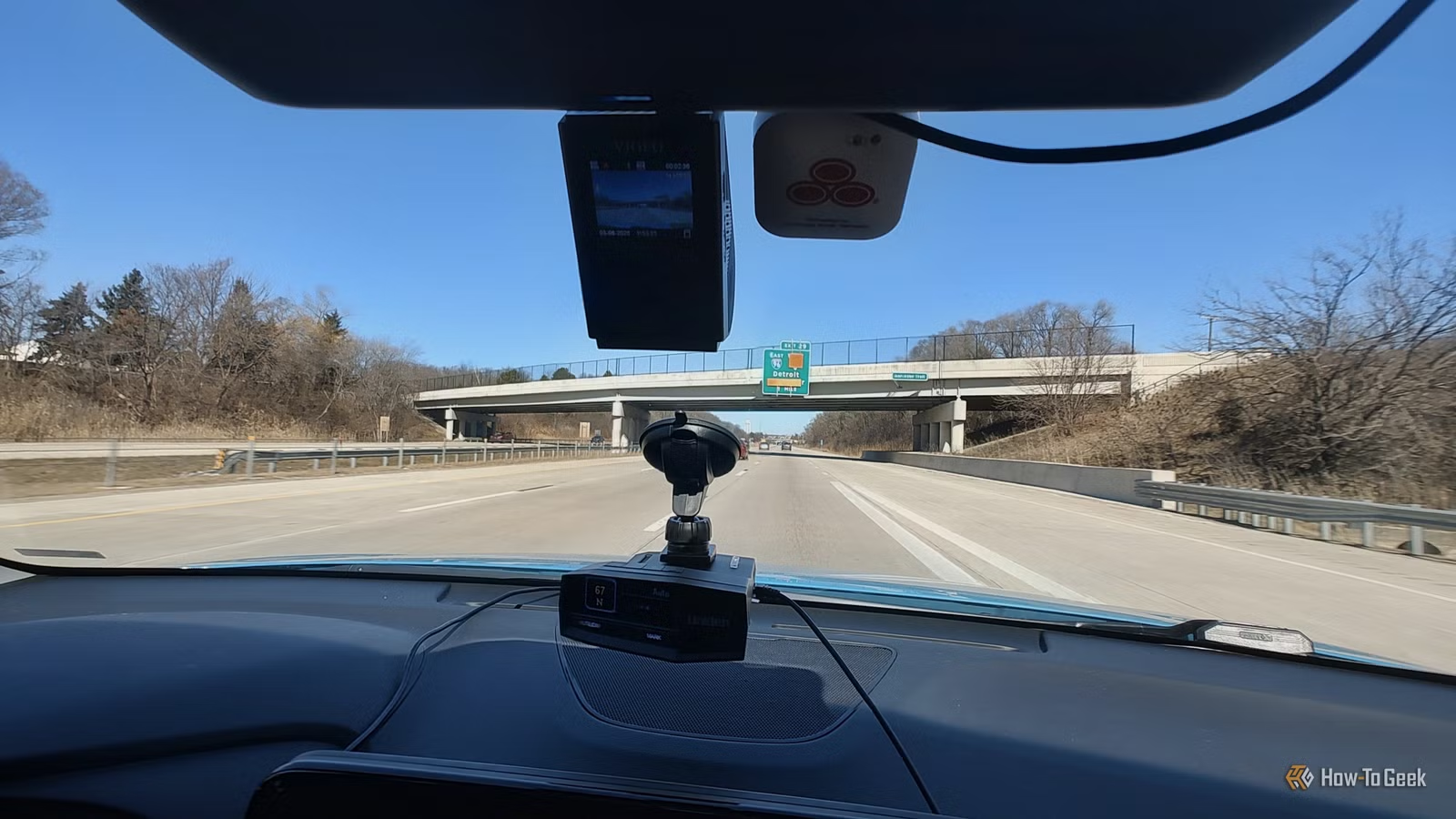
My preferred radar detectors are the Escort MAX 360 MKII and the Uniden R8. Featuring dual antennas for greater range, both units provide directional alerts, making it clear where the radar signal originates. Their sturdy build adds to their longevity, including durable power cables and mounts.
Dash Cameras Safeguard Me in Case of Accidents
G-Sensor and Parking Mode Capture Footage Before It’s Lost
While my collection of dash cams isn’t as extensive as my radar detectors, the VIOFO A119 MINI 2 I purchased in 2023 has been invaluable. I admit that I don’t use all of its capabilities regularly, such as voice commands and app integration, but the G-sensor and emergency recording features are particularly useful.
The G-sensor detects sudden speed changes, triggering the camera to lock that footage for later review to ensure it’s not overwritten. This is particularly beneficial for proving one’s innocence in an accident.
Moreover, my VIOFO camera features buffered parking mode, which saves footage before and after an incident. If someone brushes against my vehicle, the camera starts recording 15 seconds prior and 30 seconds thereafter. I added this feature after purchasing the dash cam, along with a circular polarizing lens that minimizes glare, enhancing video clarity.
Usage-Based Insurance Encourages Safer Driving
Not Sure If I Will Keep It, But the Prospects Are Encouraging
Usage-based insurance typically comes in two forms: pay-per-mile or safe driver plans. My provider offers the latter, which provides discounts for good driving habits.
- No phone distractions.
- Adherence to speed limits.
- Consistent braking, turning, and acceleration.
This new insurance option has piqued my interest as I anticipate it will provide financial benefits. Upon enrolling, I already received a $53 discount on my six-month premium and hope for a further 10% monthly savings through continued safe driving.
My insurer sent a small beacon for my windshield, which I paired with a mobile app to monitor my driving. After 14 trips and 272 miles, the app indicated areas where I could improve, particularly regarding phone distractions, which possibly flags my phone being active even when not in use.
I’m still contemplating whether to maintain this insurance, as I await additional potential savings. Regardless, it has inspired more defensive and attentive driving.
Lessons Learned from Using All Three Tools
For those who spend extensive time driving in urban environments, where traffic and law enforcement behaviors frequently change, these tools could prove beneficial.
For me, the radar detector keeps my speed in check when police are around, the dash camera provides crucial evidence in case of incidents, and the usage-based insurance program offers the prospect of lower premiums.
While none of these tools can substitute for vigilant and sober driving, each offers an enhanced level of awareness and safety that I previously lacked.