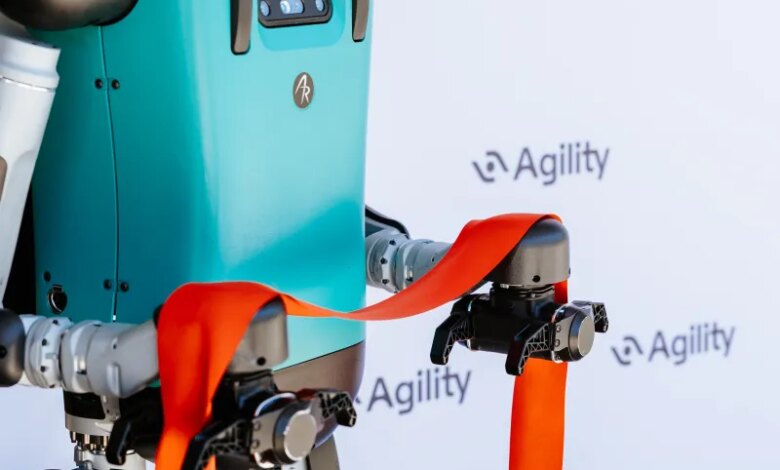
Agility Robotics is set to launch a 60,000-square-foot training facility for its humanoid robots in Fremont, California, conveniently located near the Tesla factory that will begin production of its Optimus robots this year.
Tesla has shown strong commitment to the Optimus project. Elon Musk recently expressed his belief that it could become “the biggest product ever” once it offers utility beyond Tesla itself sometime next year.
While Agility may not possess the extensive capital of Tesla, it boasts an operational humanoid robot named Digit, which is already earning revenue. This robot is employed in manufacturing and warehouse settings for clients including Amazon, GXO, Schaeffler, and Toyota Motor Manufacturing Canada. The company claims to have secured $300 million in contracts related to its robots.
“Having [Tesla] nearby is an advantage for us, as Agility has been somewhat isolated in this humanoid sector for a while,” commented CEO Peggy Johnson. “We’ve commercialized our technology, allowing us to navigate safety regulations, compliance measures, and integrate seamlessly with existing IT and warehouse management systems.”
Although Agility has not revealed the specific number of Digits produced or operational, estimates suggest that dozens have been actively working on various projects. For instance, the company has reported that Digits moved 100,000 totes at a GXO logistics site.
Currently, Johnson is guiding Agility through a reverse merger, positioning the company to become the first publicly traded business solely focused on humanoid robotics later this year. Established in 2015 by a group of researchers, Agility has developed techniques that enable robots to walk on two legs safely, positioning it ahead of newer AI-driven robotic startups like Figure, 1X, Bot Company, and Sunday Robotics.
While transformer-based neural networks fuel exciting advancements in robotic functionality, Agility is prioritizing a practical route to autonomy.
“For instance, in self-driving cars, you wouldn’t want vital systems like brake controls to operate solely based on AI,” explained Agility co-founder and chairman Damion Shelton. “Similarly, for humanoids, all safety measures should avoid reliance on generative AI to ensure reliability.”
Nevertheless, AI does enhance scalability.
“Initially, when board member Bruce Leak asked how we planned to code applications for our robots, we didn’t have a clear answer,” noted Shelton. “The possibilities for what a robot can do vastly exceed the number of engineers available to program them. Generative AI addresses that gap effectively.”
The new facility aims to expedite Agility’s robotic deployments. Johnson shared that over 30 potential customers are in discussions to deploy Digit, and the center will serve as a training ground for the six-foot-tall robot to acquire skills suitable for real-world applications.
In contrast to many recent entrants into humanoid robotics, Agility isn’t looking to create in-home robots in the near future. This perspective aligns with many robotic experts, who assert that current robots lack the necessary safety measures for consumer environments. Presently, Digit operates in isolated areas, but a new model, version 5, will launch this fall and will be equipped to detect humans, allowing for operation in less restrictive environments.
Co-founder and chief robot officer Jonathan Hurst emphasized that there’s ample demand within manufacturing and logistics alone. “Let’s begin with bins and totes, then move to picking and kitting. After that, we can tackle challenging tasks like handling cardboard, and the loading and unloading of trucks. From there, the potential for scaling into a billion-robot enterprise is immense, creating a trillion-dollar opportunity,” Hurst stated.